culture
Stolen Buddha Statue at Guanfu Museum? An Investigation Must Be Launched Promptly
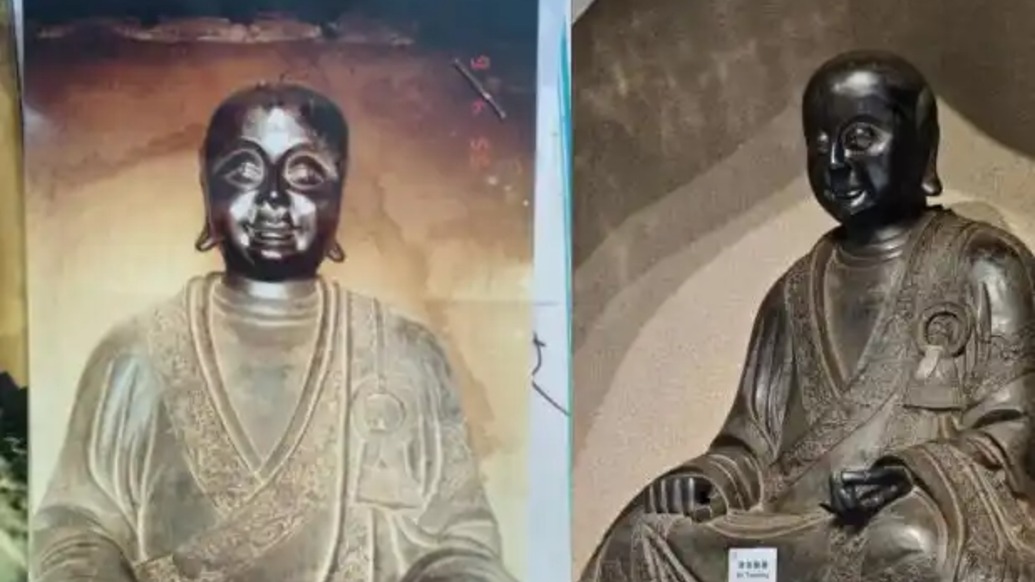
Recently, a netizen posted on social media claiming that a Buddha statue on display at the Guanfu Museum bears a striking resemblance to a bronze Buddha statue that went missing from Haikou's Five Lords Temple in Hainan in 2000, sharing comparison photos. The news has sparked an uproar online.
On the evening of July 2, the Guanfu Museum issued a statement saying that in 2005, when the museum's Xiamen branch opened, it lawfully acquired an ancient bronze arhat statue from a legitimate antique market in Xiamen as part of its collection. The statue has since been displayed at the Guanfu Museum in Beijing for two decades, during which no information was ever received — from either official sources or private individuals — regarding this piece. The statement added that upon seeing the netizen's post, the museum immediately conducted an internal review and reported the matter to the relevant authorities. It pledged to comply with the authorities' appraisal results and guidance, and to cooperate fully in accordance with the law.
Judging by the photos circulating online, the two statues do share many similarities, which naturally explains public suspicion. However, it must be acknowledged that cultural relics are a highly specialized field. Determining whether two items are one and the same cannot rely on visual comparison alone — professional appraisal and rigorous procedures are required to reach a definitive conclusion.
The reason this incident has drawn such attention lies at its core in cultural relic security. To be frank, for cultural relics, the greatest threat is not theft itself but the laundering of stolen goods. As items pass through multiple hands, their provenance is deliberately obscured, and they are eventually "cleaned" through channels such as "antique markets" and "private collections," transforming into seemingly "legitimate collectibles." It is precisely because of this laundering pipeline that relic theft remains profitable, and why it persists despite repeated crackdowns.
The Guanfu Museum enjoys considerable renown. According to public records, it was the first non-state museum with independent legal personality established since the founding of New China, opening its doors on January 18, 1997, and founded by Ma Weidu. If even the Guanfu Museum has vulnerabilities in its collection acquisition process — inadequate vetting that provides a channel for stolen goods — it would greatly alarm the public and shake confidence in the entire cultural relic acquisition and circulation system.
From this perspective, an investigation should be launched as soon as possible to deliver a conclusion that can withstand public scrutiny. If the statue is indeed a stolen relic, legal responsibility should be pursued, and every link in the relic protection chain should be reexamined — from looting and laundering to acquisition and display — to close institutional gaps. If it is ultimately proven not to be the same artifact, the appraisal basis and investigation process should be disclosed in a timely manner to address public concerns.
In April of this year, the National Cultural Heritage Administration launched a special campaign to strengthen the safety management of collections in state-owned museums nationwide, organizing all such museums to inventory their collections piece by piece, while also initiating pilot work for the second national survey of movable cultural relics. It is clear that both institutional collections and movable relics are poised for a comprehensive upgrade in protection.
Also worth noting is the element of chance in the emergence of this controversy — a netizen's casual photo and post suddenly brought intense focus. In fact, similar incidents have surfaced online before. For example, in March of this year, a long-stolen cultural relic — a piece of glazed tile — appeared on a secondhand trading platform, drawing public attention and leading to the criminal detention of the suspected seller by public security authorities.
This demonstrates that in the age of the internet, public oversight has become an important force in cultural relic protection. Exposure through online platforms provides more leads for the public to discover suspected stolen relics and increases the likelihood of exposing illegal activities.
This also suggests a constructive direction from another angle. In earlier years, when relics were stolen or lost, limited technology meant incomplete records and scarce photographic documentation. Once a relic changed hands, tracing and verifying its authenticity was extremely difficult. But today, with the internet highly developed, technologies such as image recognition and big data comparison have become quite mature, and an increasing number of institutional collections have been digitally archived.
If this incident can serve as an opportunity to further improve the national database of stolen cultural relics, promote information sharing among museums, heritage authorities, and relic trading platforms, and leverage AI image recognition for cross-checking, it may become possible to detect more lost relics in public circulation and exhibition processes in a timely manner, thereby compressing the space for illegal laundering and "cleaning."
For now, the most important thing is to ascertain the facts as quickly as possible, respond to public doubts, and clarify the full provenance of this Buddha statue at the Guanfu Museum.