culture
Procuratorate Daily: The 135km Razor Wire Piercing Millennium-Old Mount Tai — Must the Project Withstand Scientific Scrutiny?
Procuratorate Daily: The 135km Razor Wire Piercing Millennium-Old Mount Tai — Must the Project Withstand Scientific Scrutiny?
As a public landscape resource, the scientific validation of management decisions for Mount Tai cannot remain only in documents. It should be visible and trustworthy to the public, able to withstand public scrutiny and the test of time.
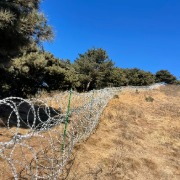
Recently, the "installation of roller-type razor wire fencing on Mount Tai Scenic Area" has drawn widespread public attention. On July 2, the Mount Tai Scenic Area responded, stating that the fencing is mainly distributed in non-open, non-tourist, and hazardous areas, and does not cross or overlap with normal tourist routes. The barrier construction takes into account fire prevention, tourist safety, and ecological protection, while reserving fire rescue access, agricultural and forestry passageways, and free public fitness and recreation areas. In the next step, experts in forestry, fire protection, environmental protection, cultural tourism, law, and other fields will be organized to conduct comprehensive assessment and continuously optimize relevant measures (per the "Mount Tai Scenic Area" WeChat official account).
The scenic area's response was not slow, but upon closer examination, the core information boils down to two points: the razor wire was built for fire prevention and forest protection, and it does not affect normal tourist visits. However, these two points alone cannot prove the project is reasonable. 135 kilometers of razor wire and an investment of over 20 million yuan — the necessity and scientific basis of the project have not been fully demonstrated in the response. The crux was not clearly addressed, so it is naturally difficult for public doubts to dissipate and for the public storm to subside.
The public's skepticism is not without reason. Mount Tai is a UNESCO World Cultural and Natural Heritage site, home to ancient trees, rare species thriving in its ecosystem, cultural resources scattered among its relics and inscriptions, and a humanistic value accumulated over millennia. A 135-kilometer razor wire net driven into the mountain forest — does it protect more than it destroys, or destroy more than it protects? When animals migrate and encounter the wire, will they be blocked or injured? In the event of a wildfire or emergency, will the barriers hinder fire rescue personnel and equipment access? Furthermore, from a visual perspective, the rigid, cold razor wire clashes with Mount Tai's character, leading many to feel it damages the overall landscape. Therefore, the public's concerns are not baseless but reasonable doubts.
The scenic area has legitimate safety management needs, but that does not make any form of control measure reasonable. What the public is truly questioning is never "whether fire prevention is necessary," but rather "whether this project decision was scientifically sound at all" — this is the root of the controversy.
If the initial project had undergone thorough feasibility studies, environmental impact assessments, and safety risk evaluations, then in the face of public inquiries, the scenic area could have used detailed data and professional assessment to explain its reasoning, allowing the public to clearly see the scientific nature and rationality of the decision — seeing is believing. But the current response precisely lacks this content — the facts are not fully laid out, the rationale is not clearly explained, and naturally the doubts remain.
Furthermore, the public's questioning of whether a public decision is scientific is precisely aligned with the construction of a law-based government. To ensure the lawful and scientific exercise of public decision-making power, China has not only clearly stipulated decision-making procedures but also established corresponding supervision and accountability systems to prevent and punish power abuse. If the scenic area management cannot provide sufficient basis for scientific decision-making, or is even proven to have problems with unscientific or non-compliant decisions, it must bear corresponding responsibility according to law and regulations. This also shows that public decision-making is not something done behind closed doors — it uses public funds, and must therefore comply with legal and regulatory requirements and withstand public scrutiny.
Ultimately, what the public is being particular about is not the razor wire itself, but the transparency and scientific basis of public decision-making. As a public landscape resource, the scientific validation of management decisions for Mount Tai cannot remain only in documents. It should be visible and trustworthy to the public, able to withstand public scrutiny and the test of time. Persuading people with scientific reasoning and moving people with a candid attitude — this is the manager's duty and the responsibility they should bear.
Originally published at: https://www.thepaper.cn/newsDetail_forward_33508601