business
Secondhand Smoke on Campus: A Delicate Tug-of-War at Chinese Universities
On his first day at school, Shang Mengmeng saw many people on campus with cigarettes dangling from their lips.
Early the next morning, when he opened his dormitory door, he saw someone squatting in the corner across the hall smoking, with cigarette butts scattered on the floors of the corridor and stairwell. He was astonished — he had never expected smoking to be so widespread on campus. People smoked in the elevators; the toilets smelled of smoke "all year round"; some even lit up in the shower rooms.
This is an arts college in Beijing, where Shang Mengmeng has spent three years as a graduate student. Over that time, he has filed more than a hundred complaints with the relevant departments about secondhand smoke on campus. Exposure to secondhand smoke triggers physical reactions in him: discomfort, difficulty breathing, dizziness, and diarrhea. At night, he is sometimes woken by smoke drifting into his dorm room. He has tried repeatedly to communicate with smokers, but with little effect.
On May 31 this year, research findings released by the Chinese Center for Disease Control and Prevention showed that the smoking rate among Chinese university students in 2025 was 7.3 percent — a decline — but exposure to secondhand smoke remained a serious problem. Exposure rates reached 31.5 percent in dormitory buildings, and were also high in teaching buildings and on sports grounds.
On university campuses, secondhand smoke is a delicate subject. Entering university, students transition from being managed and cared for to becoming independent members of society, gaining greater freedom. But when freedoms collide, boundaries have to be redrawn.
Yang Zeyu, a third-year undergraduate, is carefully managing his relationship with a roommate who smokes. The smell of smoke leaves him dizzy and irritable. Diagnosed with chronic rhinitis in high school, Yang already struggles to breathe freely, and cigarette smoke makes his obstructed breathing even harder.
He asked his roommate not to smoke in front of him. At the same time, he has quietly put up with the "thirdhand smoke" the roommate leaves behind in the bathroom and on the balcony, without ever mentioning it.
Secondhand smoke on campus is not just a health issue; it also concerns the shared understanding of civility in public spaces. When that consensus is still taking shape, and campuses lack strict tobacco-control rules — or fail to enforce them — direct conflicts arise between individuals, and between individuals and institutions.
When Your Roommate Smokes
His attempts to reason with smoking classmates went on for six months. "It never worked," Shang Mengmeng said.
He tried avoidance. Smokers gathered "in groups of three or five" chatting at the dormitory entrance, forming what he called a "smokescreen of secondhand smoke"; he would take a detour around them, or pinch his nose and dash through. To wash up or use the toilet, he would check floor by floor for a bathroom with a fainter smell of smoke. When smoke seeped through the door cracks while he slept, he would retreat to the balcony for fresh air — but sometimes someone happened to be smoking at an open window, leaving him feeling "attacked from both sides," and he would flee downstairs to the sports field to hide in a deserted corner for a while.
He described his plight on campus as being "like cured meat" — slowly smoked.
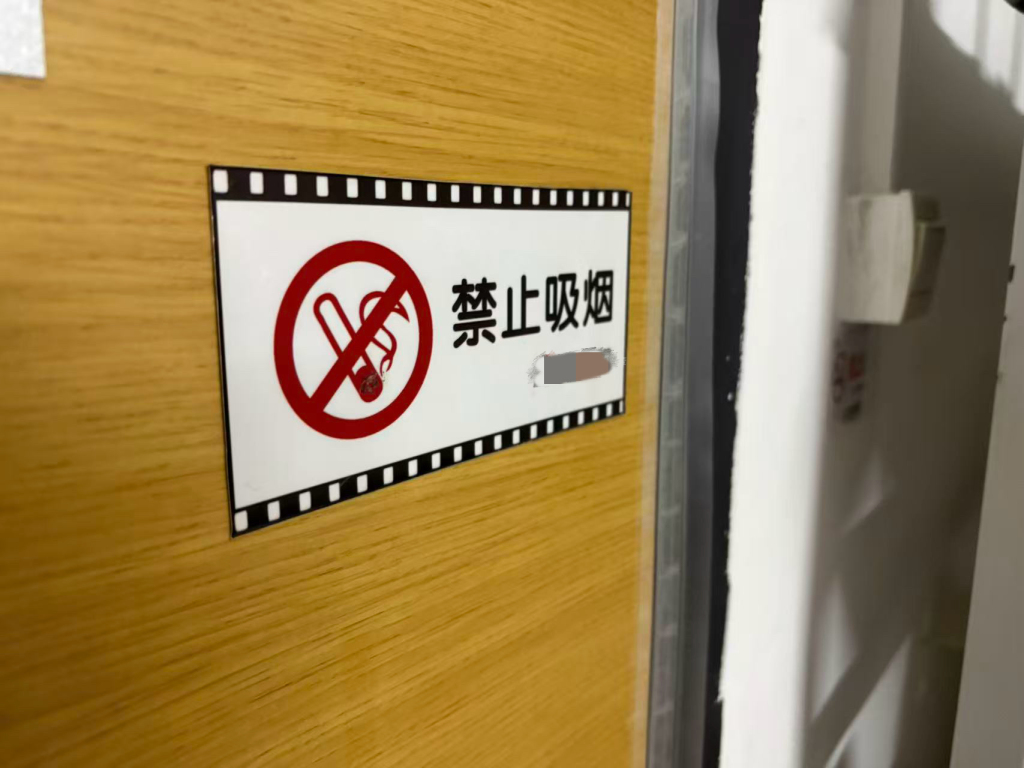
A no-smoking sign in a dormitory corridor at Shang Mengmeng's school. All photos in this article were provided by interviewees.
Escape was not always possible. Shang recalls once visiting a teacher to discuss his thesis proposal when another student came into the office to see a different teacher. The student pulled out cigarettes, offered one to that teacher as well, and they lit up. His reaction this time was severe — a pounding headache, his whole face flushed red, his mind foggy. But he feared that leaving midway would be disrespectful to his advisor.
Enduring the headache, he listened to the teacher for over an hour, still feeling dazed. Afterwards he stood outside the office in the cold wind for an hour or two, took an hour-long bus ride back to his own campus, then found a secluded corner and let the wind blow over him for several more hours. Back in his dorm that night, he took ibuprofen and other medication; the headache finally eased before he slept, but his throat still hurt for days afterward.
Yang Zeyu also tried talking and avoiding. In his first year at his university in Hunan, he told his smoking roommate that he disliked the smell, and the roommate agreed to smoke on the balcony. But Yang said the roommate still habitually collected cigarette butts in a small delivery box on the balcony, which reeked of smoke and was covered in ash.
In his second year, Yang moved to a new room, where another roommate turned out to be a smoker. For a long stretch, he raised the issue constantly, even though doing so made him uncomfortable — speaking up whenever he smelled smoke, dissuading the roommate whenever he saw signs of an impending cigarette, forwarding videos about the harms of smoking to the room's group chat. The other two roommates would chime in as well.
Yang said the smoking roommate later began avoiding him — lighting a cigarette indoors, stepping onto the balcony to smoke, then quickly returning. At the end of this semester, the roommate reviewed for exams while smoking on the balcony. Still, "the clothes on the balcony suffered": Yang could smell the "thirdhand smoke" on them. Thirdhand smoke — the residue of tobacco smoke left on surfaces after smoking — is equally harmful but far more insidious.
When this roommate celebrated his birthday last year, Yang saw that his gifts included a row of cigarette packs of various brands. Another roommate's gift, by contrast, was a giant cigarette-shaped plush toy emblazoned with the words "no smoking."
Yang recalls a period when the roommate also vaped fruit-flavored e-cigarettes — "the smell of industrial flavoring." When he vaped right inside the room, Yang and the other roommates objected strongly, and he eventually cut back.
Apart from their differences over smoking, Yang gets along fairly well with the roommate. Knowing they will share a room for three years and have competitions to enter together, Yang feels that "beyond speaking up, there's nothing else to be done — we've each taken a step back. We can't enjoy a completely smoke-free environment, and he can't smoke as freely as he'd like."
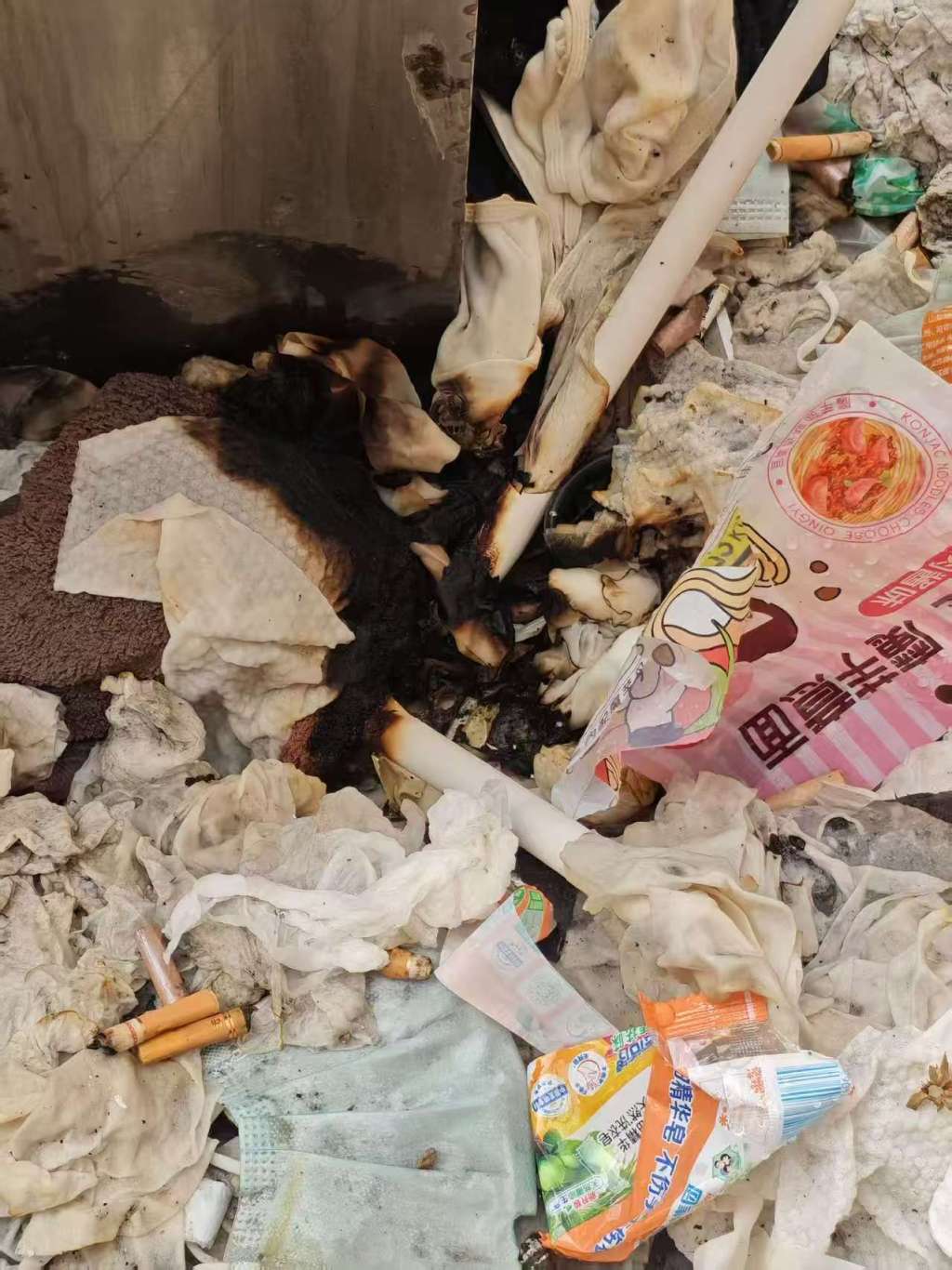
In Yang Zeyu's dormitory building, cigarette butts tossed out of windows once set fire to debris on a platform below.
When secondhand smoke appears in a public space, avoidance and endurance are nonsmokers' most common responses. Students at a Shanghai university published a campus survey on their school's social media account: faced with secondhand smoke, 53.33 percent of students chose to "put up with it," 18.67 percent would "tell classmates nearby and report it together," 13.33 percent were willing to "take photos or note down details and report to dorm supervisors or the school," and only 6.67 percent would "step forward and remind the smoker not to smoke."
A 21-year-old student at a university in Shaanxi told The Paper that he usually steers clear of smoking classmates. Occasionally, when pushed past his limit, he will shout "Don't smoke here," or joke, "Won't this stuff kill you?" — but the smoker rarely stubs out the cigarette.
Zhang Qiang, a counselor at a private junior college in Zhejiang, has handled disputes between students over smoking. One male student did not smoke while all his roommates did — "he couldn't quite fit in with the others." The nonsmoker wanted to change rooms, only to find that a suitable smoke-free dorm was not easy to come by.
This is a partial translation of the original in-depth report. The full article is available in Chinese at the source link.