business
From Shaking Silicon Valley to Inviting Musk to 'Arm-Wrestle': What Kimi Got Right
Kimi K3, the flagship model from Chinese large-model unicorn Moonshot AI (Kimi), has gone viral and drawn worldwide attention.
On July 16, Moonshot AI unveiled Kimi K3, a model with 2.8 trillion parameters, making it the world's largest open-source model by parameter count and sending shockwaves across the globe. Within 48 hours of release, user request volume approached the cluster's capacity limit. On the evening of July 19, Moonshot AI announced it was suspending new consumer subscriptions in order to prioritize all computing power for existing paying users.
On K3's impact, U.S. media bluntly stated that China has shattered the perception that "the United States leads the world in AI."
Foreign media reported that Kimi K3 holds strong appeal for users in terms of cost and customizability. The U.S. AI industry needs to invest more than one hundred billion dollars in data centers to maintain its technological edge, and many investors worry whether the valuations of these American AI companies are too high. The arrival of Kimi K3 will place considerable pressure on these U.S. firms.
A Paper reporter once visited Moonshot AI's office and met CEO Yang Zhilin in person. In the district stretching from Tsinghua University to Zhichunlu subway station, investor Wang Huiwen once remarked that all of his highest-returning investments were located in this small "tofu-block" area — from the gates of Tsinghua to Zhichunlu station, ByteDance's Doubao, DeepSeek, and Moonshot AI were all born here.
At Moonshot AI, all five founders graduated from Tsinghua University, and the company's Chinese name comes from Pink Floyd's classic rock album "The Dark Side of the Moon" — the day the company was founded happened to be the 50th anniversary of that album's release.
This rock spirit runs through the company's details: all meeting rooms are named after rock bands. One room is called "Splay" — outsiders assume it is some obscure band, but it was actually the name of a band formed by co-founders Yang Zhilin and Zhou Xinyu during their Tsinghua days, a name that also derives from the splay tree algorithm in data structures.
"Whether it's consumer users or enterprise clients, Kimi is currently in a state where demand outstrips supply," said Huang Zhenxin, head of Moonshot AI's enterprise business, in a media interview.
K3's Biggest Change Is a Qualitative Leap
"It's not a powerful model forged through extensive post-hoc skill training or fine-tuning — it's a model that is natively very intelligent," Huang explained. Kimi K3's most core characteristic is its capacity for long-horizon, high-difficulty reasoning.
Several on-site demonstrations bore this out: with a single sentence, a non-technical person could recreate a discontinued childhood game with 90% fidelity; feeding in 20 research reports on the commercial space sector, a single prompt could generate an in-depth, illustrated research report with all charts produced in real time, including professional analysis such as cyclical transmission chains and competitive landscapes; even complex chip-design work can now be accomplished with K3.
The large-model industry has long believed in the Scaling Law — scale up computing power, training data, and parameter count simultaneously, and model performance improves. But this law is now hitting a wall: a 100-fold increase in compute yields only a 10-fold boost in the model, global compute is growing scarce, and high-quality training data is largely exhausted. Moonshot AI's solution was to replace core components of the Transformer architecture that had gone 8 to 11 years without an update. Three foundational technologies form K3's core support:
The first is a new second-order optimizer called MuonClip, applied for the first time in the training of a trillion-parameter model. It lets 20T of training data deliver the effect of 40T, halving training cost and compute power consumption at the same performance level. DeepSeek has already recognized and adopted this technology.
The second is the in-house KDA hybrid linear attention mechanism, which solves the performance decay of traditional linear attention on long-range tasks. Conventional full-attention mechanisms see computation grow quadratically with context length, becoming prohibitively expensive at the million-token level, whereas KDA keeps cost growth to 10x when the model scales 10x, allowing the Scaling Law to keep extending. This is also the foundation for K3's support of a one-million-token context — enough to hold an entire novel, or the complete code of a full project.
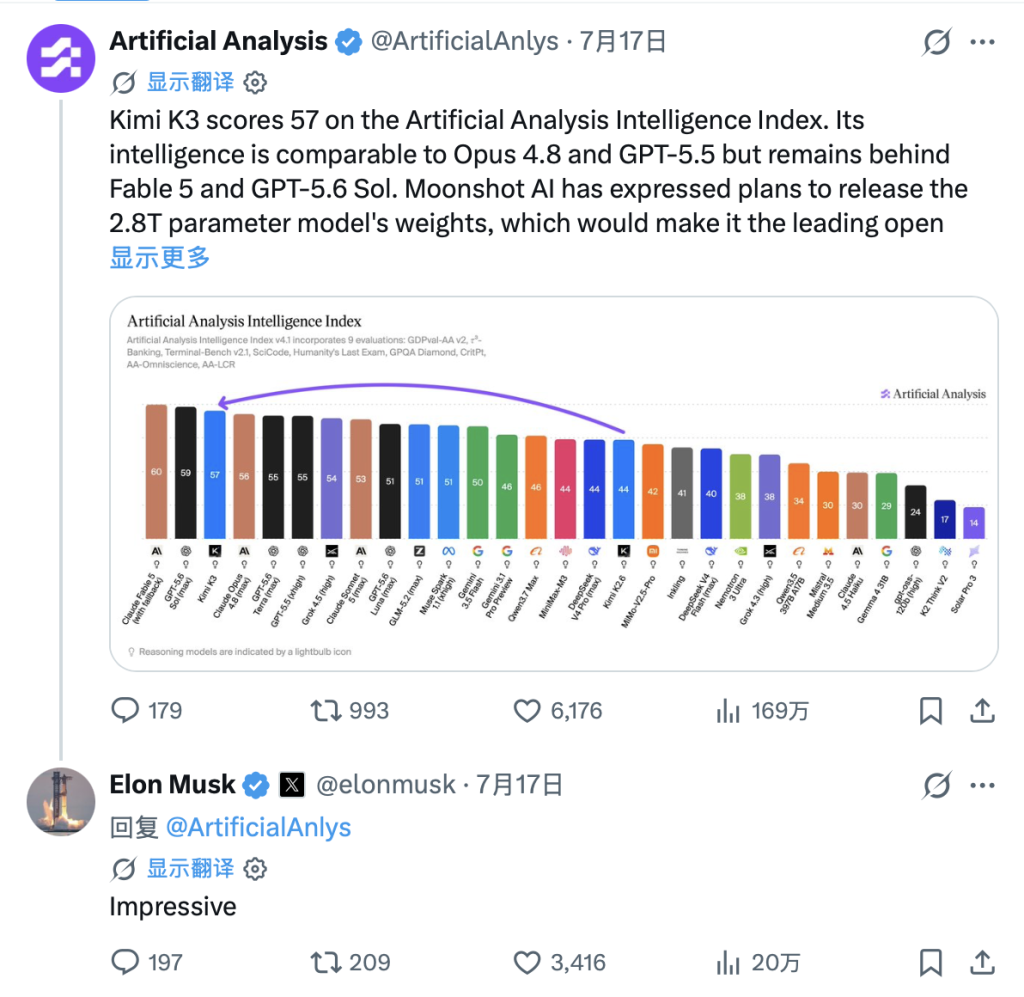
The third is Attention Residuals technology. When Moonshot AI published the related paper this March, Elon Musk reposted it on X with the comment "Impressive." The technology achieves a 25% improvement in training efficiency at less than 2% additional compute cost. One of the paper's first authors is a 17-year-old intern.
"Anyone who truly understands the field knows this generation's capability gains cannot come from distillation," Huang said, addressing outside skepticism about distillation with an analogy: "The Six-Eared Macaque and the real Sun Wukong are, in the end, still not the same." He noted that OpenAI's head of strategy has also said on X that a model this intelligent could not possibly be obtained through distillation.
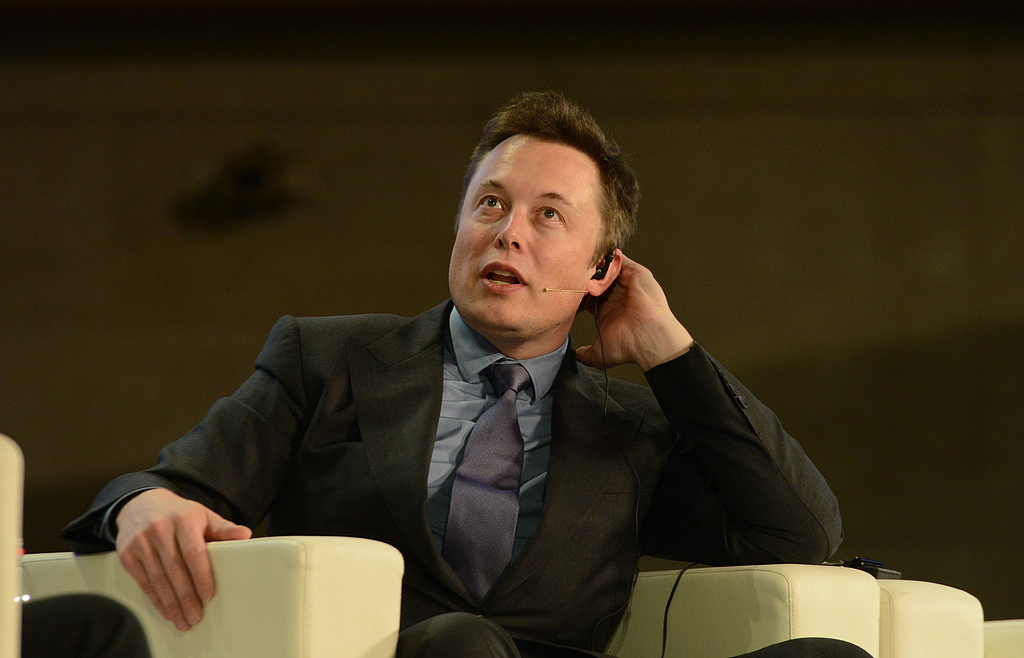
Responding to Musk: Eager to 'Arm-Wrestle'
Musk is among the most closely watched observers of K3.
On the day of K3's release, it topped the FrontendCodeArena front-end coding leaderboard with 1,679 points, becoming the first open-source model to surpass all closed-source models on that ranking. Musk commented "Impressive" under a related report — his second public endorsement of Moonshot AI's technology this year.
But just one day later, Musk declared on X that his own new Grok model, currently in training, might surpass Kimi.
Moonshot AI's official response was: "Welcome to the two-trillion club." Huang added on the spot: "We'll wait and see. We hope they come out and arm-wrestle with us. He's confident — and we're even more confident."
Musk's reaction reflects global market recognition of Kimi K3's strength. Foreign media report that since DeepSeek launched its R1 version, Chinese AI models have continuously reshaped the entire industry. To a certain extent, they have upended the economic foundation of the AI industry established by leading Western firms — namely, the paid, closed-source model.
This is a partial translation of the first half of the original report. For the full Chinese article, see the source link below.
Source: The Paper (thepaper.cn). Reporters: Fan Jialai, Hu Hanyan.