
business
Enjoy ¥200,000 in Reimbursement Only After Paying ¥500,000 Yourself? When Patients Meet Inclusive-Insurance Adjustments, How to Balance High Coverage and Sustai
"After the policy changed, families who had only been on treatment for two or three months mostly gave up. Several families who had persisted for three years are now discussing whether to sell their homes to keep the treatment going for a few more years. The most heartbreaking part is that once the medication stops, the signs of improvement a child has accumulated over the past few years through standardized treatment could be completely lost within a year and a half."
Speaking of his 12-year-old daughter, who suffers from hypophosphatemic rickets, Zhang Da (a pseudonym) was full of worry. When she was six or seven, his daughter was diagnosed with this rare disease. Nationwide, the number of reachable patients does not exceed 2,000, and there are fewer than 20 in the city where they live. Hypophosphatemic rickets carries a high rate of disability and deformity. "If supplementation cannot be provided during the critical period of bone mineralization between the ages of 14 and 16, the patient will suffer frequent fractures after their twenties or thirties, may need crutches after their forties or fifties, and will most likely be bedridden after 50."
There are currently more than 7,000 rare diseases worldwide, and the two batches of the rare-disease catalog released in China cover 207 of them. In the past, the primary problem facing rare-disease patients was that there was "no drug to treat" their condition. Thanks to advances in medicine, some new drugs have now been approved and launched, but faced with their high prices, "how to pay" has also become a source of distress for many patients and families.
Three years ago, Zhang Da's daughter began treatment with a drug called burosumab. This specialized medicine for hypophosphatemic rickets costs about ¥700,000 per year, but thanks to the local "Huiminbao" (an inclusive supplementary medical insurance) reimbursement policy of 70%, the out-of-pocket portion dropped to ¥150,000–¥170,000. Although this was still no small financial burden, seeing his daughter gradually able to run in physical education class like an ordinary child, Zhang Da felt it was worth it.
The turning point came in the summer of 2026. The local Huiminbao updated its drug catalog, adding coverage for some medicines and tightening reimbursement for others. The reimbursement ceiling for the drug Zhang Da's daughter takes was set at ¥200,000 per year. "This means that to enjoy the ¥200,000 in reimbursement, you first have to pay ¥500,000 out of pocket." This left Zhang Da's family in the dilemma described at the beginning.
Zhang Da's family is not the only one facing the risk of a treatment "drug cutoff" due to iterations in local Huiminbao policy. This is not an isolated predicament for a single patient or a single disease, but a payment challenge that patient groups such as those with rare diseases and cancer may all face.
Patients' Anxiety: Amid Iterating Payment Policies, Hoping for More Stable Treatment Expectations
Patients with Fabry disease, known as an "ultra-rare disease," are likewise going through the transitional test brought about by Huiminbao adjustments.
Fabry disease is an X-linked hereditary lysosomal storage disorder in which the deposition of metabolic substrates in multiple organs triggers multi-organ lesions. The patient A Feng (a pseudonym) suffered from severe pain in his extremities from the age of seven or eight. Because he went undiagnosed for a long time and took large amounts of medication, both of his femoral heads became necrotic, and he received artificial hip joints at a young age.
In 2019, agalsidase beta was launched in China, filling the treatment gap for Fabry disease. Starting in 2023, the drug was included in the local Huiminbao catalog. Combined with discounts offered by the pharmaceutical company, A Feng only needed to pay ¥10,000–¥20,000 out of pocket each year to maintain good condition. Change also came in 2026: the local Huiminbao underwent an optimization adjustment, and the drug was removed from the catalog. The explanation given by the relevant authorities was that another Fabry disease treatment drug had already entered the national basic medical insurance catalog, so patients already had a drug to fall back on.
"I was very panicked, suddenly losing my original direction," A Feng admitted. Because he only has resident basic medical insurance, with a relatively limited reimbursement ratio, after switching treatment plans his annual out-of-pocket cost increased to ¥40,000–¥50,000. For heavier patients, who require a larger dose, the annual out-of-pocket cost could rise to ¥70,000–¥80,000, a sudden surge in pressure for an ordinary family.
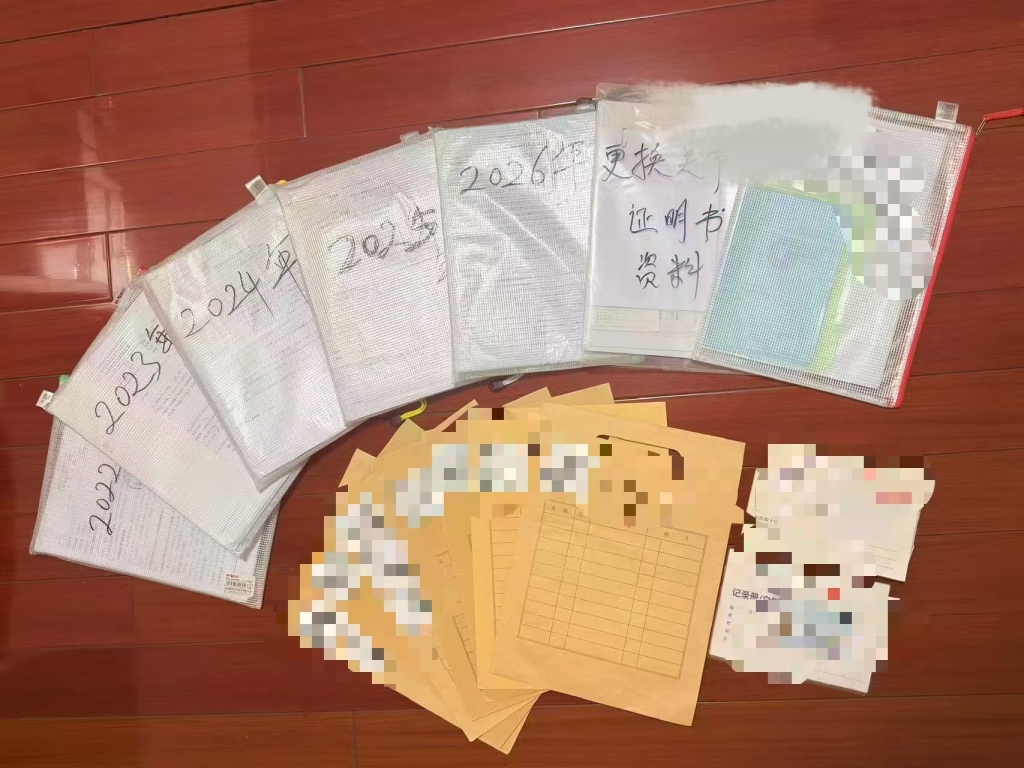
A Feng's years of medical records. Source: provided by the patient
The impact of such Huiminbao policy changes is resonating across various rare-disease chat groups. As the parent of a child with a rare disease, Zhang Da has long followed policy trends in different regions. He has observed that in recent years, coverage policies for rare-disease groups in many places have undergone repeated adjustments amid exploration.
"The first province in the country to open reimbursement for hypophosphatemic rickets was Anhui, but it too made adjustments a year or two later. As of now, Shenzhen is the only city nationwide that can basically cover 70%–80% of treatment costs and keep patients' out-of-pocket amount within ¥200,000. In recent years, the policy direction in every city toward us has been tightening, not improving," Zhang Da said. This means that after their hopes are kindled, patient families often face new uncertainty.
Regarding the "forced drug switching" that payment-policy changes may trigger, Chen Nan, chief physician of the Department of Nephrology at Ruijin Hospital affiliated with Shanghai Jiao Tong University School of Medicine, expressed clinical-level concerns. She pointed out that the core of rare-disease treatment lies in being "long-term, standardized, and adequately dosed." "The complications of Fabry disease are mostly heart failure, kidney failure, and stroke. Only through long-term, stable treatment can the risk of organ complications be effectively reduced."
Chen Nan believes that medically, it is generally not advisable for patients whose condition is stable to lightly switch treatment plans. During policy adjustments, she hopes a more moderate transition mechanism can be established to give patients a smooth adaptation period.
It is not only rare-disease patients; cancer patients receiving high-value anticancer drug treatment face similar predicaments. Gu Hongfei, founder of Lymphoma Home, told The Paper that he once encountered a patient with recurrent lymphoma who, because the local Huiminbao had removed a CAR-T therapy from its catalog, could not afford the cost of CAR-T treatment and receive the ideal therapy. More fortunate than rare-disease patients, lymphoma has more treatment options, and cooperation between pharmaceutical companies and insurers has created some payment plans for CAR-T, allowing patients to still find workable solutions to improve drug accessibility.
The Pressure on Huiminbao: High Coverage vs. Sustainability
Whether rare diseases or cancer, the difficulties faced by the patients above all point to the same payer — "Huiminbao."
This is a type of inclusive supplementary medical insurance led by local governments and underwritten by insurance companies, targeting people enrolled in basic medical insurance, positioned to provide a second layer of coverage after basic medical insurance. Since the pilot began in 2015, it has rapidly "blossomed" across the country.
Since it aims to "benefit the people," why remove high-priced rare-disease drugs? On this, a chief actuary at an insurance company explained to The Paper that this reflects the balance between Huiminbao's coverage needs and the sustainability of its risk. Although Huiminbao has an inclusive nature, it is essentially still commercial health insurance and needs to maintain long-term operation through actuarial mechanisms. "A commercial activity can forgo pursuing profit, but it cannot operate long-term while deviating from the laws of risk."
_This article is a partial English translation (approximately the first 2,000 Chinese characters) of a report by The Paper (澎湃新闻). It covers the introduction, the section "Patients' Anxiety," and the opening of the section "The Pressure on Huiminbao." For the full original report, please see the source link below._