business
What Kind of People Does the AI Era Need? Lessons from DeepSeek's Hiring List
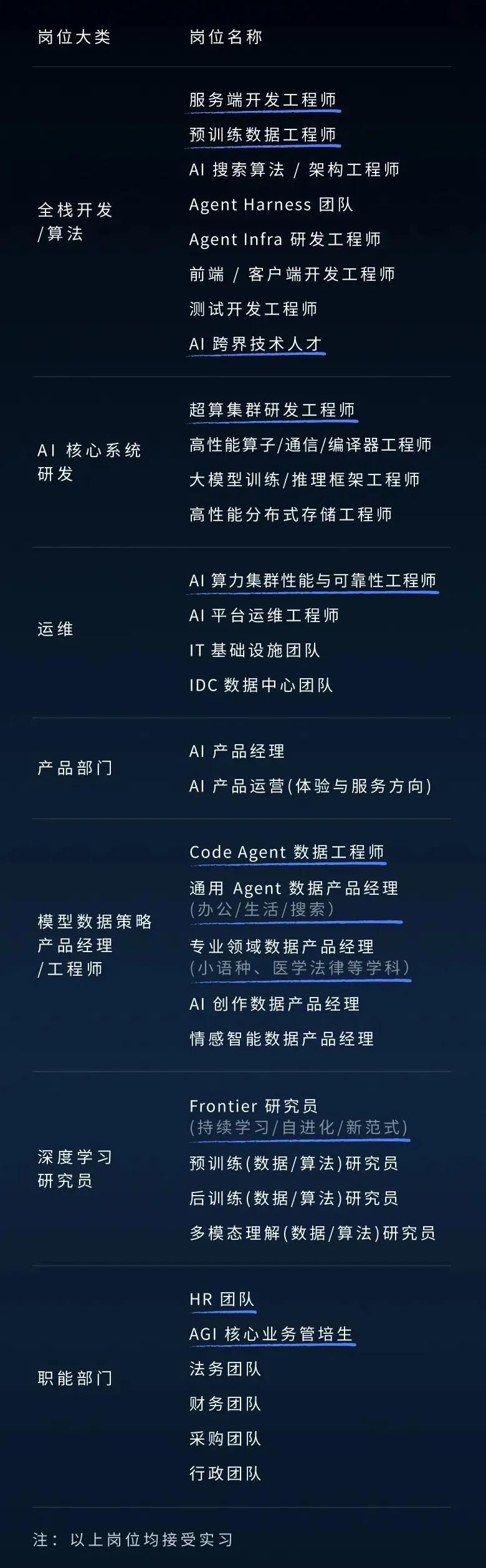
Recently, DeepSeek published a hiring list on its official website. On the surface, this looks like a routine expansion: seven broad categories and 33 positions, spanning full-stack development, core systems, operations, product, model data strategy, deep learning research, and functional departments—covering virtually every function required to run an AI company.
What makes this round of hiring worth studying is not the number of positions, but the underlying judgment about AI talent it reveals. DeepSeek's "Join Us" page states: "We devote ourselves to exploring the essence of AGI, and we embrace you who are passionate about AI." The phrasing is grand, but the hiring list itself is far more concrete. It shows exactly how a frontier AI company defines its key talent.
The first layer of its talent philosophy: AI talent is not one kind of person, but a team
The list makes clear, first of all, that DeepSeek does not conceive of AI talent as merely algorithm specialists. On one end it connects frontier research, pre-training, post-training, and multimodal understanding; on the other it connects high-performance operators, communication, compilers, training frameworks, inference frameworks, and distributed storage. But the list does not stop there. Agents, AI search, front- and back-end products, data centers, platform operations, computing reliability—and then legal, finance, procurement, administration, and human resources—are all placed on the same table.
According to public reports, this round of hiring is not about filling a few gaps; rather, every department is set to at least double in size, aiming to build a more complete talent echelon and shore up the full industrial-chain capability from foundational model R&D at the bottom to commercial application at the front end. This layout shows that AI companies have moved from a "research-breakthrough phase" into an "organizational-capability phase." For a large model to move from the lab into the real world, it must pass through many gates: the model must be trained, computing power must be stable, data must be effective, inference costs must fall, and the product experience must keep users coming back. Beyond that, data compliance, procurement cycles, and financial investment all determine whether an AI company can survive over the long run.
So the competition among AI companies is not a one-man show among a few geniuses, but a contest of systemic capability. Early breakthroughs can rely on a handful of people, but long-term competition depends on a structurally complete team. Researchers push the boundaries; systems engineers own efficiency and stability; data strategists decide what the model absorbs; product and operations teams determine whether the capability can be used continuously; and the functional departments ensure that expansion is not held back by compliance, budget, or supply chains.
This also reminds us that when observing an AI company, we cannot look only at whether it has star researchers, model releases, or leaderboard results; we must also see whether it has formed a complete talent structure. If we look only at the front-end model capability while ignoring the back-end data, computing infrastructure, product, and organizational support, we easily mistake AI competition for a technical contest among a few algorithm scientists. What DeepSeek's hiring list truly lays bare is a fact obscured by the model's halo: to go far, an AI company cannot rely solely on smart people making point breakthroughs; it must depend on an organizational capability that can iterate continuously.
The second layer of its talent philosophy: what truly matters is not the job label, but the key interface
If you read carefully the recruitment copy for DeepSeek's data-center team, you will find that it describes today's data center as "a large industrial system that has evolved from a traditional server room into one supporting AI training and inference." Power, cooling, networking, and computing systems are deeply coupled, emphasizing that every unit of electricity, every watt of cooling, and every scheduling decision affects the final computing output. The talent philosophy behind this phrasing is: as long as you sit at a key interface, you are not a marginal role.
An electrical engineer who sees himself merely as someone who manages power distribution is far from AI; but if he understands the energy consumption, redundancy, scheduling, and stability of a massively scaled computing cluster, he has entered AI infrastructure. A legal professional who sees himself merely as a contract reviewer is far from AI; but if he understands model open-sourcing, data compliance, user agreements, and cross-border data flows, he has entered the risk boundary of an AI company. A procurement officer seems even further from the technology—yet when the objects of procurement become GPUs, servers, optical modules, liquid-cooling systems, and power equipment, what he faces is in fact the lifeline of an AI company.
This is quite illuminating for ordinary people. The AI era does not demand that everyone switch careers to do algorithms; rather, it demands that every profession re-examine its own position: can the capability I hold be embedded into the new technical system? Am I connected to models and computing power, data and knowledge, products and users, technology and compliance, procurement and supply chains? The value of interface-type talent lies precisely here: they may not be responsible for inventing the model, yet they decide whether the model can enter reality at low cost and with stability.
The third layer of its talent philosophy: do not worship a polished résumé; ask only whether the contribution can be verified
DeepSeek has created an "AI cross-disciplinary technical talent" position with no restrictions on academic background. Its list of plus-factors is interesting: competition awards, having reached the extreme in some field, contributions to well-known open-source projects, a personal technical blog or book, entrepreneurial experience, having built something influential from scratch, and "not taking the usual path." It also states that it is "not looking for geniuses" but for people who "shine with their own light." These criteria share one thing in common: they are not résumé labels, but verifiable contributions.
Traditional hiring likes to look at certainty: school, major, degree, famous employers, years of experience, job level, and certificates. These still have reference value, but they mostly indicate whether a person's past path is relatively clear, training is complete, and track record is stable—without fully proving whether he can solve new problems. The AI frontier is precisely full of new problems; many tasks have no standard answer and no mature process. At such times, all we can look at is whether a person has done something beyond average, whether he has long been immersed in a hard problem, and whether he has built something from scratch under incomplete resources.