business
Europeans' AI Self-Rescue From 'Air-Conditioner Shame': Grab It Before It's Gone, Then Dodge the Snitches
Europeans' AI Self-Rescue From 'Air-Conditioner Shame': Grab It Before It's Gone, Then Dodge the Snitches
Record-breaking heat is sweeping across Europe, and for local residents, buying and installing an air conditioner this summer is about as difficult as scrambling for a newly released iPhone on launch day.
It is a somewhat surreal European summer: on one side, the harsh reality of Berlin's historic 41°C heat and thousands of excess deaths; on the other, a deep-rooted culture of 'air-conditioner shame,' months-long bureaucratic approval processes, and exorbitant professional installation fees.
In Vienna, software developer Denis Yurchak went so far as to deploy an AI agent to monitor inventory across all of Austria around the clock, just to get his hands on a drill-free air conditioner. He nearly drove three hours across the border to Hungary to pick one up in person, and finally managed to snag a Chinese-brand unit after pushing back against the store's on-the-spot price hike.
'If one day I really get a notice telling me to remove the air conditioner, I won't do it — I'll stand my ground, and if necessary, take it to court,' Yurchak told The Paper (www.thepaper.cn). He remains worried about being reported, even though this year's rules have been relaxed.
After one heat wave, the World Health Organization warned in early July that a new round of extreme heat is forming over the Atlantic, and Europe could face more deadly high temperatures in the coming weeks.
Pressed by reality, technological pragmatism is eroding conservative mindsets. Beyond using AI monitoring software to track inventory, a website called 'I Need Air Conditioning' scrapes and monitors split-unit stock data in real time, and its traffic has surged. To cool down while staying green, German resident Friedrich is planning to build his own small photovoltaic system to power his AC — fighting fire with fire, as it were.
In Europe, 'how to cool down' is no longer a simple matter of personal preference or consumer choice; it has evolved into a profound debate entangled with climate ethics, social equity, and institutional failures.
How Hard Is It to Buy an Air Conditioner?
Looking across the whole apartment building, only one unit has an outdoor AC compressor hanging by the window. It belongs to Yurchak, who went through considerable trouble to bring a portable split-unit back from 200 kilometers away.
'This is the first time I've felt 'cold' in a Vienna summer,' Yurchak joked. The air conditioner was the best purchase he ever made — once installed, the room temperature dropped to 22°C instantly, finally ending the sleepless nights he had endured under the heat wave.
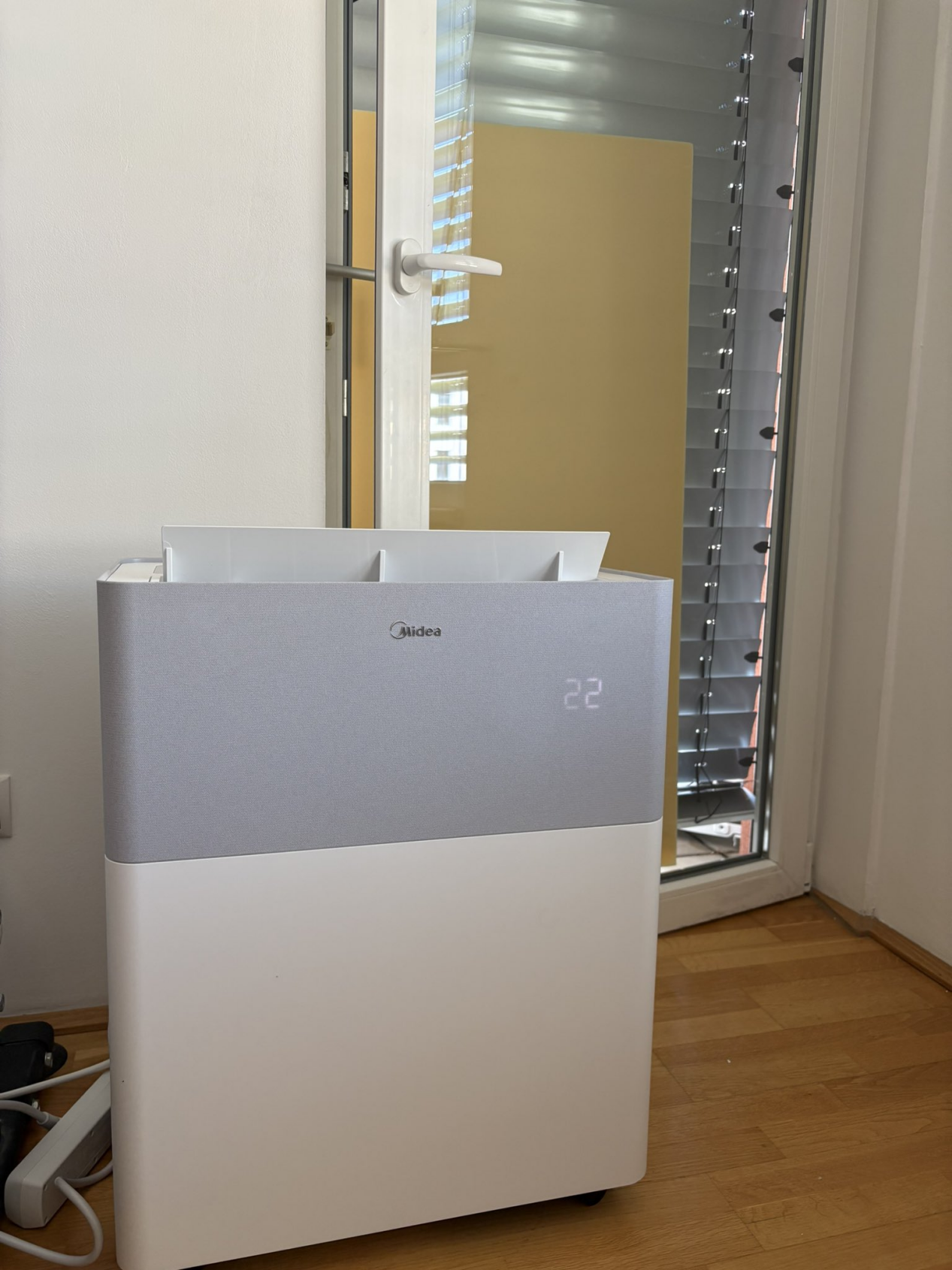
The air conditioner Denis Yurchak purchased
Looking out the window, Yurchak noticed that most of his neighbors keep their windows open, some pacing restlessly indoors, and an older neighbor who often steps onto the balcony, gasping for breath — looking thoroughly miserable.
A kind of 'air-conditioner shame' seems to pervade the neighborhood; very few people install AC. Yurchak even found neighbors who had bought units but struggled to hide the outdoor compressor deep in their balconies, covering it up for fear of being seen. 'The mentality of being afraid to reveal you have an air conditioner is really strange,' he said.
Even without the 'AC stigma,' buying an air conditioner this summer was still a major challenge for Yurchak.
At the end of June, Vienna's temperature soared to 38°C. His previous ventless portable AC rattled day and night for three days straight, yet the room temperature only dropped marginally below the outside. And it wasn't cheap to run — it consumed 65 kWh over those three days.
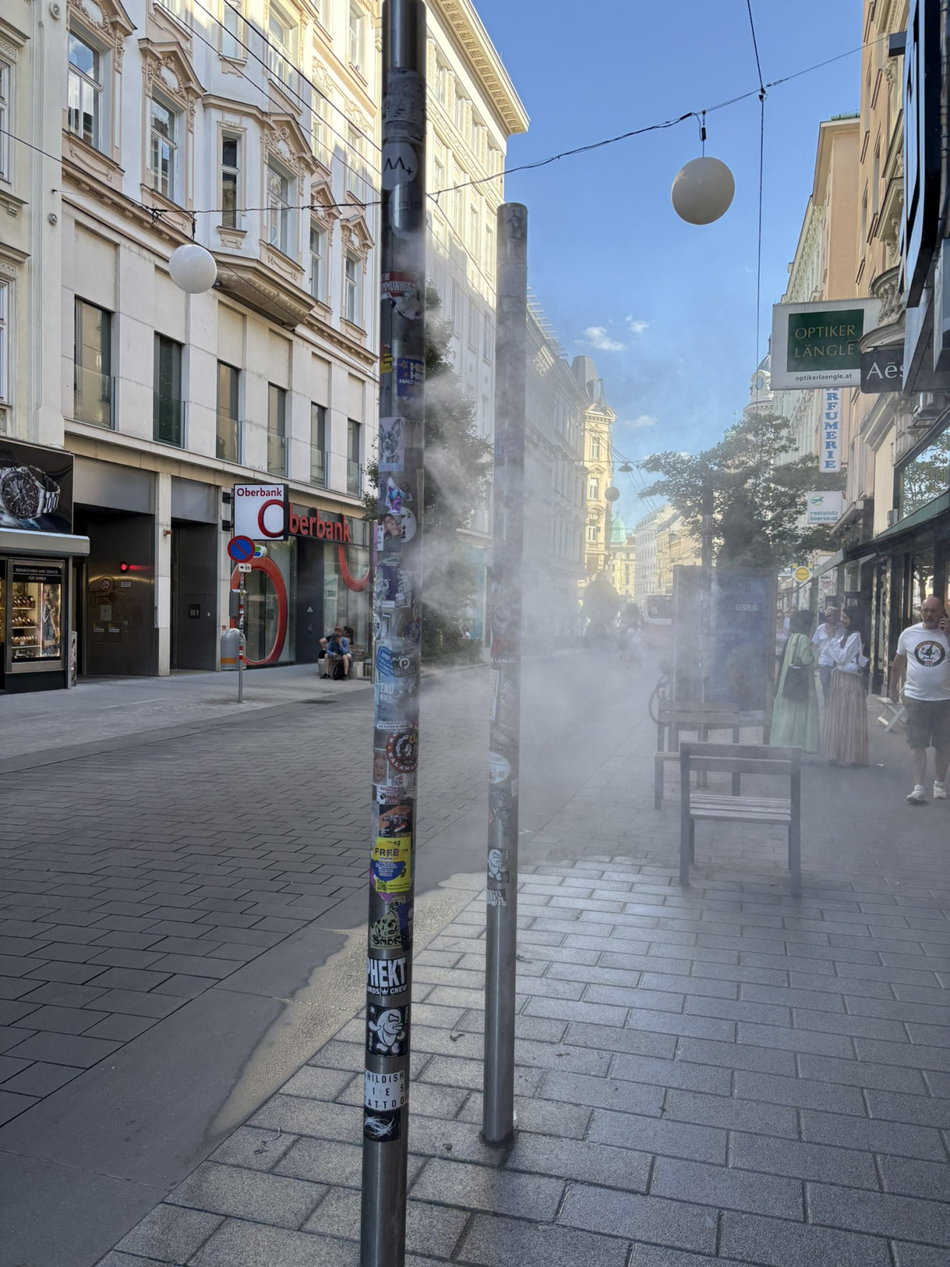
June: Vienna sprays water on the streets to beat the heat.
Six years ago, Yurchak moved from Moscow to Austria and developed the international calling apps Yadaphone and eSIMPal. To his surprise, air conditioning turned out to be a major part of the culture shock. An appliance he believes every household should own is extremely rare in Vienna, even as summers grow hotter year after year.
In past years, Yurchak tried to install AC in his rented apartment, but local municipal housing only permits it under very special circumstances — for instance, when a resident's medical needs reach care level 6 (requiring round-the-clock care). On top of that, labor installation costs are extremely high, roughly €1,000–2,000, several times the price of the unit itself.
With no other choice, he could only buy a portable unit that requires no special permit. But these are usually single-hose models: a duct must be run out the window, and as the machine runs, indoor air is reduced, creating negative pressure. To fill that vacuum, hot outside air seeps back in, so cooling efficiency is poor.
It was only this May that the Austrian government announced relaxed rules for AC installation. Provided all necessary regulations on noise protection, energy efficiency, fire safety, and installation are met, municipal-housing tenants may install air conditioners once they obtain a permit. This thrilled Yurchak, but because demand had long been subdued, units were hard to find in stock — and the latest heat wave made them even scarcer.
Yurchak had also planned to escape the heat abroad, eyeing one of the few still-cool islands in Europe, but airfares had jumped from the usual tens of euros to several hundred — several times pricier.
Austria's municipal efficiency is also undermining people's efforts to cope with the heat. According to Austrian broadcaster ORF Wien, within about a month of Vienna's city government relaxing the AC rules, it received 122 inquiries or preliminary applications — but only 20 air conditioners were approved, with the rest still under review.
Midea's portable split-unit, which requires no drilling and offers flexible installation, can in some cases bypass the complicated approval process for traditional AC — making it Yurchak's top choice. He found a website showing which Austrian stores had such split-units in stock, but it had no alert feature. So he deployed an AI agent to check the site every half hour and notify him the moment stock appeared.
For two straight days, no notification came. When Yurchak checked the forecast and learned the temperature would hit 38°C in three days, he decided he would do whatever it took to get an air conditioner.
Yet not a single portable split-unit could be found anywhere in Austria, so he looked into picking one up in neighboring Hungary — the only place he could find with stock. 'My wife thinks I'm crazy, but I really can't survive 38-degree heat,' he said.
Yurchak kept calling air-conditioner dealers in Hungary. When he finally got through, no one on the other end could speak English, so he turned on AI real-time translation for Hungarian to manage a rough conversation. Told he could use a delivery service to ship the unit to a pickup point inside Hungary, he went on to search for a border hotel, making about 20 calls before booking a room that could receive the package. Then he hurriedly rented a car, ready to drive three hours to Hungary the next day.
Translated from the Chinese original '手慢无、买完还得防举报:“空调羞耻”下欧洲人的AI自救', published by The Paper (澎湃新闻).