business
In Memoriam: Nansun Shi — The True Leading Lady of Hong Kong Cinema Who Defined What a Producer Should Be
Nansun Shi had an unerring eye for talent and a generous spirit for helping others succeed — she was the anchor and steadying force of Hong Kong cinema. Asked about the secret to being a successful producer, she answered plainly: "Don't lose money, don't lose face, and don't have regrets when you look back on your work years later." She embodied the film industry's most professional kind of producer: not a mouthpiece for capital, nor an obstacle to creativity, but the armor and the backbone behind the creators — someone who believed in the value of film and the power of professionalism. Standing in the shadows of the silver screen, she lived as the protagonist of her own story. She never acted in a single film, yet she directed the most extraordinary life of her own.
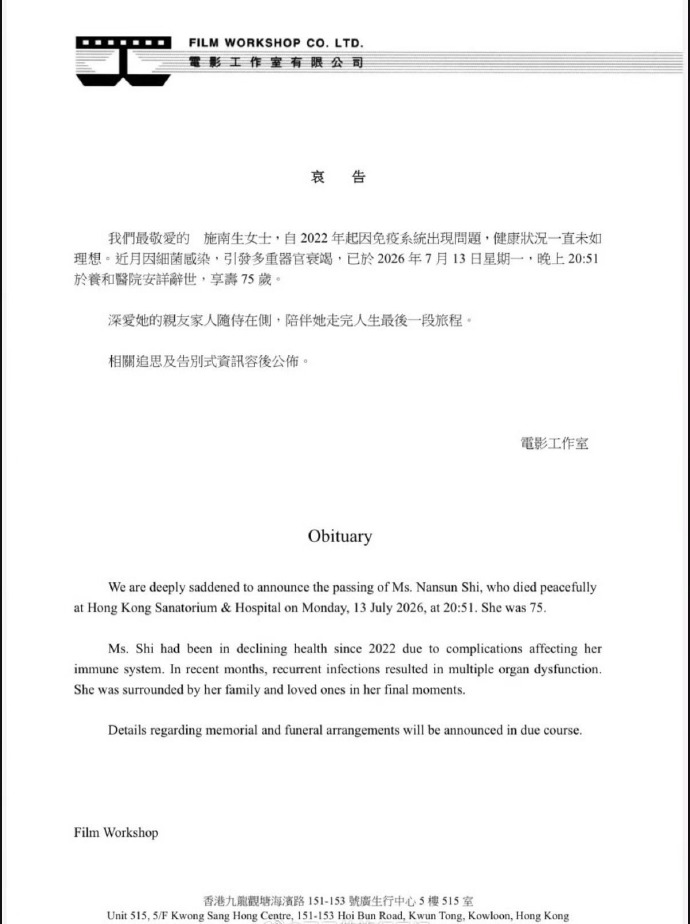
On the evening of July 13, 2026, at Hong Kong Sanatorium & Hospital, Nansun Shi — a "chivalrous heroine" of a golden era of cinema — passed away peacefully at the age of 75, after a bacterial infection led to multiple organ failure.

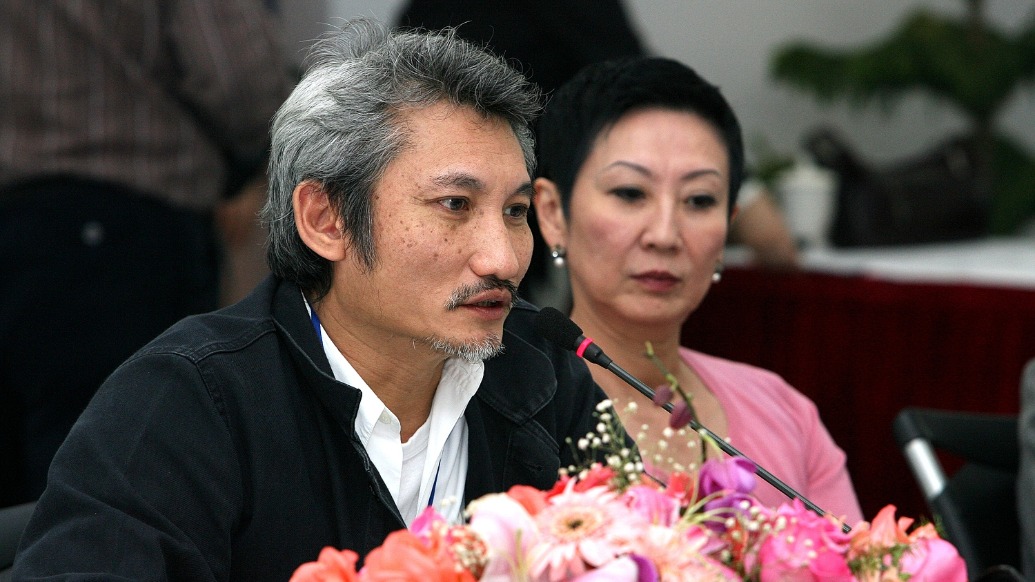
After her passing, her former husband, director Tsui Hark, appeared outside the hospital and spoke to reporters. He revealed that she had departed peacefully, surrounded by family and close friends. "She and her family have always been so grateful for everyone's attention, support and blessings. We hope everyone will turn the grief and longing over her departure into strength and warmth, to accept it and say farewell. May she rest in peace — her spirit will always be with us."
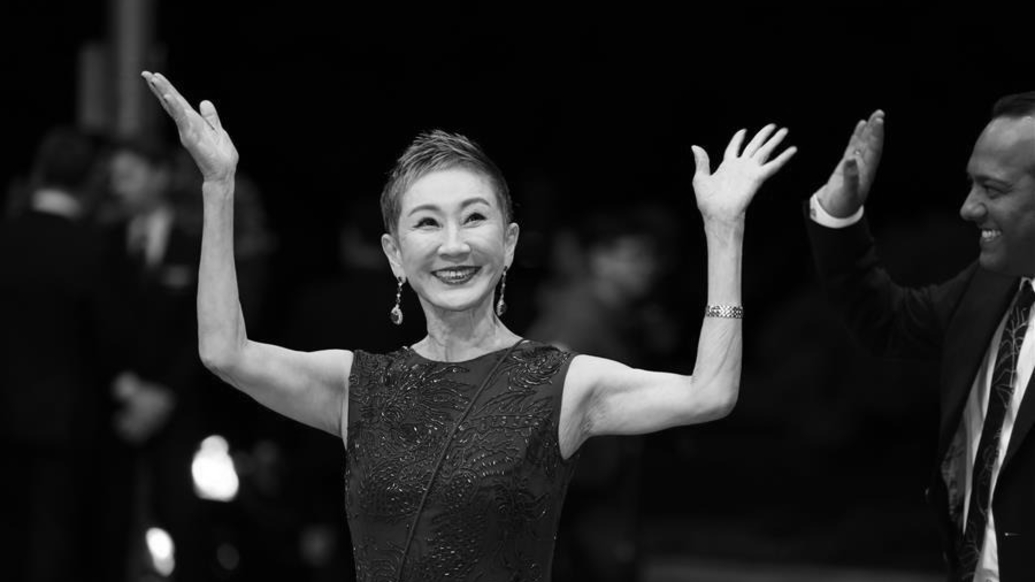
The bad news left far too many people stunned and unprepared. After all, the image of her accepting the Lifetime Achievement Award on the Hong Kong Film Awards stage last year was still vivid in memory. Standing beside Tsui Hark, the comrade who had walked alongside her all the way, she thanked the industry partners who had accompanied her and declared, resolute and stirring: "Hong Kong cinema, keep going!" The presenter, Brigitte Lin, said that Nansun Shi had made an indispensable contribution to the golden age of Hong Kong cinema.
She was the only woman among the "Seven Wonders of Cinema City," the "city-builder" on Tsui Hark's road of dreams, the ferryman who carried Chinese-language cinema to the world, and — in the words of superstars like Leslie Cheung, Brigitte Lin and Joey Wong — the most dependable "big sister." Always sporting a crisp short haircut, Nansun Shi was the true leading lady of Hong Kong cinema. Though she rarely stood in the center of the spotlight, in hindsight her brilliance is woven into the trench coat of A Better Tomorrow, the moonlight of A Chinese Ghost Story, the rooftop of Infernal Affairs — and into the film memories of several generations.
Nansun Shi's life traced the entire golden era of Hong Kong cinema, and it defined the most dignified, most professional meaning of those three words: "the producer."
Cinema City's "Head Steward" and Tsui Hark's "Best Partner"
Born in Shanghai in 1951, Nansun Shi moved to Hong Kong with her family when she was young. She received a fine education from an early age, and after graduating from secondary school she went to study in Britain, earning her degree from the Polytechnic of North London. Her training in science and engineering forged in her a rigorous logic and precise judgment, while her years living abroad gave her command of English, French and several other languages, granting her an international perspective rare among her peers in the film and television industry.
After returning to Hong Kong in the 1970s, she worked successively at TVB, Commercial Television (CTV) and Rediffusion Television (RTV), building deep experience from program production to administrative management. Within the standardized workflows of the television industry she came to understand the full chain of content production, and she honed a formidable talent for coordination and organization.
In 1981, when Raymond Wong brought Nansun Shi into Cinema City's cramped "struggle room," this film company — cobbled together by six men — was less a proper enterprise than a hot-blooded creative gang.
Karl Maka, Dean Shek, Raymond Wong, Tsui Hark, Eric Tsang and Teddy Robin: six geniuses whose heads brimmed with wild ideas. They could talk plot points through the night and shoot comedies to the point of obsession, yet not one of them could read a financial statement, calculate a shooting schedule, or handle overseas distribution. Nansun Shi's arrival was the turning point that took Cinema City from a "ragtag troupe" to an industry benchmark.
This woman — a graduate in computing and statistics from the Polytechnic of North London, fluent in English, French, Cantonese and Mandarin — plunged into the vibrant chaos of Hong Kong cinema with the rigor of a scientist and the polish of a public-relations professional. With one hand she established disciplined budgeting systems and production workflows, framing unbridled creativity within controllable costs; with the other she built distribution networks spanning Southeast Asia and even Europe, carrying film prints to every distributor's booth at Cannes and Berlin.
After she arrived, Aces Go Places set a box-office record in Hong Kong film history, and It Takes Two, Night Caller and The Perfect Wife ignited the market one after another. In just a few short years, Cinema City rewrote the landscape of Hong Kong comedy. It is fair to say that without her spending every dollar where it mattered most, and without her negotiating every distribution contract, the wild ideas brainstormed in the struggle room would have forever stayed at the dinner table.
As the only woman among the "Seven Wonders of Cinema City," Nansun Shi was the ballast of the entire team. Ni Kuang once said: "In both EQ and IQ, she was higher than me in every respect. I lost, thoroughly convinced, and simply set my ego aside." That extraordinary clarity and competence let her carve out a place of her own in a male-dominated film industry.

In 1984, Nansun Shi and Tsui Hark co-founded Film Workshop, beginning one of the most legendary partnerships in Chinese-language cinema.
Tsui Hark was a famous "technical madman," his mind forever filled with spectacles he could never exhaust: he wanted to film the chivalry of the martial world, the realms of ghosts and immortals, the fate of nations — to hurl the most extreme Eastern aesthetics onto celluloid. And Nansun Shi was the one who always stood behind him, turning every "impossible" into "shot and finished."
On the Lifetime Achievement Award stage last year, Tsui Hark said with deep emotion: "For all these years, it was she who held up the fragile tent that is Film Workshop, so that in the wind and rain, this fool could sit inside and let his mind run wild. So both of these awards tonight should belong to her."
And so, in our memories, there is the swagger of Mark's trench coat sweeping across the Hong Kong streets in A Better Tomorrow; the Eastern spectral beauty of Nie Xiaoqian's white robe drifting past Lanruo Temple in A Chinese Ghost Story; the new martial-arts era kicked open by the Shadowless Kick of the Once Upon a Time in China series; the flashing blades and chivalrous spirit amid the desert sands of Dragon Inn; and the passion and Zen flowing to their utmost through the misty Jiangnan of Green Snake.
These classic images, etched into the DNA of several generations, bear Tsui Hark's name in front of the camera — and behind it stands the figure of Nansun Shi. She managed the financing, the distribution, the budgets, and all the tedious matters that gave directors headaches. Tsui Hark could polish a single shot for three days and nights, could fly a visual-effects team to Hollywood, could pursue perfection regardless of cost — because he knew that behind him, Nansun Shi had it covered.
Translator's note: This is an English rendering of the opening portion of the original Chinese tribute published on The Paper (thepaper.cn). Only the first part of the article has been translated here.