business
What Does an 18-Year-Old's 'Thousand-Mile Journey' Look Like? A Conversation with Two Teenagers Who Went to Hengzhou for Disaster Relief After the Gaokao
What Does an 18-Year-Old's 'Thousand-Mile Journey' Look Like? A Conversation with Two Teenagers Who Went to Hengzhou for Disaster Relief After the Gaokao
"Going to Guangxi, for disaster relief? We can't do much on the front lines, but logistics must surely be short-handed in a situation like this."
"It's not about any personal heroics — if we can go and lend a hand, just be a small screw in the machine, that's already good enough."
On the evening of July 7, images of the floods in Hengzhou, Guangxi, caught Wu Yulun's eye. He immediately made calls, joined a volunteer group, and invited a classmate — his classmate Xin Ziyu agreed without hesitation.
Two days later, the two 18-year-olds, fresh out of the gaokao, set out from Shanghai on a thousand-mile journey to Hengzhou, Guangxi, bringing supplies they had bought themselves, without telling their parents. Before this, they had rarely traveled far on their own, let alone done much heavy physical labor. It may sound impulsive, but in fact they made thorough preparations and reasoned decisions in a very short time.
In just a few days, they hauled relief supplies at various distribution points in Hengzhou, witnessing supplies and rescue workers from all corners of the country pour into the flood-stricken front lines, and seeing affected residents quickly get their lives back on track, with whole families — old and young — pitching in as volunteers. As one local put it, "The home is gone, but the people are still here, so we'll do what we can."
Vast fields of jasmine in Hengzhou lay submerged in water, and every time they passed they felt a pang of regret. Yet they tasted the local sweet corn and fresh lychees, made good brothers, remembered many lovely faces, and for the first time understood things beyond any textbook: such as human resilience in the face of disaster, and how everyone set aside their status to labor only for relief…
On the first night in Hengzhou, Wu Yulun's parents learned where their son had gone; only after repeatedly confirming his safety by phone did they relax. Xin Ziyu didn't come clean until the day before returning to Shanghai, and when they met, his father talked with him about his experience fighting the 1998 floods. "We found some common ground."
In recent days their story has reached more and more people, and has appeared on the WeChat official accounts of the Communist Youth League Central Committee, Xinhua News Agency, and the People's Daily, earning much encouragement and recognition. Speaking with a reporter from The Paper about this special and precious rite of passage into adulthood, Wu Yulun and Xin Ziyu recalled their unforgettable trip to Hengzhou.
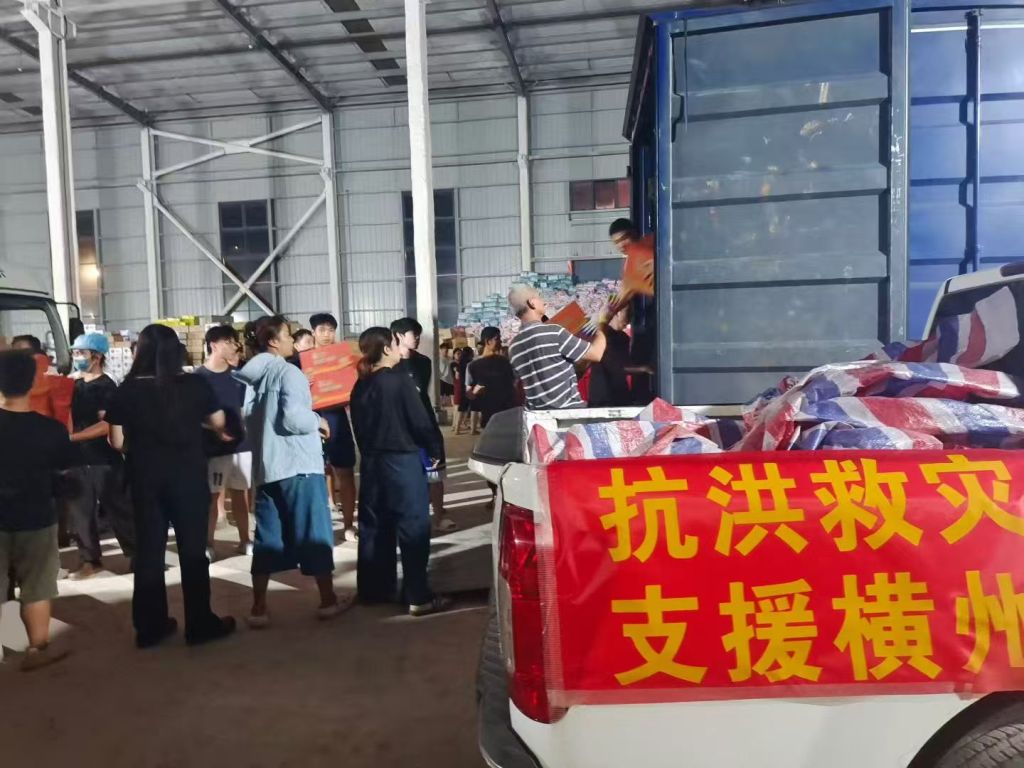
Crowds carry relief supplies. All photos in this article are provided by the interviewees.
Off They Went, to Help with Disaster Relief
Before heading to Guangxi, Wu Yulun felt some pressure; he asked an AI about "what risks exist in flooded areas," "how to guard against mosquitoes and snakes," and "how to find one's way in mountainous areas with no signal," while jotting down an emergency plan and a supply list.
It was the evening of July 7. A few hours earlier, he had seen news of the Hengzhou, Guangxi floods — Typhoon Maysak brought extreme rainfall, floodwaters trapped towns and villages, and the area was severely affected.
The front lines surely needed supplies and volunteers. He couldn't get through to local foundations or volunteer organizations at first, but he found a mobilization appeal issued by the local Communist Youth League organization, scanned the code, and joined a reserve volunteer group. After communicating with the League's contact person, Wu Yulun confirmed he could contribute; he asked a few close friends, and Xin Ziyu — willing and free — readily agreed.
"Before this, Xin Ziyu had never traveled far alone, and was still two weeks shy of turning 18; Wu Yulun had only ventured out alone once or twice around Shanghai. Before departure, the two teens made a pact: never act separately, and take no part in front-line rescue. The reason was simple: 'We're just fresh high-school graduates with no rescue skills or experience of long-distance outdoor trekking. We were afraid that if anything went wrong, we'd just add to their burden and make things worse. If we can go and contribute a bit of effort, just be a small screw, that's already good enough.'"
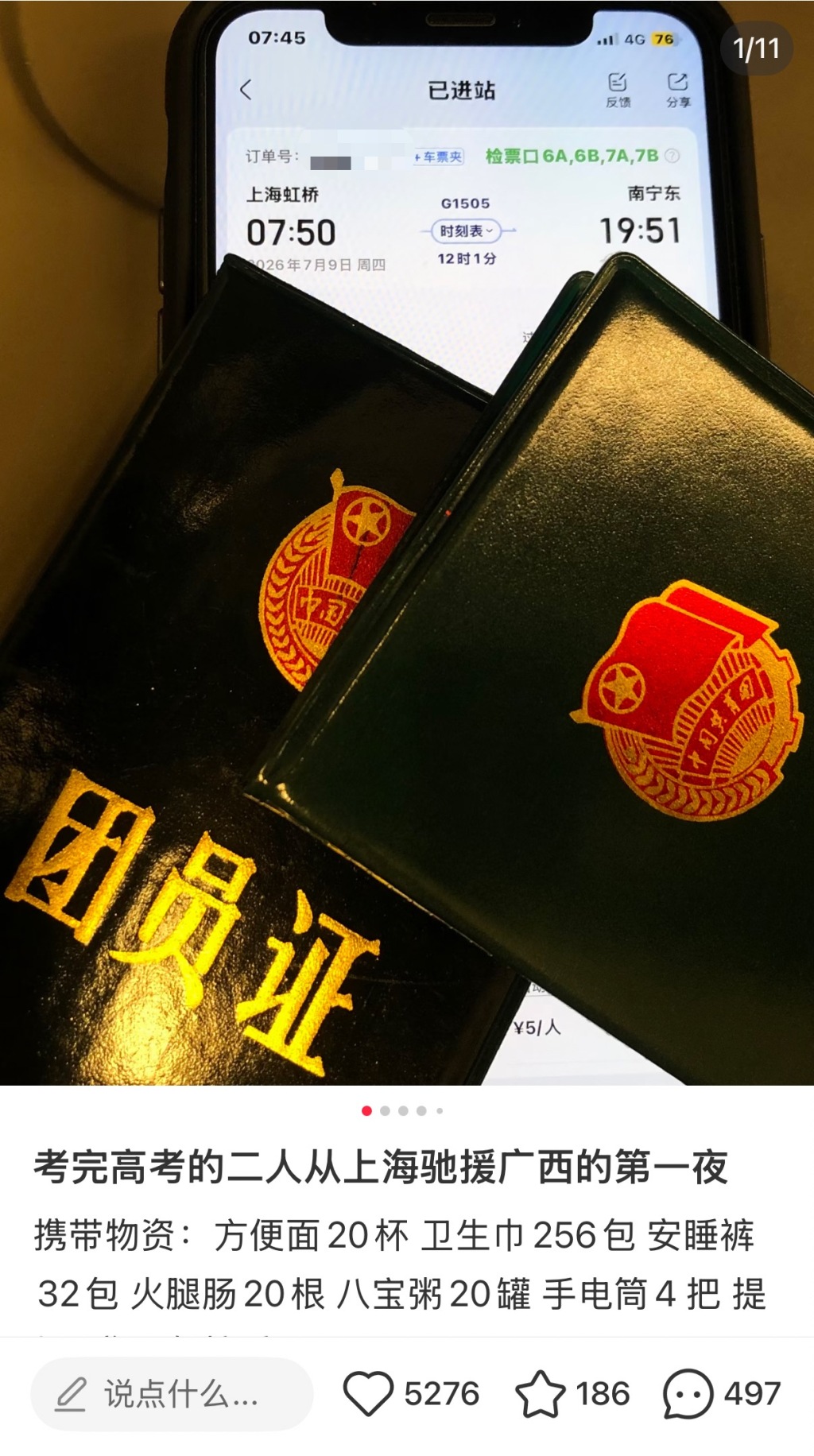
Wu Yulun's post on a social platform
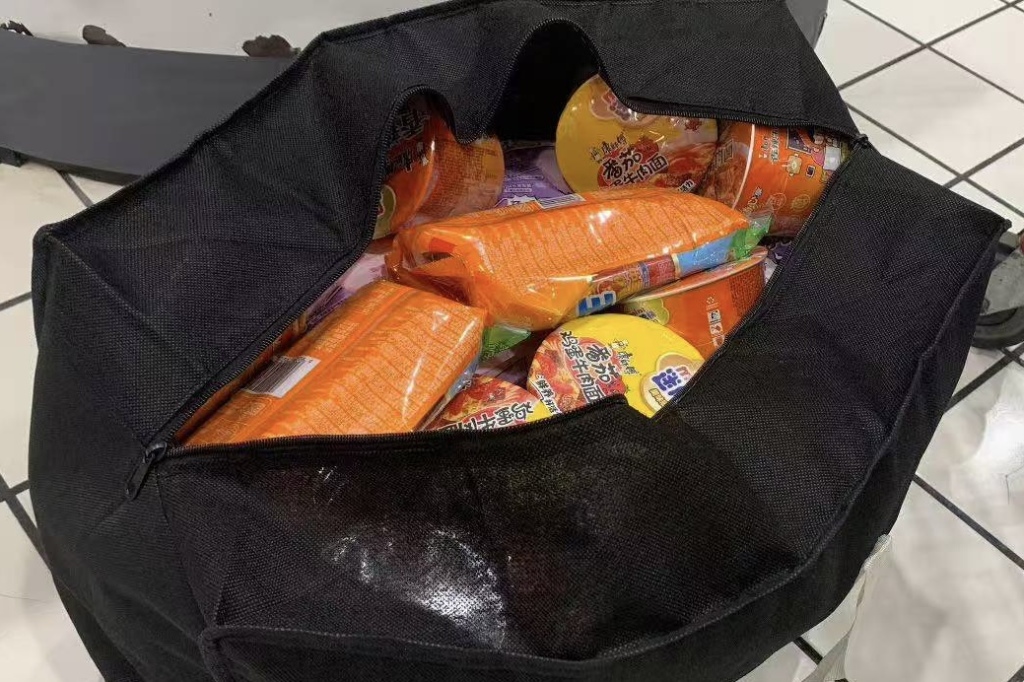
Some of the supplies the two purchased before departure
With no time to ship the supplies, on July 8 the two went separately to supermarkets to buy: 20 packs of instant noodles, 20 cans of eight-treasure porridge, plus sanitary pads, overnight pants, flashlights, lanterns, rubber boots, work gloves, medicine, bandages, and more — relief items and personal necessities all stocked up, costing about 1,000 yuan in total.
On the morning of the 9th, the two told their parents they were "going on a trip to Jiangsu," slung bags over their shoulders and carried several large packs by hand, and boarded the 7:50 a.m. high-speed train from Shanghai to Nanning. The train headed south; as it neared Nanning, the green hills and clear waters outside the window turned into yellow-muddy torrents.
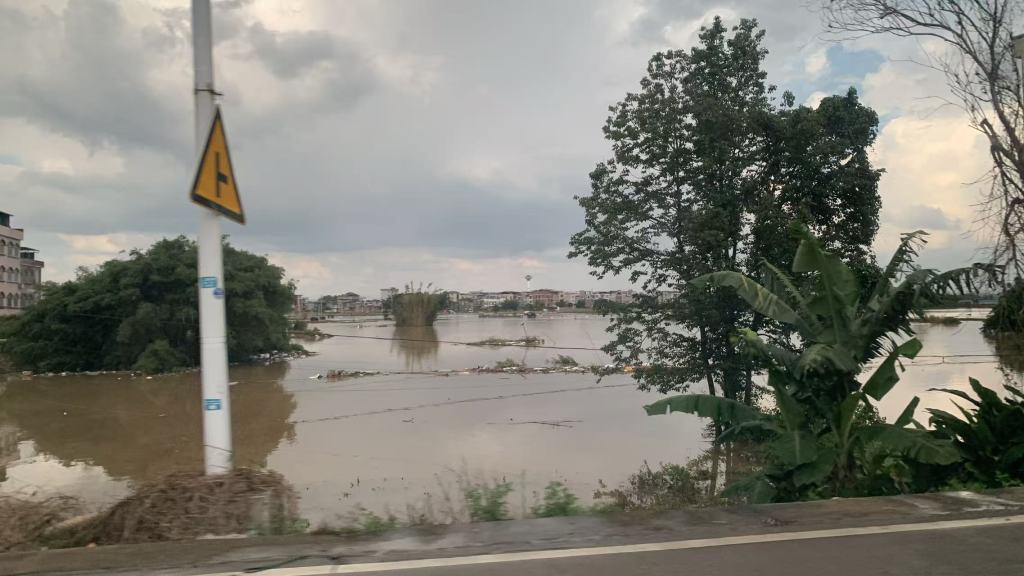
Floodwaters submerge the jasmine fields
After a full 12 hours of travel, they set foot on Guangxi soil for the first time. At 9:30 that night, an older guy in the relief-transport group was hauling a truckload of vegetables to Hengzhou and could give them a lift along the way. After the floodwaters receded, the roads along the way were muddy and bumpy, jolting the passengers this way and that.
"Halfway there, the guy suddenly rolled down the window and said, 'In past years these places were covered with vast seas of jasmine, and opening the window you'd be met with the scent of jasmine everywhere.' Hengzhou is known as the 'Jasmine Capital of the World,' with nearly 80 percent of the country's jasmine grown here. What Wu Yulun and Xin Ziyu mostly smelled at the time, however, was the stench of silt."
Busy Straight Through to 4 a.m. — Able to Fall Asleep Standing Up
Around midnight on July 10, the two rendezvoused with the main group at a winery warehouse in Maling Town, Hengzhou.
This was a supply distribution point. Relief materials from all over the country arrived in waves by container truck; volunteers handled loading and unloading, dozens of them weaving into a "human chain," passing heavy items hand to hand to the stacking area; after sorting, the goods were loaded onto small pickups and off-road vehicles bound for the front lines, while the most dangerous spots required manual carrying — a one-way hike into the mountains of about 12 hours.
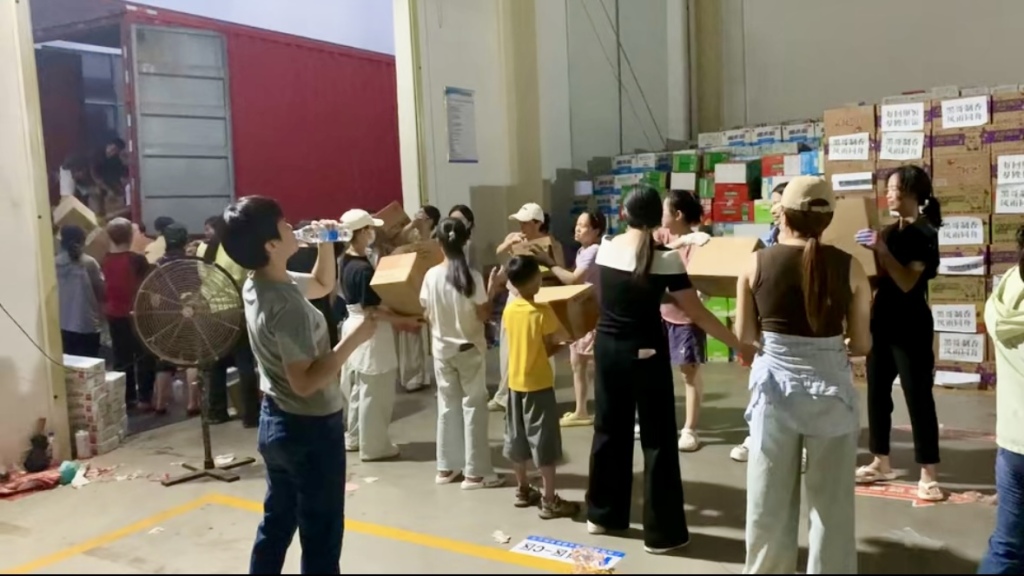
Men, women, old and young form a 'human chain' to pass along supplies
"After registering and donating their supplies, the two slipped into the line to help. On the first day they worked straight through to 4 a.m. 'Xin Ziyu is really stubborn — I told him to take a break and drink some water, and he got angry with me, impossible to hold back,' Wu Yulun recalled. After a full day of travel and high-intensity labor, Xin Ziyu later fell asleep standing up."
"Xin Ziyu stands 1.85 meters tall. 'People saw I was fairly sturdy and kept calling out, "Hey handsome, you're big and tall, get up on the truck and unload," and amid all those "handsome" calls I rather lost myself,' he said."
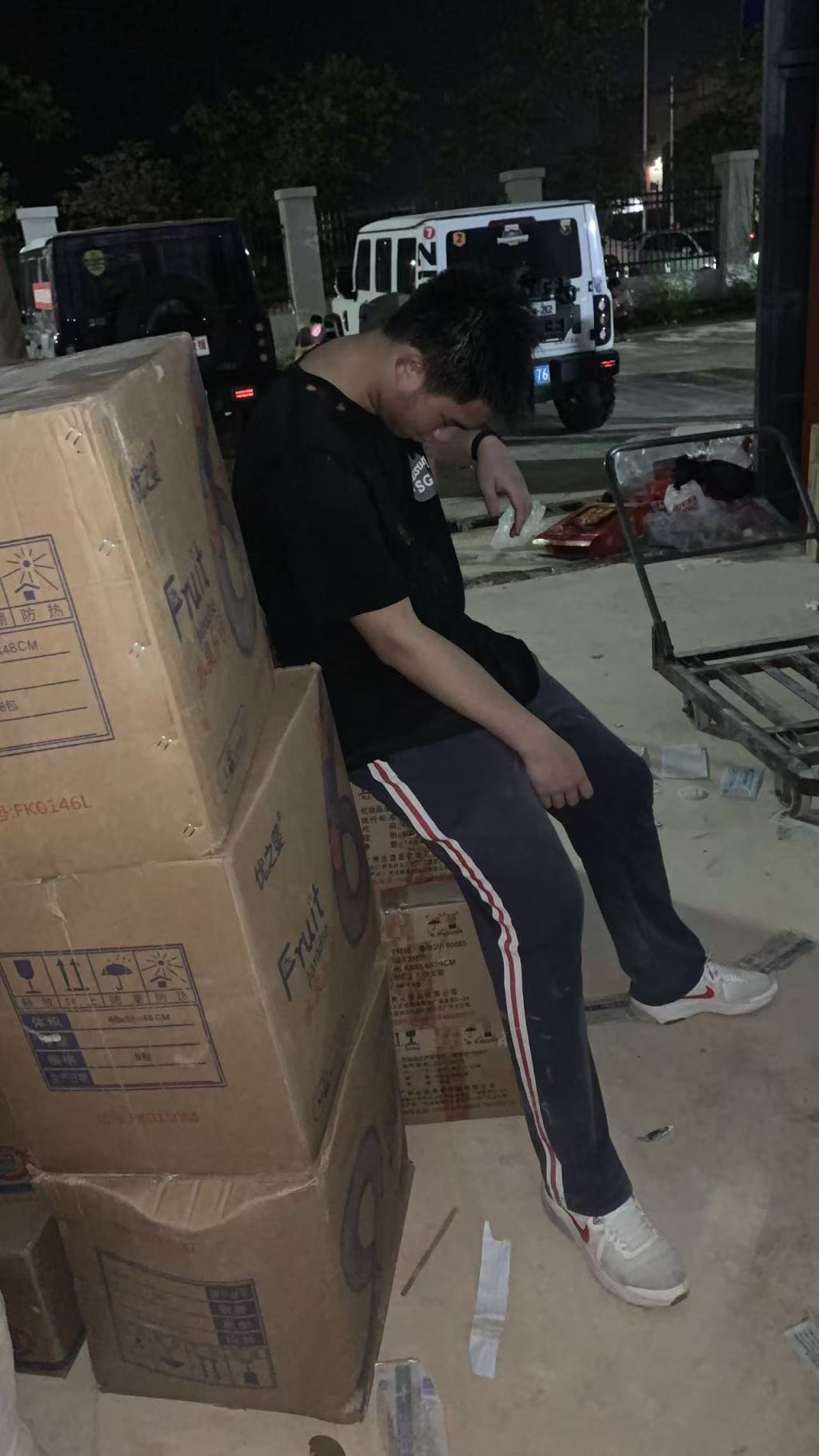
Exhausted, Xin Ziyu fell asleep standing up
"There are several supply distribution points around Hengzhou, and the WeChat groups post recruitment notices — they went wherever help was needed. Over four days, the two helped load and unload at Maling Town, the Hengzhou Civil Affairs Bureau, and several industrial parks. Most of the time they stood at either end of the line, either climbing onto trucks to unload or stacking items — the most physically demanding jobs. 'The moment our heads hit the pillow at night we'd fall asleep, and our appetites were bigger than usual,' Wu Yulun said. Volunteers handed out rations, and for the first time he experienced eating bread one bite at a time and downing mineral water like oral rehydration fluid — 'two or three gulps and the bottle was gone.'"
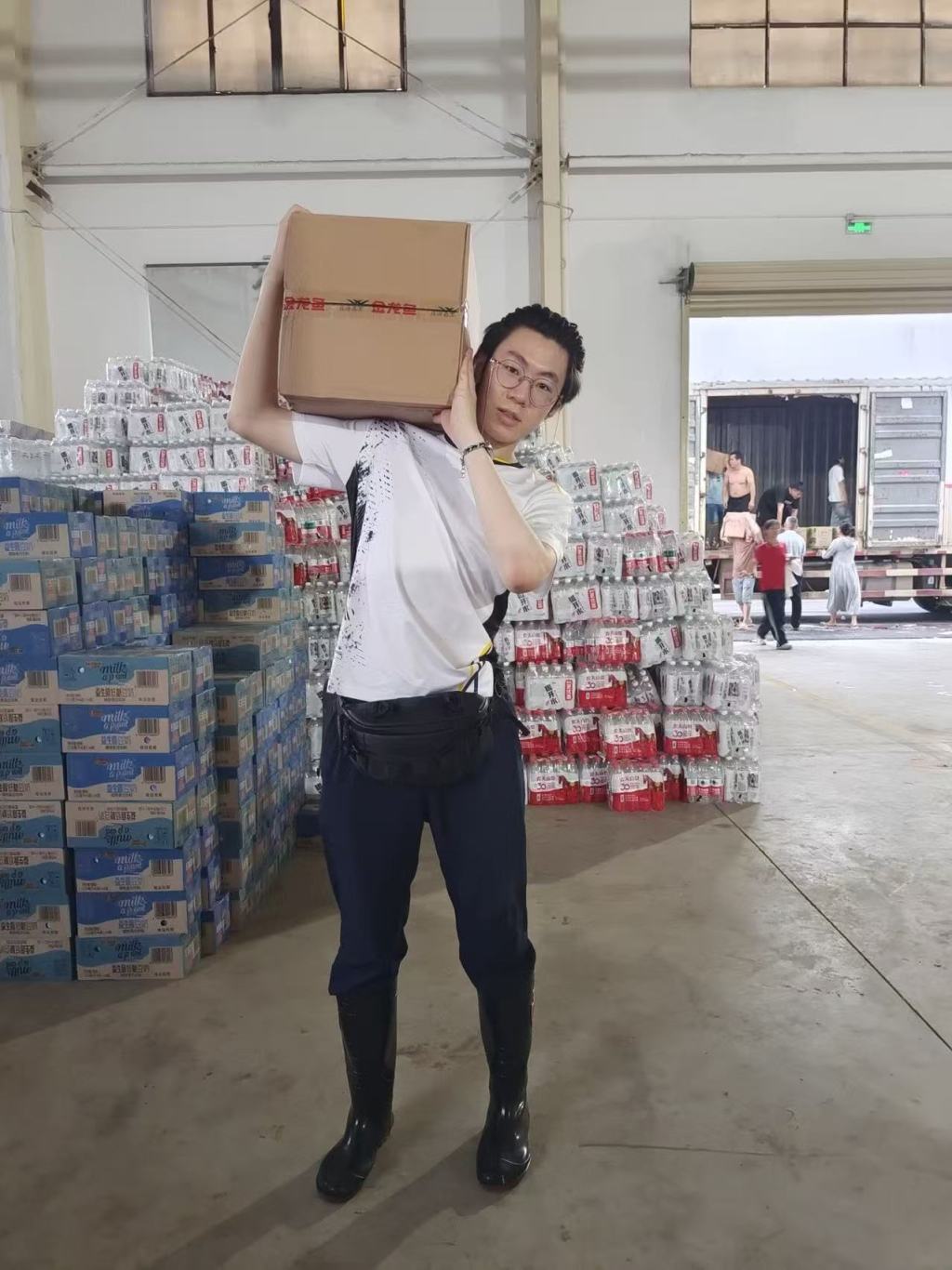
Wu Yulun carrying heavy cargo on his shoulder
Supplies poured in by the ton — drinking water, eight-treasure porridge, disinfectant, clothes, generators… After hauling for a while, shoulders ached and backs hurt, hunger and fatigue set in, and the crowd would chant in unison, "Hengzhou, keep going! Hengzhou, keep going!"
"This scene left a deep impression on Wu Yulun. As a child raised in the city, his daily chores were nothing more than making the bed, washing dishes, and taking his turn on duty; he had little real feel for the textbook line 'labor creates value.' Now, when he finished unloading a truck and ate boxed meals with fellow villagers, sweat streaming down their faces, watching an empty warehouse fill with tons of supplies within hours, it felt entirely different. 'This can't be compared with getting a phone from your parents after the gaokao or visiting some scenic spot — it's the self-fulfillment that labor brings.'"
"This sense of fulfillment outweighed the toil. The unloading happened inside warehouses, hot and humid, with few fans. 'Back in Shanghai I'd never go out in weather like this,' Wu Yulun said. Xin Ziyu added, 'But while working you're sweating, drenched head to toe, and you don't think about any of that at all.' When it got unbearably hot, they'd walk to the window, and a gust of wind would feel wonderfully refreshing."
People from All Corners Working Together
The hauling teams mixed young and old, men and women, with many whole families joining in. For three days running, Xin Ziyu kept running into a local older sister who worked the fields by day and came to move supplies by night, with her two children also in the line. She taught him to spread his feet and squat when lifting and setting down goods, saving a lot of effort. Over a few days, he picked up quite a few work tricks and also learned the importance of drinking water and resting in time.