business
In Shanghai, WAIC 2026 Witnesses How AI Is Changing the Future
In the height of summer, waves of intelligence surge along the banks of the Huangpu River. A global gathering is about to open here.
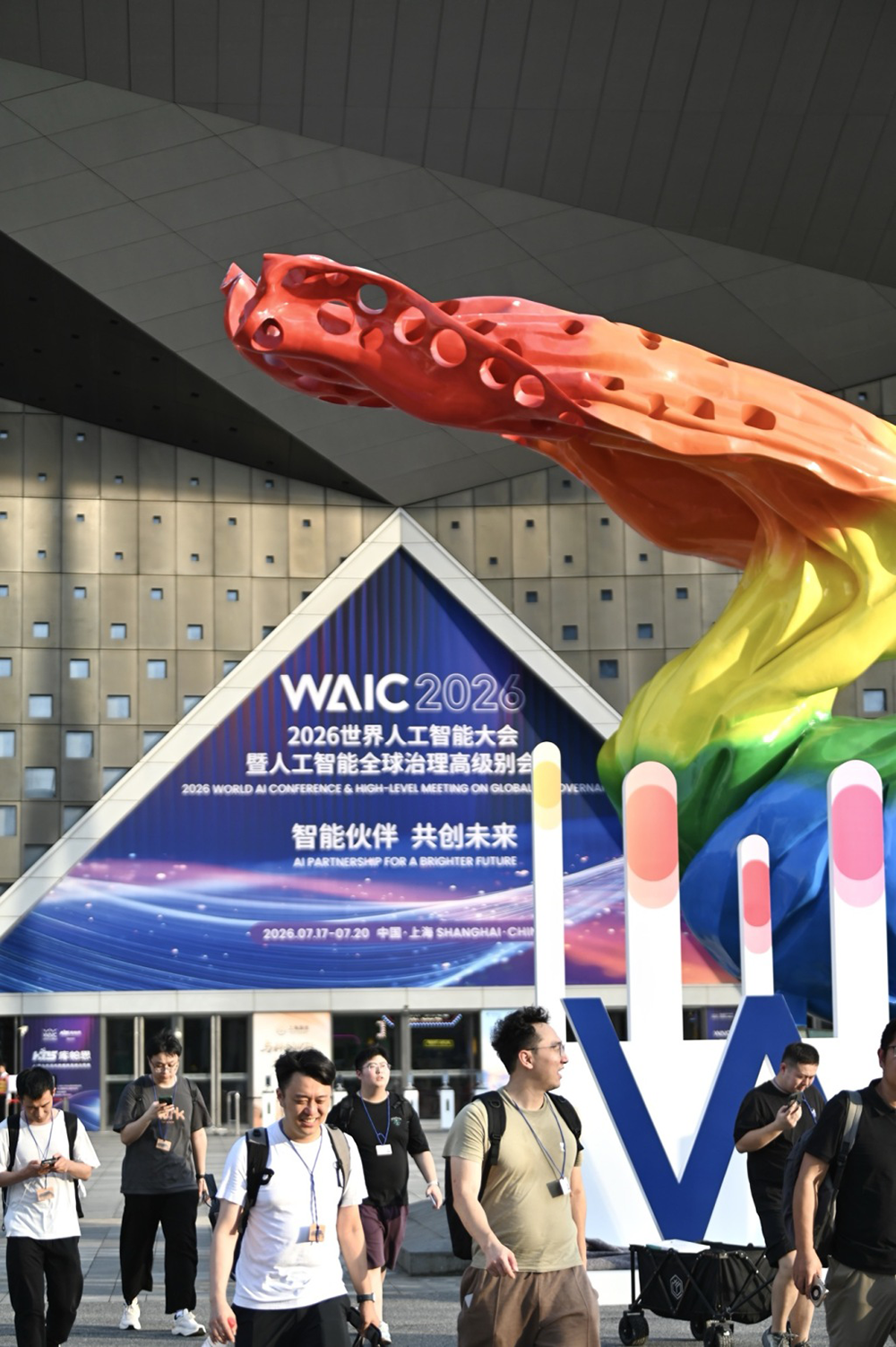
The 2026 World Artificial Intelligence Conference (WAIC) and the High-Level Meeting on Global AI Governance will be held in Shanghai from July 17 to 20. President Xi Jinping will attend the opening ceremony and deliver a keynote address, comprehensively and systematically expounding China's policy positions and philosophy on the development and governance of artificial intelligence. China has extended broad invitations to government officials from various countries, figures from industry, academia and research, and heads of international organizations to join the event.
"Intelligent partners, creating the future together." After eight years of iteration and upgrading, this edition of WAIC will serve as the best window for observing the global intelligence revolution, showcasing China's AI development practices, and putting the principle of "technology for good" into practice.
AI Opens a New Era for Humanity
Every leap forward in human civilization has required the guidance of a disruptive technological revolution. The birth of artificial intelligence has shifted the underlying logic of civilization's development from being driven by human labor alone to a new stage of human-machine collaborative governance — a watershed transformation dividing the course of human development.
"Whoever seizes the opportunities of big data, artificial intelligence and other new economic developments grasps the pulse of the times." Compared with how the steam engine transformed production, electricity reshaped daily life, and the internet connected communication, artificial intelligence achieves a comprehensive reconstruction of production, cognition and global governance systems — a historic force rewriting the trajectory of human civilization.
In recent years, various domestic deep large models have achieved successive technological breakthroughs. Driven by fundamental theory, computing-power infrastructure and social demand, they have been implemented at an accelerating pace, becoming the core engine of a new round of technological revolution and industrial transformation.
From the perspective of productivity, AI has achieved the large-scale liberation of mental labor, taking on high-load cognitive tasks such as massive screening, complex modeling and repetitive computation, and reshaping the production logic of entire industrial chains. In industry, Shanghai's Baowu has used AI to optimize smelting processes, cutting energy consumption per ton of steel by 15% and saving over 1.2 billion yuan in annual production costs, while humanoid robots deployed on precision assembly lines keep pushing manufacturing defect rates lower. In frontier research, AlphaFold has cracked protein structures and AI has simulated the plasma motion of nuclear fusion — problems that once took top teams years to tackle can now be reasoned through and verified in a matter of days, continually expanding the boundaries of basic scientific exploration.
From the perspective of cognitive civilization, artificial intelligence has sparked humanity's fifth cognitive revolution, reshaping the systems of knowledge production and inclusive dissemination. AI breaks down interdisciplinary knowledge barriers, enabling autonomous knowledge generation, universal sharing and access for all. At the same time, AI has become an "extended brain" for human cognition, making up for the limits of individual understanding: countless complex cognitive tasks that a single person could hardly complete become reality through human-machine collaboration, fundamentally changing the way humans understand and transform the world.
From the perspective of global governance, artificial intelligence brings an entirely new proposition in which opportunity and risk coexist, compelling the world to build a new order of collaborative governance. Challenges such as algorithmic bias, data leaks, transformation of employment structures and human-machine ethical conflicts have become challenges for all of humanity. Around this single frontier technology, humanity needs to build an inclusive, unified and coordinated framework for global governance.
Looking back across the long cycle of tens of thousands of years of civilization, artificial intelligence is by no means merely a single new technology or a new field, but a transformative force reshaping the trajectory of civilization's development.
It is against this magnificent historical backdrop that the world looks to WAIC 2026 as an opportunity to build a platform for all parties to enhance mutual trust, forge consensus and deepen cooperation, jointly advancing the healthy, safe and orderly development of artificial intelligence and making this conference a milestone in the history of AI development.
China's AI: From Follower to Partial Front-Runner
On April 29, 2025, General Secretary Xi Jinping visited the "Model Speed Space" large-model innovation ecosystem community in Shanghai for an inspection. "Artificial intelligence is a young cause, and also a cause for the young" — his remarks pointed the way for the high-quality development of the AI industry, marking a key chapter in the history of Shanghai's AI development.
Facing the wave of the intelligence revolution sweeping the globe, China has seized the opportunity of the times with long-term strategic vision. Over the past decade, the domestic AI industry has completed the full development path of tracking and learning, partial breakthroughs and ecosystem leadership. Relying on a super-large market, a complete industrial system and the new type of nationwide system, it has forged a distinctively Chinese path of AI development and joined the core ranks of global intelligent innovation.
Top-level design and systematic planning have built a full-chain matrix of AI development policies. In 2017, the "New Generation Artificial Intelligence Development Plan" was issued, formally elevating AI to a national strategy and laying out a three-step blueprint for technology, industry and governance. In 2024, "AI Plus" was written into the Government Work Report, driving the deep empowerment of the real economy by intelligent technology; in 2025, supporting implementation guidelines took effect, connecting policy support across research, transformation and livelihood applications.
Unlike some countries that simply pursue an algorithm race, China has always adhered to "placing equal emphasis on research and application, and advancing innovation and governance in step." On one hand, it tackles core technologies such as computing chips, foundation large models and underlying architectures to break through bottlenecks in key fields; on the other, drawing on vast real-world industries, urban governance and livelihood scenarios, it pushes technology out of the laboratory, forming a virtuous industrial cycle of "research — deployment — iterative optimization."
China's industrial clusters lead the world in scale, and its complete industrial chain continues to be consolidated. Over the past decade, domestic AI-related enterprises have exceeded 4,500, and in 2025 the scale of the AI core industry surpassed 1.2 trillion yuan, covering the full chain of computing hardware, foundation large models, industry solutions, smart terminals and data services.
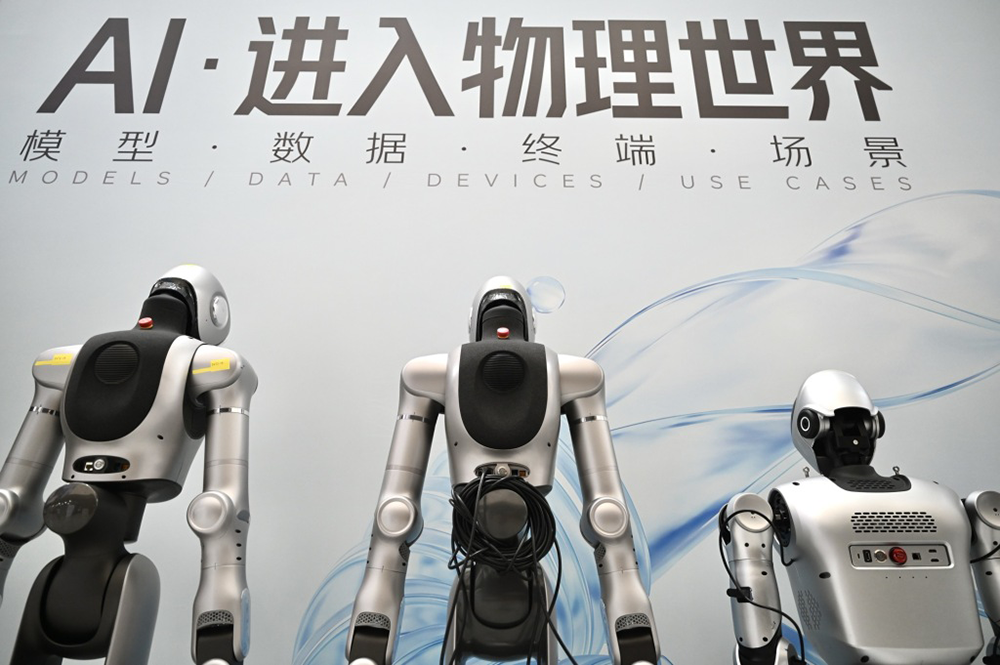
This year's conference will feature heavyweight exhibits including the industry's largest-scale Ascend 950 super node in real machine form, Shanghai Dongfang Suanxin's DF1000 — the world's first 3D near-memory computing chip — along with the MiniMax M3 multimodal large model and the StepFun Agent operating system, plus a concentrated display of humanoid robots and AI dexterous hands, marking a cluster of breakthroughs in domestic computing power and general-model technology.
Massive real-world deployment scenarios build a unique competitive advantage, forming a closed loop of mutual empowerment between demand and technology. China possesses the world's most complete range of industrial sectors, mega-city governance samples and broad urban-rural livelihood needs, providing AI with vast, differentiated real-world scenarios — a core competitiveness distinct from overseas: Shanghai has rolled out a citywide digital-twin system, with AI participating in traffic scheduling, community governance and emergency early warning; factories across the Yangtze River Delta have deployed industrial intelligent robots at scale; and thousands of hospitals nationwide have brought AI-assisted diagnosis online.
From following, to running alongside, to partially leading, the rise of China's AI industry is the inevitable result of overlapping advantages: the new type of nationwide system, a super-large market and sustained openness and innovation.
WAIC: Eight Years of Iteration, Carrying the Mission of the Times
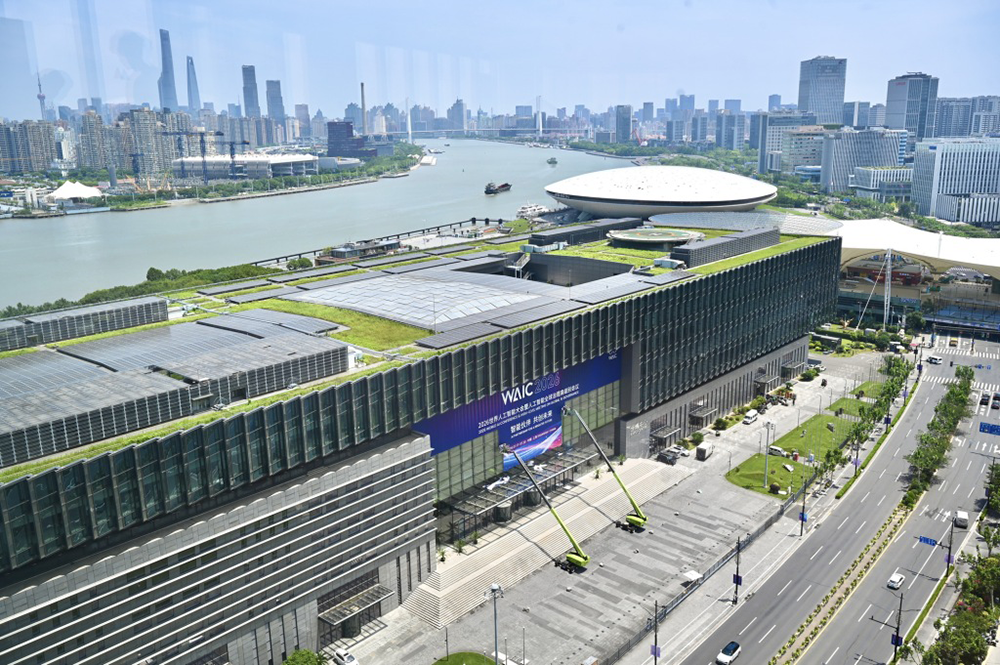
Since the first World Artificial Intelligence Conference was held in Shanghai in 2018, this international metropolis has hosted the world's top AI event for eight consecutive years. Through eight years of dedicated cultivation, the conference has evolved from an early-stage industry forum into a top-tier platform co-hosted by ten ministries and commissions together with the Shanghai Municipal Government, covering government, industry, academia and research worldwide; from a single small exhibition hall into a flagship event spanning "three districts and four venues," with 100,000 square meters of exhibition space and more than 300 global product debuts; and from a single technology showcase into a comprehensive platform integrating academic discussion, industrial matchmaking, global governance, talent incubation and public experience.
(This is an abridged English translation of the first portion of the original commentary. "Jingweidu" is an economic-commentary IP created by The Paper.)