business
Instant Commentary: A Photograph 'Fake at a Glance' Wins First Prize — More Than Mere Carelessness
Recently, some netizens reported that among the list of winners for the third round of Hohhot's "Citizen Photography Bimonthly Contest," the garment worn by a sanitation worker in the first-prize winning photograph contained garbled, nonsensical text, raising suspicions that the image had been "generated by AI." After the controversy spread, the related post has since been deleted.
On July 14, the Hohhot Federation of Literary and Art Circles issued a notice stating that it had launched an investigation immediately, and verification confirmed that the work was indeed AI-generated rather than an original photograph taken from real life. This officially confirmed netizens' suspicions: the entry was simply padding the field with a fake.
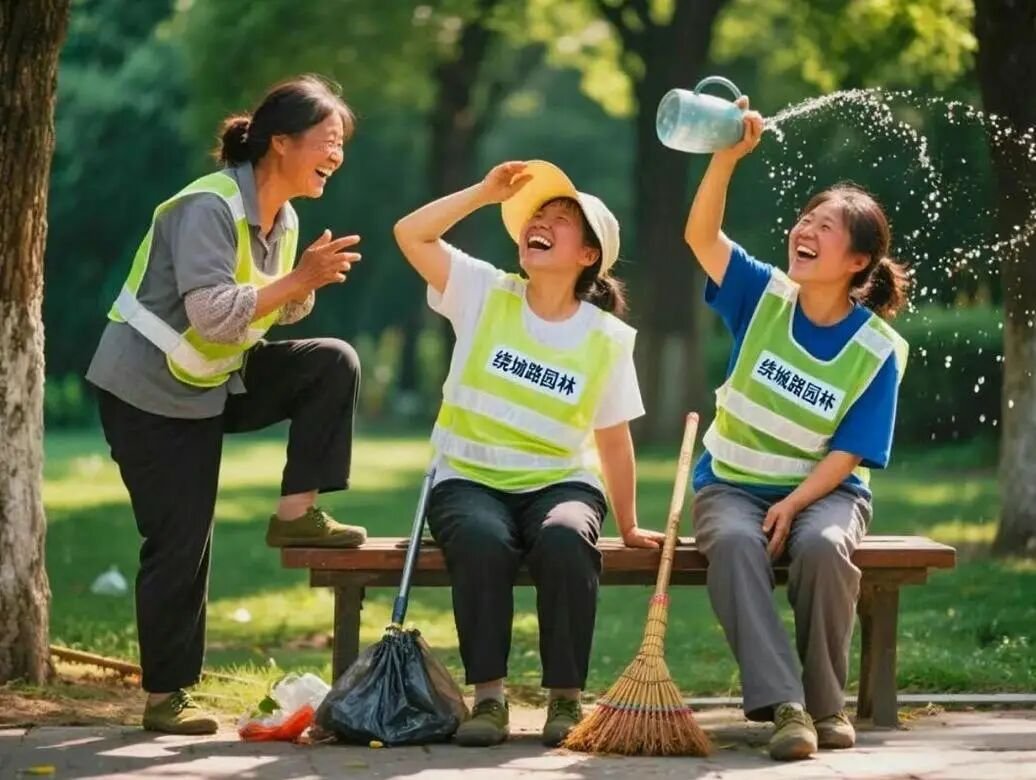
The disqualified winning work, "Salle Garden" (洒乐园林).
Even so, the award remains incredible, because the original work is the very definition of "fake at a glance." Not only do the garbled characters on the clothing represent a textbook AI artifact, but the unnatural lighting and depth-of-field effects, together with the near-identical facial expressions and portraits, crank the "AI smell" up to the maximum.
Yet this is the work that, in a contest "hosted by the Hohhot Federation of Literary and Art Circles and organized by the Hohhot Photographers Association," slipped through layer after layer of review to take first prize — something that comes as a great surprise. It even makes one wonder whether the contest had any review at all, especially since a staff member, pressed by reporters, frankly admitted it was "too fake." If the judges had taken even a cursory look during the evaluation, could a work so flimsy that calling it "passing off fish eyes for pearls" would be generous have really slipped through the net?
In fact, discussions about AI disrupting industries such as photography and painting have been quite heated in recent years, with many worrying that the fields are once again about to be "overturned" by technology. But objectively speaking, rather than marveling at how advanced the technology is, it is better to say that the gatekeeping was too crude and the attitude too lax.
For example, this past January, a photography contest held by a hotel brand — whose panel of judges even included vice presidents of various associations and other luminaries — saw a suspected AI work take first prize, only to be withdrawn after netizens called it out. Moreover, at the end of last year, the first-prize work "Autumn Mist over the Lake" (《湖秋雾影》) from a photography contest hosted by a provincial tourism development group was questioned by netizens as AI-generated, similarly sparking heated debate.
Judging from the details of these incidents, all of these AI works are the kind where the problems become obvious the moment you look closely. Yet it is precisely these flaws that sail through with a green light, advancing from the preliminary round to the final review and nearly clutching the heavy trophy and certificate.
This also raises the suspicion that it is more than mere carelessness; it is more likely a manifestation of certain photography and other social awards having long "fenced off their own little garden." In fact, even in the pre-AI era, people were no strangers to similar phenomena: works that clearly defy common sense and popular aesthetics are singled out with suspicious precision, prompting accusations of "favoritism awards" and even vested-interest kickbacks.
Against this backdrop, the very act of "judging" in some award contests easily becomes a mere formality, with all parties adopting an attitude of "don't take it too seriously." And AI happens to lay this problem bare more starkly than ever — after all, whether a work is "good or not" is relatively subjective, and some works can still muddle through; but whether it is "fake or not" cannot be hidden. AI has precisely amplified certain unhealthy trends, exposing slack and sloppy review processes for what they are, and causing some formerly niche award contests to repeatedly trigger public opinion storms and top the trending searches.
This incident may also serve as a reminder: on the one hand, all kinds of award contests will likely have to "look carefully" from now on, and could even consider introducing AI detection to "fight magic with magic," establishing a truly binding mechanism for technical identification and accountability tracing. Yet the more fundamental remedy likely lies in correcting attitudes — abandoning the ingrained ills of favoritism-based and "self-amusing" award judging, and improving the industry ecosystem and selection procedures of various social awards as a whole. To prevent "AI intrusions," the key lies in whether people take the works seriously in the first place.