business
Explainer: From Eastward Port Shifts to Reviving Abandoned Pipelines, How Gulf States Are Reducing Their Reliance on the Strait of Hormuz
From Saudi Arabia activating an east-west oil pipeline, to the UAE building new port facilities beyond the Strait of Hormuz, to Iraq reopening an oil pipeline running through Syria to the Mediterranean, Gulf states are placing growing emphasis on developing alternative routes for energy exports and cargo trade, as attacks and shipping disruptions have exposed the risks of depending on the Strait of Hormuz. According to people familiar with the matter, DP World is planning to build a new port and container terminal along the coast of Fujairah in the UAE. Once completed, the project would allow containers to enter and leave the UAE without passing through the Strait of Hormuz, after which they could be transported overland to Dubai, Abu Dhabi and other neighboring Gulf states. The move would significantly reshape the UAE's economic landscape. Carole Nakhle, CEO of Crystol Energy, noted that the UAE has made faster progress than many of its neighbors in developing alternative energy routes, with implications reaching far beyond energy security. "Once the UAE reduces its dependence on the Strait of Hormuz, it will gain greater bargaining power in any potential agreement with Iran, weakening Iran's influence in the region." Analysts say DP World's plan shows that the U.S.-Israel-Iran conflict is forcing governments and businesses in the Gulf to rethink their infrastructure and economic corridors. According to Xinhua, U.S. officials familiar with the matter disclosed on the 14th that Iraq and Syria will rebuild a long-abandoned oil pipeline to carry crude produced in northern Iraq's oil fields to a Syrian Mediterranean port, thereby bypassing the Strait of Hormuz.
The UAE Launches a Major Port Strategy Shift
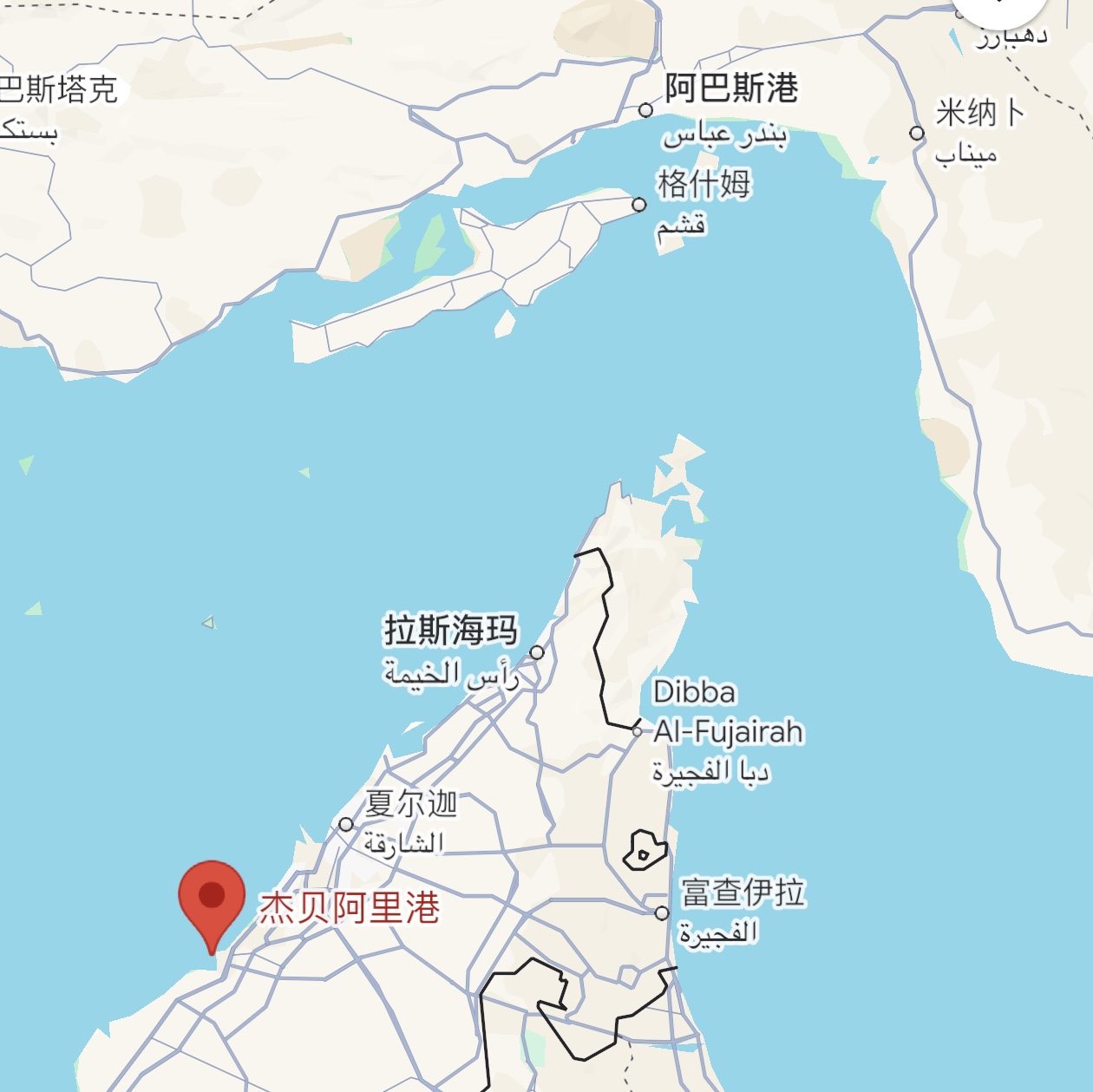
Fujairah, located on the UAE's east coast, is the country's best route for bypassing the Strait of Hormuz. Since the outbreak of the U.S.-Israel-Iran conflict, the UAE has been forced to rely on port facilities on its east coast, rerouting cargo originally bound for Jebel Ali Port to Fujairah Port and the nearby Khor Fakkan Port. However, both ports face severe congestion due to their limited throughput capacity.
According to the Financial Times, people familiar with the matter said DP World is currently discussing a term sheet with government officials, and the structure and financing plan for the new project have not yet been finalized. Sources revealed that DP World will initially invest hundreds of millions of dollars to develop the new facility. One company executive said the new port serves as "a defensive measure" and could be completed in as little as a year and a half. Meanwhile, Gulftainer, the operator of Khor Fakkan Port, announced a $2 billion investment plan earlier this month to expand the port's throughput capacity.
The new Fujairah port project is expected to reduce the UAE's reliance on Jebel Ali Port, and will inevitably have a major impact on Dubai. Jebel Ali is one of DP World's most important assets, handling 15.6 million twenty-foot containers last year, and is a key pillar of Dubai's status as a global logistics and re-export hub, trade center and financial center. But according to sources, the port's business volume has fallen by 90% to 95% amid the conflict's spillover and the closure of the Strait of Hormuz. To make matters worse, with the prolonged U.S.-Iran conflict, a recovery for Jebel Ali still appears far off. Before the conflict, about 135 vessels passed through the Strait of Hormuz daily, but since the U.S. and Iran signed a memorandum of understanding and the strait briefly reopened, daily traffic has been only slightly above 40 vessels. Over the past week, renewed mutual strikes between the U.S. and Iran have again sharply cut traffic through the strait. Lars Jensen, CEO of shipping consultancy Vespucci Maritime, said the impact on Jebel Ali is likely to be significant and permanent. As a result, ratings agency Moody's estimates that DP World's overall earnings will fall from $6.6 billion in 2025 to around $5.9 billion this year. Even so, Gulf officials say the eastward shift does not mean Jebel Ali will be completely replaced. As a trade hub in the Middle East, the port has been expanded and upgraded over decades into a complex of economic free zones, warehouses and industrial facilities.
Iraq Pushes to Rebuild an Oil Pipeline
Iraq, for its part, has set its sights on Syria. According to U.S. State Department officials familiar with the matter, on the 14th the United States is supporting Iraq and Syria in rebuilding a long-abandoned crude oil pipeline spanning the two countries. The Iraq-Syria pipeline was originally built in 1952, running about 800 kilometers from the Kirkuk oil-producing region in eastern Iraq to the Mediterranean port of Baniyas on the Syrian coast, with a transport capacity of 300,000 barrels per day. The pipeline was severely damaged during the 2003 Iraq War and has been abandoned for years since.
Iraq is one of the countries most severely affected by the closure of the Strait of Hormuz. Before the conflict, 95% of Iraq's oil exports were shipped out through the Strait of Hormuz, and 90% of government finances depended on oil revenue. During the U.S.-Israel-Iran conflict, Iraq was forced to export crude by tanker truck through Syria, but the volume was very small. Data from British energy analytics firm Vortexa showed that Iraq's seaborne oil exports in May this year plunged to just 8% of the same period last year. According to Middle East Eye, a UK-based outlet focused on the region, citing sources, the project was brokered by Tom Barrack, the U.S. ambassador to Turkey and special envoy for Syria and Iraq. Iraq, Syria and relevant U.S. companies have finalized a cooperation agreement to rebuild the pipeline, with a signing ceremony scheduled to be held later this week in Washington. However, officials familiar with the matter noted that the pipeline's power systems, pumping stations and storage tanks are badly damaged; the pipeline may need to be completely replaced, and the project could take two to three years.
What About Other Gulf States?
Saudi Arabia may be the country best prepared to cope with a Strait of Hormuz crisis. Saudi Arabia's east-west oil pipeline network stretches about 1,200 kilometers, connecting the Abqaiq oil field on the eastern Gulf coast with the Red Sea port of Yanbu. According to consultancy Lipow Oil Associates, Saudi Arabia can transport about 4 million barrels of crude per day through the pipeline, and expanded capacity is expected to reach 7 million barrels per day. However, Saudi Arabia's transport option is not perfect. Tankers loading at Yanbu and heading to other parts of Asia must pass through the Red Sea and the Bab el-Mandeb Strait, a region facing potential threats from Yemen's Houthi forces. U.S. broadcaster CNBC noted that Saudi Arabia's alternative merely shifts geopolitical risk to another region. Notably, relations between Saudi Arabia and the Houthis have grown tense recently.
The situation for other Gulf states is more severe. Kuwait and Qatar remain heavily reliant on the Strait of Hormuz, underscoring the limitations of existing alternatives. Andy Lipow, president of Lipow Oil Associates, said Gulf states still face a shortage of oil storage capacity. Once storage runs out, Saudi Arabia, Iraq and Kuwait could all be forced to cut production, worsening the current energy crisis. Adam Posen, president of the Peterson Institute for International Economics, said building sufficient alternatives will also take time. "To solve this kind of persistent problem, it will take another 18 to 24 months to establish various workarounds, including building different pipelines, finding alternative shipping methods and alternative resources."