business
From City to Village: Civilian Stories of the Rainstorm Across Northeast China
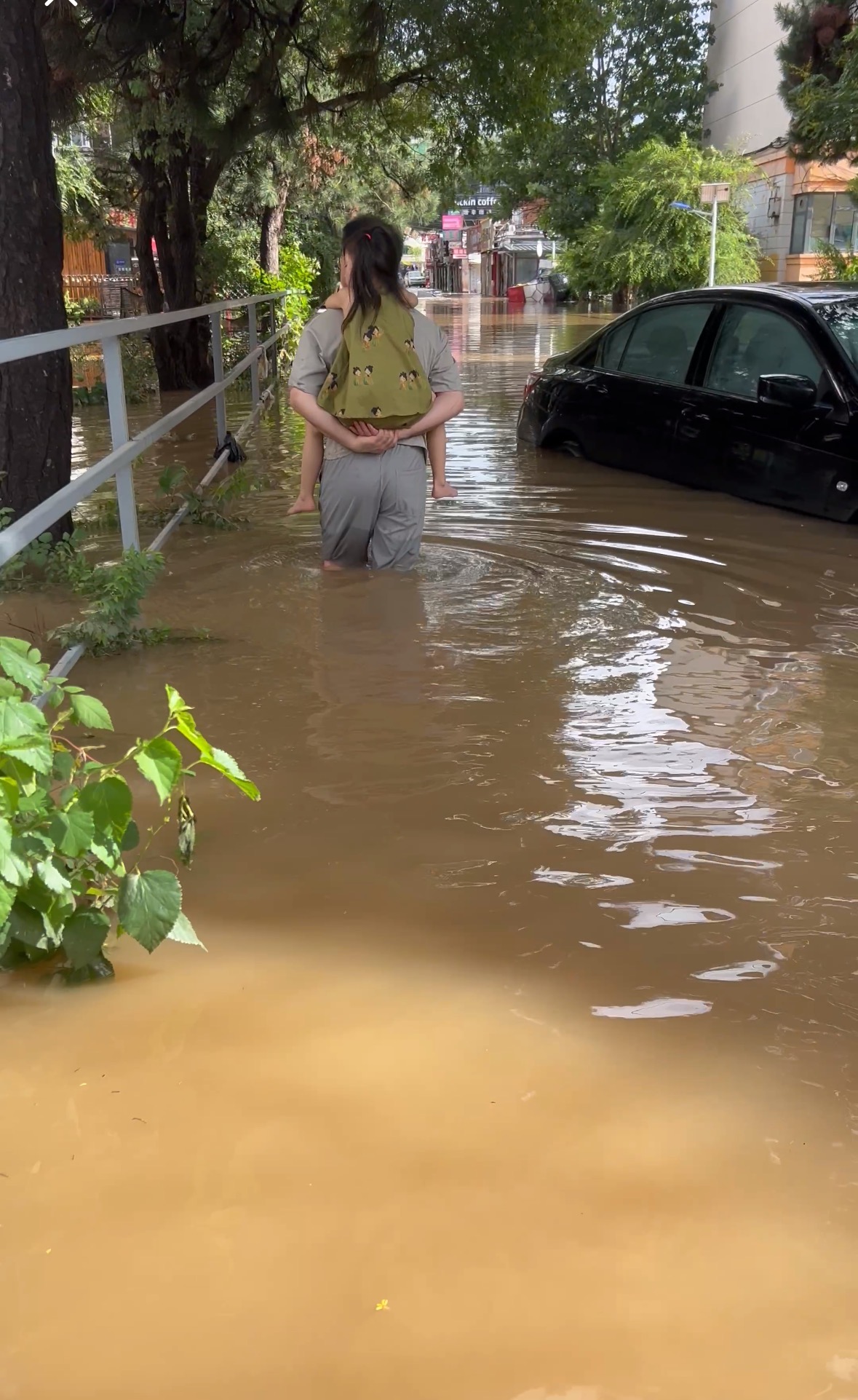
At noon on July 14, Huang Qing's husband carried their child out of the residential compound to find food. All photos in this article were provided by the interviewees.
After a brief lull the day before, the rainstorm launched its assault in the early hours of July 13.
At 6 a.m. on the 13th, Huang Qing, who lives on the first floor of the Hunhe Guoji Cheng compound in Shenyang's Sujiatun District, glanced into the yard—there was no visible standing water yet.
Two hours later, Huang pulled the curtain aside again and saw her Labrador floating in the water, paddling in panic—she had no idea how long it had been swimming. By then, the floodwater had risen above the cars' wheels.
After the rain stopped, standing at a sixth-floor neighbor's windowsill, Huang looked out at her familiar compound, roads, and trees submerged in water, with nearby high-rises looming out of the mud. The compound still had no water or power, but crews were already working on repairs.
Under the combined influence of moisture from the periphery of Typhoon Bavi, a Northeast cold vortex, and the subtropical high, many parts of Northeast China were hit by heavy rainfall, with localized extreme rainstorms. According to CCTV, as of July 15, flood control, drainage, and post-disaster operations were still underway across Liaoning, Jilin, and Heilongjiang.
When she was following the Guangxi rainstorm disaster in early July, Huang Qing could hardly imagine that she herself would soon experience such rare extreme weather—and that it would be caused by a typhoon that had made landfall a thousand miles away.
In fact, the 'surprises' brought by extreme weather have become the norm in recent years. On July 14, Chen Tao, chief forecaster at the National Meteorological Center, told the media that against the backdrop of global warming, weather extremes are intensifying, complexities are growing, and climate patterns are shifting, making monitoring and prediction harder. Extreme, sudden, high-impact weather events are becoming more frequent and repeatedly exceeding historical understanding and defense standards.
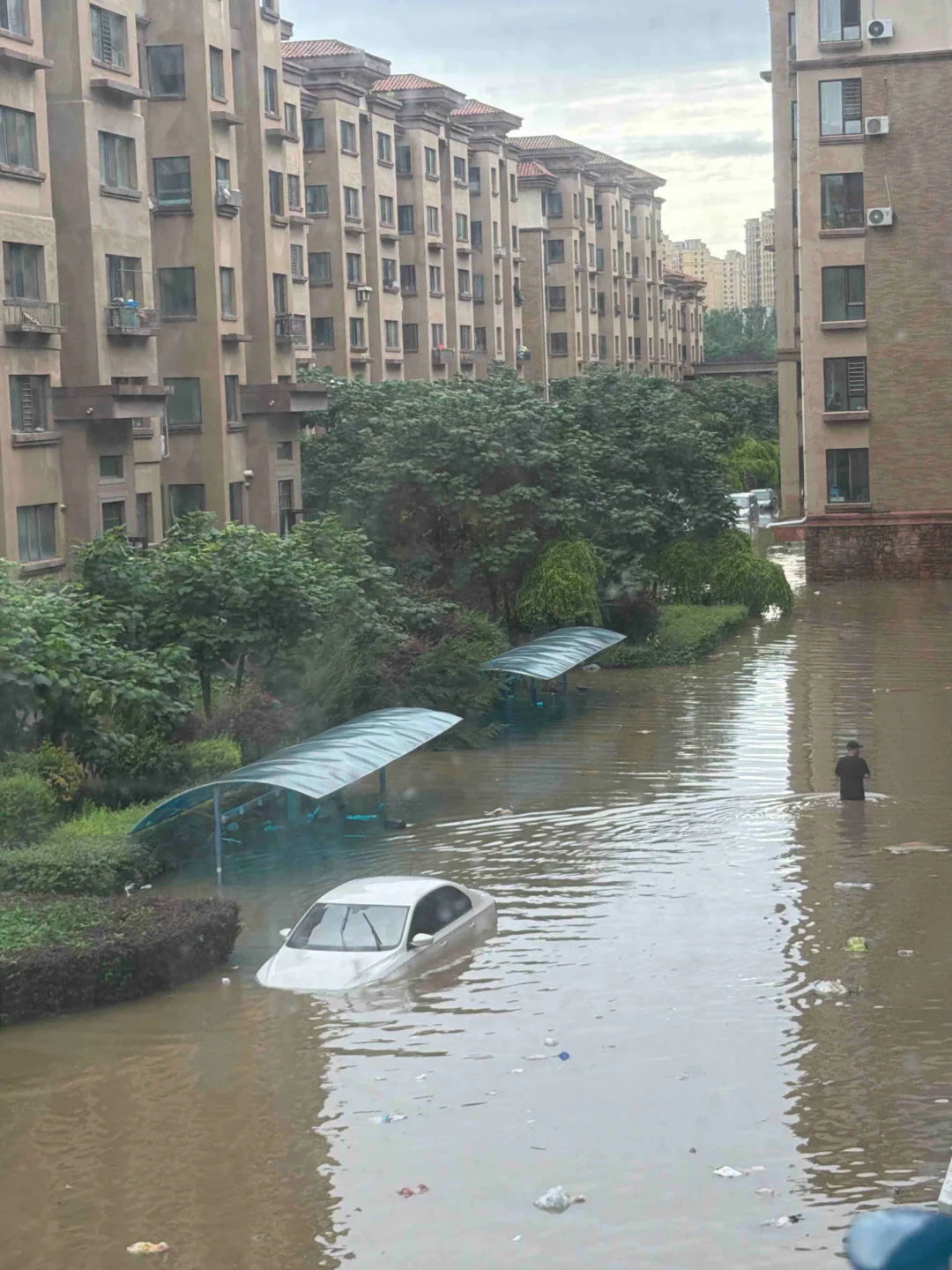
On July 14, severe flooding persisted in the compound where Huang Qing lives.
Urban Waterlogging
In Huang Qing's memory, the water rose all at once.
She recalled that the water came with terrifying speed, and that she never expected 'it could get so deep.' Her compound, Hunhe Guoji Cheng, sits in southern Shenyang, south of the Hun River, about 10 kilometers from it.
The Hun River, a tributary of the Liao River, flows through Qingyuan, Xinbin, Fushun, Shenyang, Liaozhong, Haicheng, and Tai'an, cutting through downtown Shenyang; it is also known as the city's 'mother river.' According to Xinhua, at 2 p.m. on July 13 the water level at the Shenyang hydrological station on the Hun River reached 37.99 meters, and under the national river-flood numbering standard this flood was designated 'Hun River No. 1 Flood of 2026.'
Huang Qing remembers that light rain had been falling on and off for over half a month beforehand. In the early hours of July 13 the rain grew heavy. At 6:21 that morning, the Sujiatun District meteorological station issued a red rainstorm warning, forecasting 100 to 150 millimeters of rainfall across all its subdistricts over the next six hours, with a high risk of flash floods.
At 8 a.m. on the 13th, Huang saw rainwater submerge the tires of parked cars. At 9:10, Shenyang's Flood Control and Drought Relief Headquarters issued a citywide red flood warning and raised the municipal emergency response to Level I.
By 10 a.m. that day, the water had risen at one point to Huang Qing's chest. She saw that the compound's vehicles were all submerged—'you couldn't see the road at all; it was water everywhere.'
In Liaoning, the provincial capital Shenyang was among the hardest-hit areas. In a Weibo post at 10:33 a.m. on July 14, the Shenyang Meteorological Bureau said that of the province's 15 heaviest-rainfall monitoring stations, 14 were in Shenyang. The Shenyang Daily reported that from the early hours of July 13 to daytime on the 14th, Shenyang endured its strongest rainstorm since 1951, with an overall urban rainstorm intensity rated at the 'extremely severe' level.
Downtown Shenyang suffered serious waterlogging. In a post, China Weather described streets so badly flooded that 'cars moved like boats.'
As the water rose, Huang Qing's tables, sofa, refrigerator, washing machine, and bed were all soaked. She said that with the power and water out, she worried that if the water kept rising she might not be able to get out. On the night of July 13, she and her family moved in with neighbors upstairs.
At noon on July 14 the rain stopped, but the water level did not drop noticeably. She said that by afternoon the flood still reached thigh-deep and the compound remained without water or power. At 4:10 that afternoon, the Shenyang Meteorological Service announced that rainfall in the Shenyang area had essentially ended.
'The house is now full of foul-smelling silt,' said Huang Qing. With no supplies stockpiled in advance, she had gone a whole day without eating; that afternoon, after the rain stopped, she and her husband waded through the murky floodwater with their child to look for food.
Because of the storm, 22-year-old Peng You was trapped at home in a compound near Shenyang Agricultural University. At 11 a.m. on July 13, Peng saw that the community's walkways were completely submerged, and someone in the owners' group chat shared video of water reaching their windowsill—about 1.4 meters deep. In a first-floor neighbor's home, the washing machine and refrigerator had been knocked over by the water, which reached the bed; many residents couldn't sleep all night.
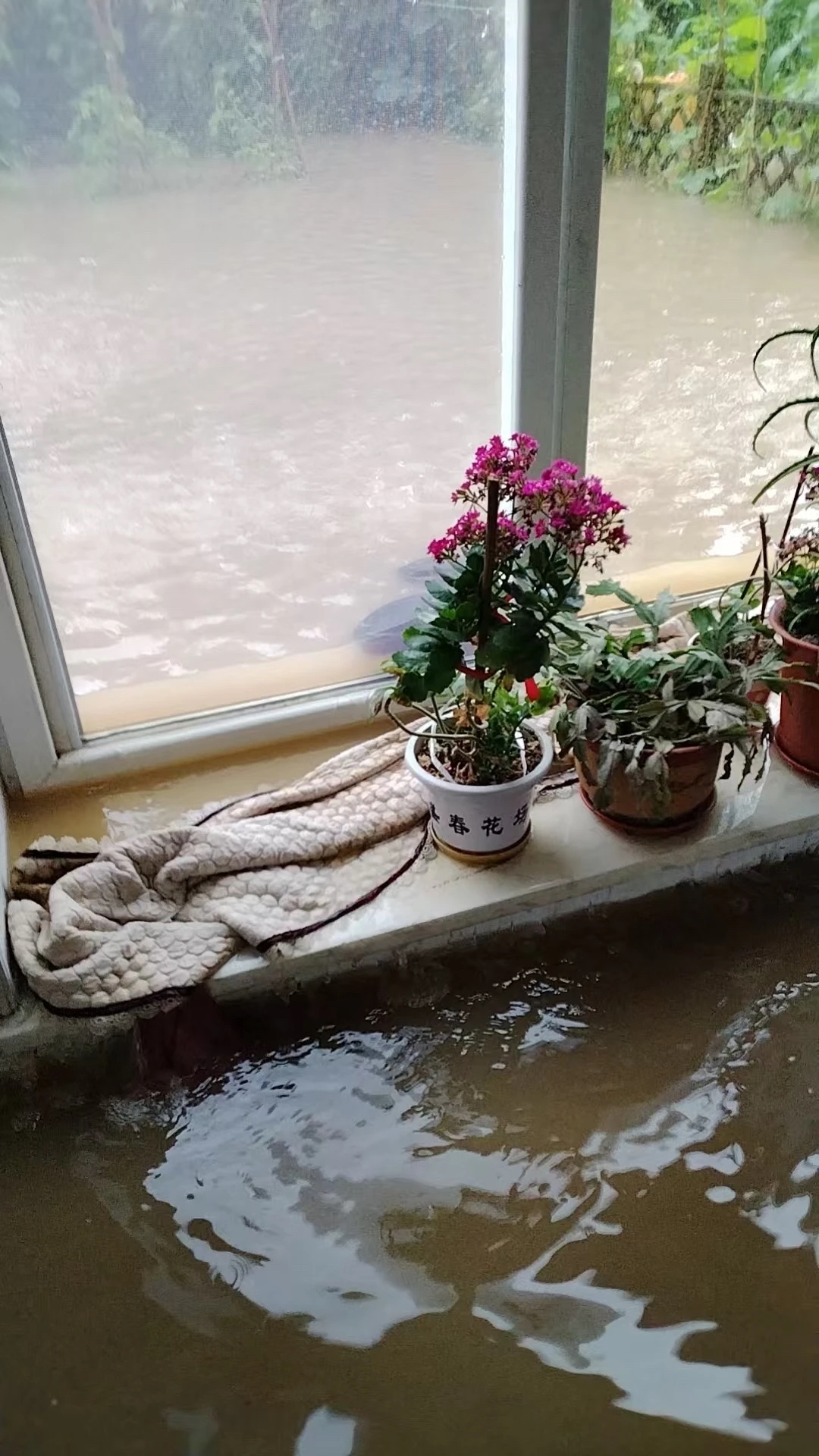
On July 13, the flooded home of Peng You's first-floor neighbor.
'Basically every vehicle parked downstairs in the compound was flooded,' Peng You told The Paper. Her own car and an e-bike were also underwater. At its peak, 'you couldn't see the car roofs at all.' She recalled seeing adult men wading through chest-deep water, and others swimming out.
Peng You said her compound is an old one, 20 or 30 years old, with no elevator. Most residents are elderly. Nearby there had once been a village; after it was demolished, most of its older residents moved into this comparatively cheap compound.
The compound lies north of the Hun River, about one kilometer from it in a straight line, and is near the Xinkai River, a Hun tributary. 'There's also a reservoir nearby, and the compound sits low, so the waterlogging was pretty severe.'
Peng You said this was the first time she had seen rain last so long. She recalled the downpour began in the early hours of the 13th and did not stop until daytime on the 14th. She remembered that the weather used to be dry, sometimes without rain for a month. This time it rained for roughly ten days, but earlier it was only light or moderate, with pauses; the 13th and 14th brought the torrential rain. Before that, she had thought this was just an ordinary storm.
After the rain stopped, Peng You still did not go out—'they say there are bacteria in the water.' She saw that the community's floodwater was yellow and turbid, 'very foul-smelling.' On July 14, the Shenyang Meteorological Bureau reposted a Jiangsu media report warning that 'typhoons bring strong wind and heavy rain, and flood-covered roads mix with large numbers of pathogenic bacteria, hiding health risks.'
Peng You lives on the third floor, so she was less affected; after the rain stopped, a first-floor neighbor's home was still being pumped out. Despite the outage, she was glad she had charged three or four power banks in advance, and had some self-heating packs for hot water.
Unable to leave home, Peng You could only eat the instant noodles she had stockpiled. For several days she ate nothing but instant noodles and luosifen (river-snail rice noodles), while her parents had dried noodles and frozen wontons. If not for the storm, she had planned to go to Shenyang's Zhongjie district for the sushi that has recently become so popular.
Village Floods
Beyond the cities, the rainstorm also hit farmland in parts of the Northeast. On July 14, on social media, young people working in Liaoning's cities said their parents were in the countryside and they could not reach them.
Unlike Shenyang and other areas, Lingyuan, in western Liaoning bordering several counties and cities in Hebei, experienced the rainstorm earlier. Wang Rou, a villager in Sanshijiazi Township, Lingyuan, recalled that on July 10 'the rain just poured down as if heaven was dumping water.' It stopped on the 12th, but by the 15th the water level still had not gone down.
Wang Rou said her family was hit by rare cellar flooding, with water pooling more than a person's height deep in the cellar. Inside were everyday staples—millet, corn, glutinous millet, and potatoes. After last year's autumn corn harvest they sold some and kept the rest in the cellar for their own consumption.
On July 15, to rescue the grain, Wang Rou's 74-year-old mother climbed down into the cellar and brought out some of the millet. The waterlogged millet had to be rinsed many times before cooking. 'It came out tasteless, a bit bitter, with mud in it,' said Wang Rou. Her parents ate the water-soaked grain for two days …
— This is an abridged translation of the first portion of the original Chinese report. (本文为原文前半部分的节译。)