business
A Young Chinese Scholar's Reflections from the Fields Medal Ceremony: Learn from Wang Hong and Dare to Tackle Big Problems
On the morning of July 23, 2026, local time, the queue outside the Pennsylvania Convention Center in Philadelphia wrapped all the way around the venue. "I was a bit late getting in — the first winner was already being announced when I entered," Yang Bowen said in an exclusive interview with The Paper.
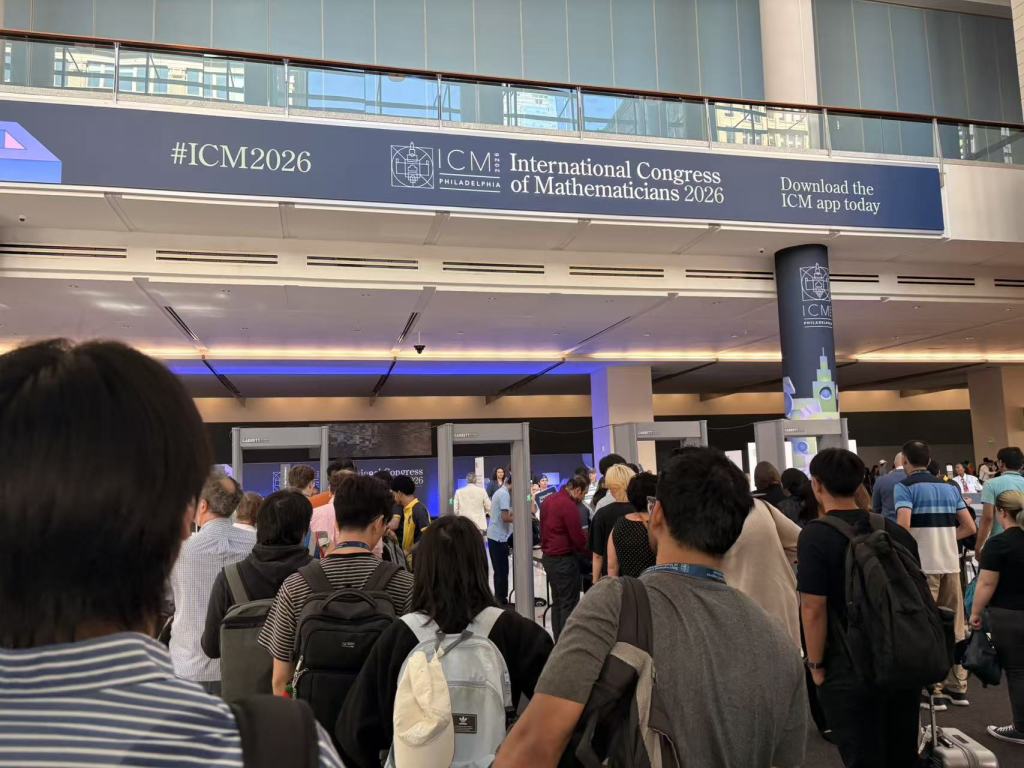
People queuing for security checks at the Pennsylvania Convention Center. Photo courtesy of the interviewee.
Yang Bowen is a postdoctoral researcher at the CMSA research center of Harvard University's Department of Mathematics. The "first winner" he referred to was Deng Yu — the first Chinese-national Fields Medalist to walk onto the award stage. On that day, Yang witnessed history at the opening ceremony of the 2026 International Congress of Mathematicians (ICM): Deng Yu and Wang Hong both received the medal, marking the first time mathematicians of Chinese nationality have won this prize.
"During the ceremony, Deng Yu was the first to go on stage," Yang said. "After receiving his medal, he sat in his seat for a long time, and I could clearly see he kept smiling — he was really happy."
What moved Yang most was a detail from the award presentation video: Wang Hong mentioned that she had learned about the notoriously difficult Kakeya conjecture from a blog, decided to first attempt a relatively simpler sub-case, and ultimately achieved a breakthrough. This led Yang to a realization: one should learn from Wang Hong and dare to step out of one's comfort zone to challenge big problems.
Witnessing a Historic Moment for Chinese Mathematics
Yang told The Paper that at almost 9 a.m. local time on July 23, he arrived at the Pennsylvania Convention Center, the venue of the ICM 2026 opening ceremony, where the security-check queue at the entrance stretched all the way around the building.
By the time Yang found his seat, the hall was packed and the atmosphere electric. The announcement of the first laureate had already begun — it was Deng Yu, a Chinese-national mathematician and professor of mathematics at the University of Chicago.
"Although I believe the people in the hall had already learned the results one way or another beforehand, everyone still chose to come in person, because we all very much wanted to witness this moment ourselves," Yang said, describing the enthusiastic atmosphere in the hall.
Yang explained that because the award proceedings were fairly long — an introduction video was played for each laureate, followed by the medal presentation and photos on stage — Deng Yu, as the first laureate to be honored, sat in his seat for quite a while after receiving his medal. "I could clearly see that Deng Yu kept smiling the whole time. He was truly delighted," Yang said.
Yang is no stranger to this young mathematician, who is nicknamed "Deng the Divine" (Deng Shen) by Chinese students. As a fellow young scholar passionate about mathematics, Yang had heard of Deng Yu's name as early as his undergraduate years.
"Deng Yu once placed in the top five of the Putnam Competition, the premier mathematics contest for undergraduates in North America. He is exceptionally strong," Yang said.
Yang also came to know Deng Yu better through Zhihu, a Chinese social platform. "Deng Yu used to be active on Zhihu, sharing his experience of pursuing a PhD at Princeton. I have always thought he was extraordinary — his career path seems to have been touching the ceiling at every step: he first studied at Peking University, then transferred to MIT for his undergraduate degree, went on to a PhD at Princeton, and later took a faculty position at the University of Chicago," Yang said, adding that everyone calls Deng Yu "Deng Shen," a title he truly deserves.
The Paper previously learned from Peking University that Deng Yu began his undergraduate studies at the university's School of Mathematical Sciences before transferring to MIT, where he earned a bachelor's degree in mathematics. He then received his PhD from Princeton University in 2015 under the supervision of Professor Alexandru D. Ionescu.
By comparison, Wang Hong — a Peking University alumna of the same class year as Deng Yu — was already well known before winning the medal.
Having solved the Kakeya conjecture, a major open problem, Wang Hong has been frequently invited to lecture around the world over the past year or so.
In 2025, when Yang attended an academic conference at Stanford University, he learned that Wang Hong happened to be giving a lecture there, and he made a point of attending. "Our fields are different, so I could only understand about 30 percent of it, but being so close to this legendary figure felt wonderful," Yang recalled.
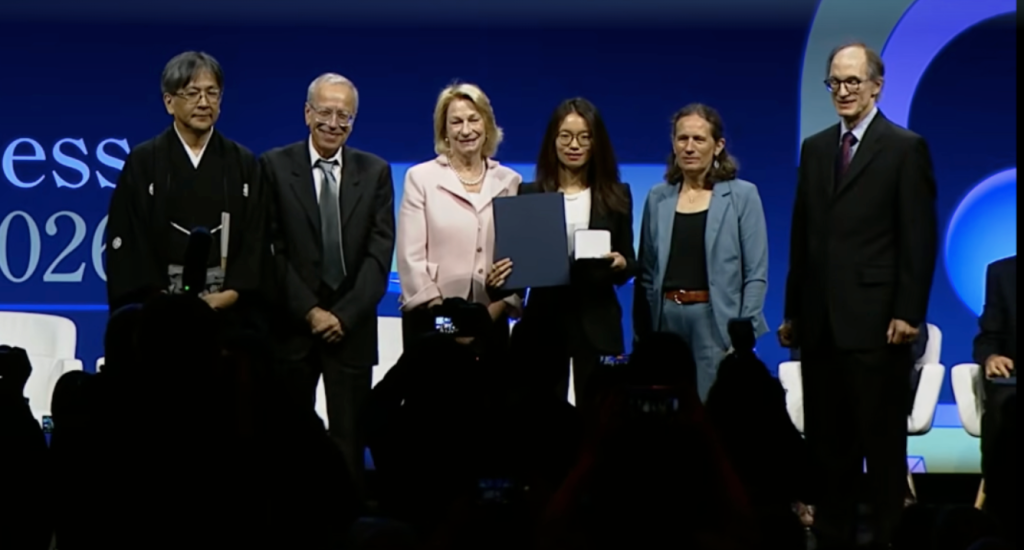
Wang Hong (fourth from left) at the Fields Medal ceremony. Source: Peking University's official WeChat account.
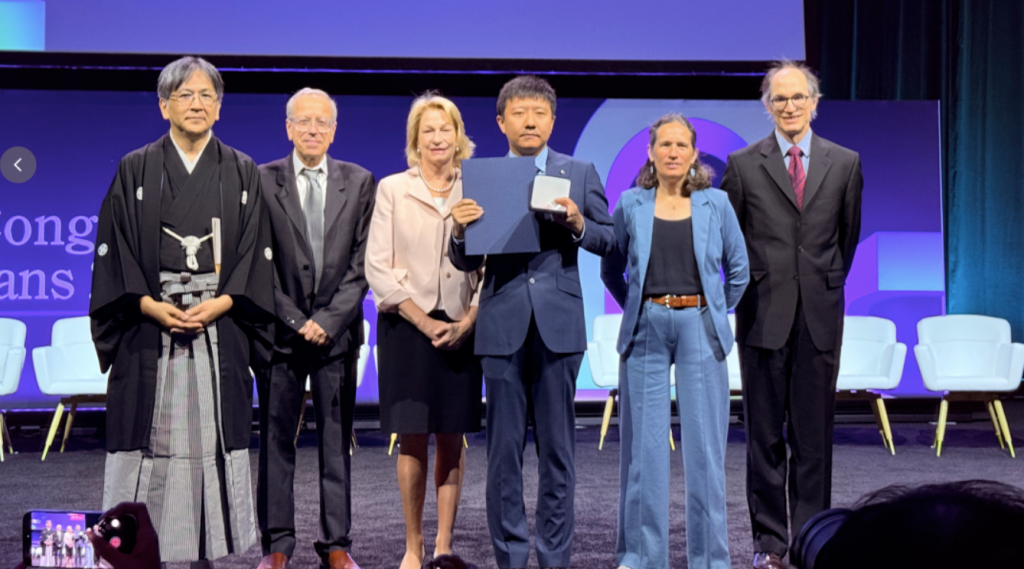
Deng Yu (fourth from left) at the Fields Medal ceremony. Source: Peking University's official WeChat account.
"This was the first time I watched the Fields Medal ceremony in person. When the prize was last awarded, I was still a PhD student," Yang said. As a young Chinese mathematician, he was thrilled to witness history and see two Chinese mathematicians win the award, feeling heartfelt joy for the Chinese mathematical community.
"Go After What You Love, and Don't Worry Too Much About Success or Failure in Advance"
Yet what impressed Yang most was not the spotlight moments of Deng Yu and Wang Hong on the award stage, but something Wang Hong said at the press conference that followed.
"At one point she felt mathematics was too hard and considered giving up — she even interned at an architecture firm for a while," Yang said. Wang Hong shared at the press conference that when she first entered university, mathematics suddenly became much more difficult and she thought about quitting. She took an internship at an architecture firm, but upon returning realized she still loved mathematics. So she set herself a deadline: "If I can make it work, I will continue; if not, I will go back."
"She advised everyone to go after what they love and not to worry excessively about success or failure in advance," Yang said. "Many people understand this principle, but it is very hard to put into practice."
Wang Hong's account in the award presentation video also left a deep impression on Yang. In the video, Wang Hong mentioned that she had learned about the Kakeya conjecture from a blog. "At the time she was probably at the same postdoctoral stage that I am at now, so she decided to first try a relatively simpler sub-case. Unexpectedly, after writing it up, she found her approach very promising, proactively reached out to experts in the field to collaborate, and ultimately achieved the breakthrough," Yang said.
"I really admire her initiative," Yang reflected. "Those of us in academia tend to keep digging within our familiar territory after graduation, but sometimes even if you solve all the small problems, you may never achieve a major breakthrough. Wang Hong dared to step out of her comfort zone and take on a world-famous big problem she had never touched before. Something like that fails with 99.9 percent probability, but she dared to try."
"She looks like a very quiet person, but she is full of energy inside," Yang said. "The deepest lesson Wang Hong gave me is this: first give yourself a chance to try — if it works out, wonderful; if not, that is okay too."
This has been an enormous inspiration for Yang. "Seeing Wang Hong's courage to challenge big problems during her postdoctoral stage, I have decided to go back and think hard about which big problems in my own field are worth a try," Yang said. "It will most likely fail, but that is fine. As Wang Hong said, first give yourself some time to try."
(Note: This is a partial translation of the original article. The full Chinese version is available at the source link.)