business
Rerouted Ambulance: Shenzhen Guangsheng Hospital Violated Dispatch Orders by Taking Patient to Its Own Facility, and Was Fined for Falsifying Medical Records
Believing that the hospital committed numerous failings in patient admission and clinical treatment, the patient's family member, Ms. Wu, has spent two years fighting for her rights.
In March 2024, after her mother suffered a fracture from a fall, Ms. Wu called 120 repeatedly, clearly asking to be taken to a nearby public hospital. The Shenzhen Emergency Medical Center also issued instructions to dispatch to a nearby public hospital. Yet in the end, Ms. Wu's mother was 'diverted' by an ambulance from Shenzhen Guangsheng Hospital — a private hospital — to the hospital's own facility.
After the surgery, the mother developed symptoms such as mental abnormalities, urinary and fecal incontinence, and inability to stand. Ms. Wu believes these are linked to the treatment provided by Shenzhen Guangsheng Hospital. Furthermore, Ms. Wu discovered that the hospital had engaged in violations including falsifying the medical records.
In response to Ms. Wu's complaints, the Shenzhen Municipal Health Commission had previously replied several times, stating it had imposed administrative penalties on Shenzhen Guangsheng Hospital and the relevant medical staff: Shenzhen Guangsheng Hospital was fined 50,000 yuan for failing to transport the patient to the designated medical institution in accordance with dispatch instructions; Dr. Liu was given a warning for failing to revise the Discharge Summary as required; Dr. Li was given a warning for violating regulations in writing the patient's anesthesia record; and Dr. Song, who altered the Surgical Informed Consent Form without the family's consent — constituting medical-record falsification — was fined 30,000 yuan and ordered to suspend practice for one month.
Ms. Wu said that because the medical records were altered — and these are crucial materials for medical appraisal — the failure to restore the records has left the relevant medical appraisal unconducted, stalling her rights defense. On this matter, in July this year The Paper repeatedly contacted Shenzhen Guangsheng Hospital but received no substantive response.
Wanted to go to a public hospital, but was taken to a private one
Ms. Wu lives in Fuhai Subdistrict, Bao'an District, Shenzhen. On the morning of March 17, 2024, her mother (then 78 years old) suffered a fracture from a fall and needed medical treatment. Ms. Wu then called 120 multiple times.
Ms. Wu said that at the time, she repeatedly stressed on the 120 call that she wanted her mother taken to either Shajing People's Hospital or Fuyong People's Hospital, both of which are only about four to five kilometers from her home. The 120 operator replied that they would dispatch an ambulance from Shenzhen Guangsheng Hospital as the nearest option, and that which hospital to deliver the patient to would be decided by the doctor on scene.
In the end, the ambulance took Ms. Wu's mother to Shenzhen Guangsheng Hospital. Public records show that Shenzhen Guangsheng Hospital, located in Fuhai Subdistrict, Bao'an District, began operations in 2006 and is a first-tier general hospital integrating prevention, medical care, and rehabilitation. The hospital is about four kilometers from Ms. Wu's home. Under the Hospital Grading Management Measures, a first-tier hospital is a grassroots hospital or health center that directly provides prevention, medical care, health, and rehabilitation services to a community of a certain population.
Ms. Wu complained about this issue. In April 2024, Shenzhen Guangsheng Hospital replied that at the scene and during the return trip with the patient, neither the paramedic doctor nor the nurse on the 120 ambulance heard the family request a specific hospital. The hospital said the patient had preexisting conditions, but they were stable, and the fracture from this fall could be treated there; if not, the patient would be transferred to a higher-level hospital.
Notably, the Shenzhen Emergency Medical Center's 120 call-handling record shows that at the time, the 120 ambulance was arranged to take Ms. Wu's mother to Fuyong People's Hospital. Yet the recording of Ms. Wu's call with the 120 operator shows that, regarding which hospital to dispatch, the operator said they would send the nearest and most urgent vehicle — Shenzhen Guangsheng Hospital's ambulance; on the matter of a designated hospital, the operator said it would be decided based on the patient's condition, that Ms. Wu could raise her request, but whether to honor it would be decided by the doctor on scene.
In December 2024, the Shenzhen Municipal Health Commission imposed a 50,000-yuan fine on Shenzhen Guangsheng Hospital for failing to transport the patient to the designated medical institution in accordance with dispatch instructions.
Hospital and medical staff penalized for record falsification, among other violations
On the day she was admitted, Shenzhen Guangsheng Hospital issued a Diagnosis Statement indicating Ms. Wu's mother's conditions as: comminuted intertrochanteric fracture of the left femur, Alzheimer's disease, and hypothyroidism. On the same day, Ms. Wu's mother underwent surgery at Shenzhen Guangsheng Hospital for an intertrochanteric fracture of the left femur.
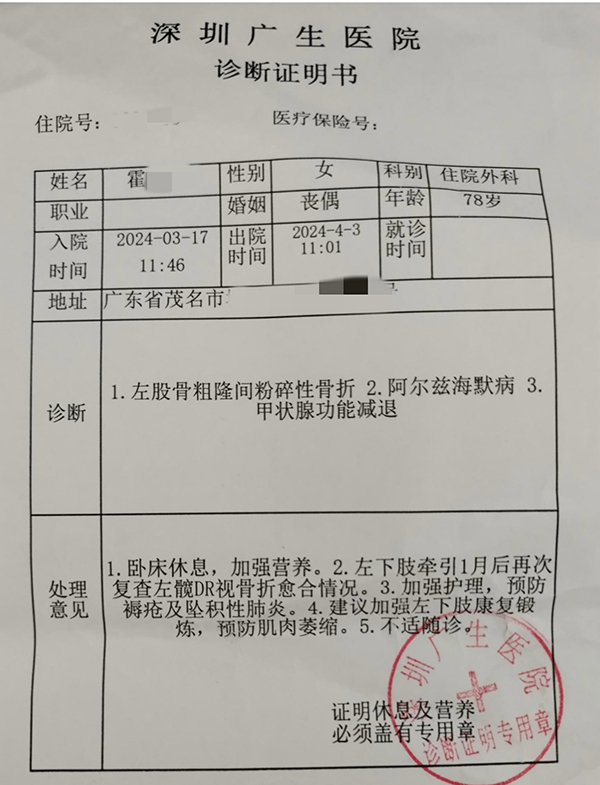
The diagnosis document of Ms. Wu's mother. (All images in this article courtesy of the interviewee.)
Ms. Wu said that after the surgery, her mother developed symptoms such as mental abnormalities, urinary and fecal incontinence, and inability to stand. The family believes these are related to the treatment at Shenzhen Guangsheng Hospital, and so they began their rights defense.
In June 2024, Ms. Wu and her sister reached an agreement with Shenzhen Guangsheng Hospital regarding the out-of-pocket portion of the medical bills, under which the hospital would reduce part of the fees and the family would no longer complain about costs. Ms. Wu said her mother's treatment cost about 22,000 yuan in total, of which the hospital later waived 5,000 yuan.
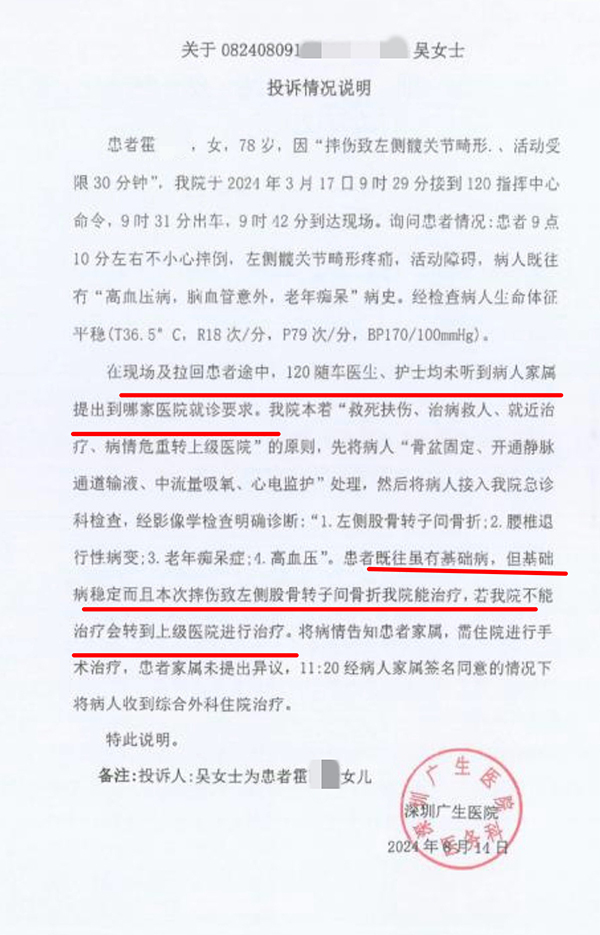
In 2024, Shenzhen Guangsheng Hospital's response to Ms. Wu's complaint.
Later, Ms. Wu discovered that her mother's Surgical Informed Consent Form and Discharge Summary did not match the versions she had originally signed and confirmed. She then complained to the Shenzhen Municipal Health Commission.
Ms. Wu said that in November 2024, she obtained a surgical consent form from Shenzhen Guangsheng Hospital that stated her mother 'had severe osteoporosis and cognitive and mental impairments, and would be unable to cooperate with treatment after surgery, possibly affecting fracture healing.' This did not match the actual situation: before the operation, her mother was in good physical condition, had no cognitive or mental impairments, and could communicate and cooperate with treatment normally.
On this matter, in May 2025 the Shenzhen Municipal Health Commission stated in a Handling Opinion that it was under investigation.
In December 2025, the Shenzhen Municipal Health Commission replied again, stating that Dr. Liu had been given a warning as an administrative penalty for failing to revise the Discharge Summary as required. As for Ms. Wu's report that the hospital used excessive drug doses, the Anesthesia Record failed to accurately document the use of propofol and its dosage, and the Shenzhen Health Commission has opened a case for handling.
In February 2026, the Shenzhen Municipal Health Commission stated in an Administrative Handling Document that Ms. Wu's side had reported that Shenzhen Guangsheng Hospital had fabricated and exaggerated the patient's condition, and that the medical records documenting a 'history of dementia' did not match reality, among other matters. After verifying the patient's inpatient records and combining this with interviews and investigations of relevant personnel, it found no violation of Paragraph 4 of Article 83 of the Shenzhen Special Economic Zone Medical Regulations.
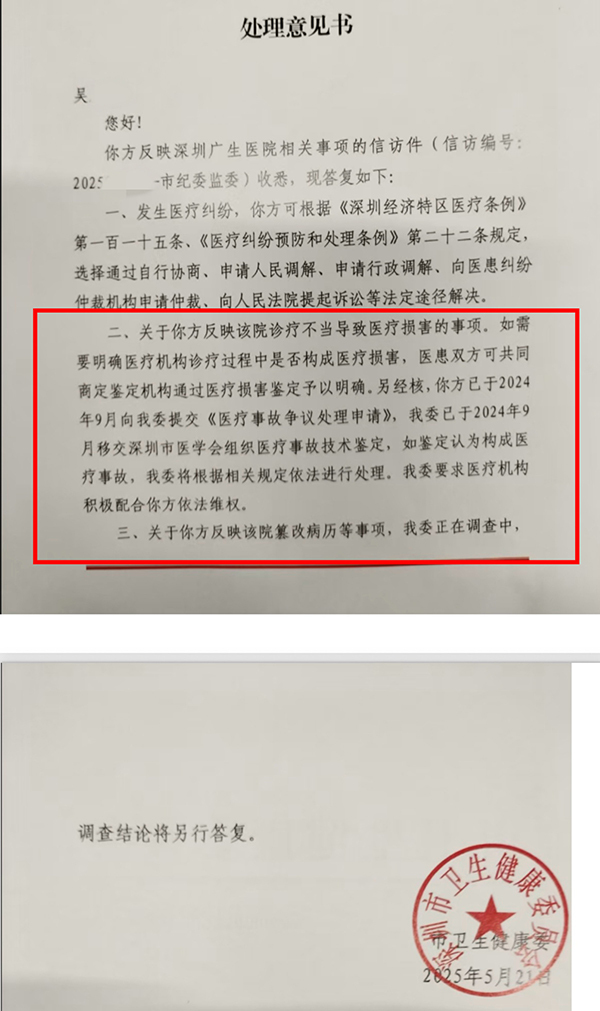
In May 2025, the reply issued by the Shenzhen Municipal Health Commission.