top-news
On the 'Sky Road': A Railway Attendant and His Watch Over Four High-Altitude Stations
On the afternoon of July 5, at the Shigatse railway station platform, under a blue sky with white clouds, the rumble of the tracks came rushing toward you.
An Haiping hardly had a moment's rest. In his standard railway uniform, wearing a work cap with sunglasses perched on his nose, he stood by to give directions and answer questions as passengers streamed off the train — some dragging suitcases, some cradling children, some clutching bouquets of flowers. As departure time neared, travelers would approach with phones in hand to ask about their journeys, and he answered each one.
Before the departure bell rang, he gripped his whistle and blew a warning, urging passengers still lingering on the platform to board quickly. Hats left behind by travelers were carefully collected by him, then, once the train had pulled away into the distance, taken back to the lost-and-found at the duty office.
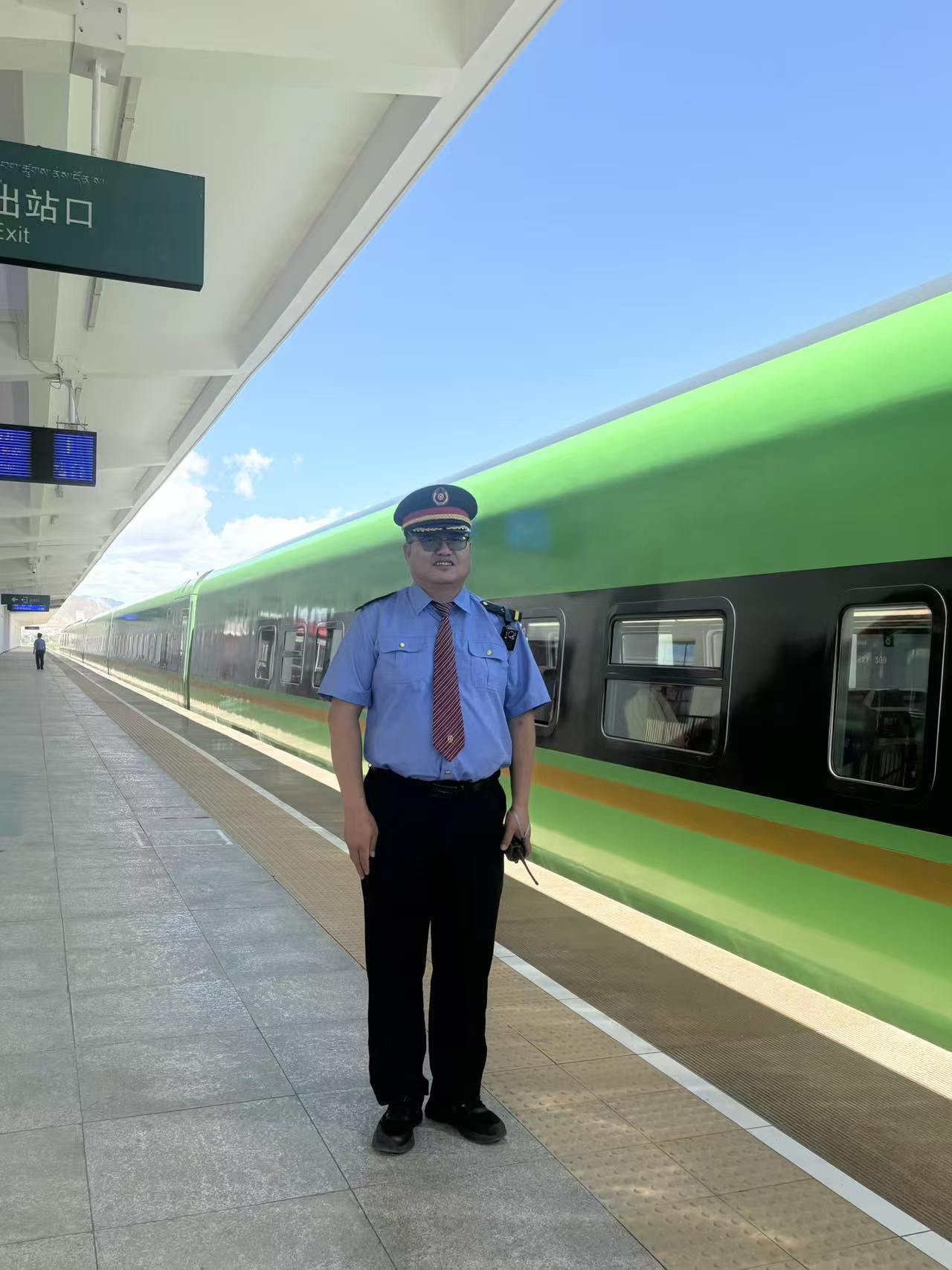
An Haiping is from Delingha, Qinghai, born in 1989, and has worked in railway passenger service on the Qinghai–Tibet Railway and its extensions for 13 years. The figures 3,568 m, 4,513 m, 4,702 m, and 3,850 m are the altitudes of the four stations he has guarded or is guarding.
An originally studied engineering. When he first entered the profession, he spent a year at the Golmud train operation depot. In 2014, when the Lhasa–Shigatse extension of the Qinghai–Tibet Railway began running regular-speed trains, he was transferred to Qushui station along the line, at an altitude of 3,568 m.
In 2016, shortly after he and his wife married, she visited him on the Lhasa–Shigatse line, staying with him at Qushui to celebrate the New Year for a week before they returned home together to meet relatives once he went on leave. The railway job requires him to work continuously for a month and rest for a month, so he and his family in Delingha live a two-place life.
But because Qushui station saw few passengers boarding or alighting, that year An was transferred to Nagqu station at an altitude of 4,513 m.
When he first arrived at Nagqu, the altitude rose sharply and An suffered intense altitude sickness, his lips turning purple. With seven trains passing through the passenger station each day, during breaks he would hug a 30-liter oxygen tank and breathe from it.
The schedule back then was grueling: he got up at 5 a.m. each day, and by the time he finished tidying up after work it was nearly 11 p.m.; lying down to sleep was often already past midnight, leaving him only four or five hours of rest a day. Once, struck by a severe cold, he ran a fever and his tonsils inflamed badly; medicine and IV drips barely helped. When he truly could not hold on, he had no choice but to take leave and return to the relatively lower-altitude Xining for treatment.
In 2018, the birth of his son became the softest tug on An Haiping's heart. Each time he had just grown close to the child at home, it would be time to set off for his post, and for a full month they would not see each other; the young child would always cry. He could only coax him: 'When Daddy comes back from leave, I'll take you on the train to play everywhere.' During the days separated by a thousand li, video calls became the family's only way of seeing one another. What he remembers vividly is taking the child, then just over two years old, on the train to Xining — the little one was too excited to sleep.
His wife hated to see An Haiping toil so, but An felt that, born into a rural family with modest means, and with his wife doing odd jobs outside the home, his income made up the bulk of the household, so 'for a better life ahead, I'll change posts only when I really can't keep going.' He said pay here is calculated by altitude: 3,500 m is one tier, 4,000 m another, and 4,500 m yet another.
On New Year's Day 2022, An was transferred to Amdo station as stationmaster. At 4,702 m, it was once the highest staffed railway station in the world, until the 4,721 m Yanshiping station officially opened at the end of 2025. At Amdo, An's altitude sickness grew more severe — 'I have to breathe oxygen whenever I'm not working,' he said, inhaling for a few minutes, stepping out for a turn, then coming back in to inhale again.
At Amdo station, a team of three staff members is on duty, with two such teams rotating. Of his own cohort, he was the stationmaster; the other two handled ticketing and daily passenger service — checking tickets, dispatching and seeing off trains. None of the three understood Tibetan; when Tibetan compatriots spoke Tibetan, they could only find a security inspector to interpret. Over the years, though, An picked up a few simple Tibetan phrases, such as those for showing an ID card or a ticket. Seeing Tibetan compatriots burdened with luggage, he would help them load it onto a cart and bring it onto the platform ahead of time.
Once, on a snowy day, an elderly Tibetan woman with limited mobility needed help, and he carried her belongings aboard the train. A few days later, the old woman came looking for him with some dried beef. Through the local security inspector's translation, An finally understood she was saying, 'The bespectacled chubby fellow who helped me with my things last time.'
Amdo is a small station; the waiting-room door stands open year-round, and cattle can even wander in through the entrance. Sometimes An is also responsible for shooing the cows back out. Five trains pass through here daily — three to Lhasa, two to Xining. As stationmaster, he starts his shift at 8:30 a.m. and knocks off at 5:20 p.m., keeping a close eye on equipment inspections and passenger safety.
Travelers come and go: local herders take the train to Lhasa to make pilgrimages or visit relatives; most heading to the interior are migrant workers. Nearby runs National Highway 109, and An can see truck drivers from Sichuan and Gansu, as well as tourists who make a special trip to get off and photograph the Tanggula Mountains landmark before boarding an afternoon train to Lhasa. Here, passengers suffering altitude sickness or sudden physical distress are seen almost every day. Many self-driving tourists, so oxygen-deprived upon passing through that they can hardly move, can only ship their vehicles to Golmud and continue their journey by train.
Summer is the peak passenger season; with students on summer break adding to tourist flows, trains from Xining are basically full. In winter, the snow season is long and clearing snow is daily work. From New Year's Day through the end of June and early July, wind and snow never cease — snow falls four or five times a day, and sometimes hail as well. In the bitter cold of minus twenty or thirty degrees, An layers thermal underwear, a vest, and a thick down jacket over his body. When shoveling snow, local herders and waiting passengers sometimes lend a hand of their own accord.
The temperature difference between inside and outside the station is great: indoors it is still warm, but stepping out the wind bites like a blade, and the swing between hot and cold makes catching a cold all too easy; An has to visit the local hospital from time to time, and when he can't hold on, he goes for an IV drip.
One July, his wife came to visit, but the local temperature was below 10°C and within just two days she was miserably stricken by altitude sickness; on leaving she said she would never come again.
Guarding this small station, An lives right in the office. At night he must open the door for signal workers and others, standing watch over the station around the clock, hardly ever leaving its side.