business
Outsourced Guardianship Gone Wrong: Children Sent to Closed “Special Training” Institutions
Three months after leaving the closed "special training" institution, Li Yu sometimes still feels as if she were still inside. She cannot help but keep up with related news.
She came across a report in which a 21-year-old man said that in May this year he was "abducted" from Bijie in Guizhou and taken to a "special training" institution in Yongchuan District, Chongqing, where he was held in lockdown for eight days. The man later learned that his parents, who thought he was "staying up late and playing with his phone," had signed an agreement with Chongqing Shangze Education Consulting Co., Ltd. (hereafter Shangze Education).
After the man disclosed his experience online, it drew attention. The Chongqing Huaxiu Secondary Vocational School (hereafter Huaxiu Vocational School) that he mentioned also left a deep impression on Li Yu; she left a comment under his personal social media account saying, "Thank you for bringing these institutions to light."
Huaxiu Vocational School is located at No. 20, Zhuhai Road, Yongchuan District, Chongqing. According to Tianyancha, a corporate registry database, besides Shangze Education, several other institutions have been registered at the same address as Huaxiu Vocational School, including Chongqing Shengxue Education Consulting Co., Ltd. (hereafter Shengxue Education) and Yongzheng (Chongqing) Education Consulting Co., Ltd. (hereafter Yongzheng Education). The "special training" institution where Li Yu stayed was Yongzheng Education.
These institutions are intricately intertwined. Their shareholders and legal representatives have cooperative relationships, and some share the same registered phone number and email. One of Yongzheng Education's key personnel is also a shareholder of Shengxue Education, and a key staff member of Shengxue Education serves as a liaison for Shangze Education. Moreover, the legal representative of Shengxue Education shares the same name as a former principal of Huaxiu Vocational School.
Through a promotional online post, The Paper reached a contact who claimed to be a teacher at Huaxiu Vocational School. The contact said the school offered a complete set of courses "designed for rebellious teenagers with internet addiction," and that children being treated for internet addiction could, after passing an assessment, transfer to Huaxiu Vocational School to study. A manager the contact referred the reporter to said that Shangze Education, Shengxue Education and others were agencies that handled external recruitment for the vocational school. On July 21, when the reporter disclosed their identity during the interview, the manager said that Shangze Education and similar institutions rented the premises of Huaxiu Vocational School, and that Huaxiu Vocational School did not provide "character education."
This summer, as multiple cases of adults or minors being forcibly sent to "special training" institutions came to light, such institutions—which claim to "cure internet addiction," "treat depression" and "correct behavior"—have once again sparked controversy. Recently, The Paper conducted extensive interviews in an attempt to untangle how the above-mentioned institutions' model, which appears to be deeply bound up with vocational schools, actually operates. We also interviewed students who had been through such institutions, parents who had tricked their children into them, and volunteers who have long followed the related abuses, hoping to understand why parents send their children into institutions that resemble "black boxes." Some parents have "outsourced" the guardianship of their "problem" children; the process is full of deception, disguise and regret, and the result is an even deeper rift.
Hidden within these stories are also the reasons why illegal "special training" institutions have kept emerging year after year.
"The deceived children"
In May last year, 16-year-old Li Yu was diagnosed with severe depression at a top-tier hospital in Chongqing. After that, she began avoiding school, and her absences grew increasingly frequent.
When she skipped school, Li Yu would often chat with another girl in her class who also suffered from depression, and they would go out together to play escape rooms. Their bond grew stronger, and they became close friends.
Li Yu's condition improved, and she later summoned the courage to return to school. Her teachers and classmates were kind to her, and she grew fond of them. She had once been an excellent student in her class, winning many awards; in the placement exam at the start of seventh grade, she was admitted into the best class.
But before long, she again lost interest in studying, and her grades became severely uneven. One day after returning home from school, she picked up her phone, opened WeChat, and discovered that her account had been logged into from another device. She guessed it was her mother, who would sometimes use Li Yu's fingerprint to unlock her phone while she was still asleep in the morning, and read through her WeChat messages.
Furious at the time and craving privacy, she went out again with her classmate and spent the night at her friend's home. That evening she had a wonderful time, and made plans with her parents for them to pick her up the next afternoon.
But after returning home, her mother forbade her from going out alone and from contacting her close friend. The next day, the homeroom teacher summoned both Li Yu and her mother to the school. The teacher sternly told her that if she wanted to return to a normal life, she had to cut ties with her depressed friend, lest the friend affect her studies. Li Yu could not make sense of it, and felt utterly helpless.
Afterward, the homeroom teacher took them to the office of the deputy head of the moral education department, where the vice principal was also present. They maintained that Li Yu's visit to her friend's home that day constituted running away from home, and considered the matter very serious. The vice principal explicitly told her that if she wanted to keep attending school, she had to sever contact with her friend, and asked her to give the school an answer within three days.
During that period Li Yu became even more confused; she still secretly kept in touch with her friend. When her parents found out, they would stop her. She became even more afraid to go to school, and felt that she had "that illness," which cost a lot of money to treat—and her parents kept saying the medication had side effects and did her no good. So she simply stopped taking it.
Around that time, Li Yu became interested in makeup and wanted to find a boarding school where she could study cosmetology—a way, too, to escape her living situation. Her parents agreed and picked out a school, with tuition of over 7,000 yuan per semester. When she and her mother went to inspect the school, they paid a 200-yuan deposit for a bed.
That day was a Sunday, and she was supposed to enroll the next day. But her mother said she wanted to take her to look at another cosmetology school. Li Yu said the one they had already seen was fine, but her mother told her they were just going to buy bedding for the dormitory, and only then did she agree to go.
In the car, Li Yu dozed off. When she opened her eyes again, they were already at the gate of Huaxiu Vocational School. She saw several buildings painted with camouflage patterns inside, and sensing something was off, she took a photo and sent it to the homeroom teacher at the cosmetology school, joking, "Teacher, do you think I'll be able to get out of here?" The teacher reassured her: if your parents loved and understood you enough, and you did not like this school, they would not have sent you to our (cosmetology) school.
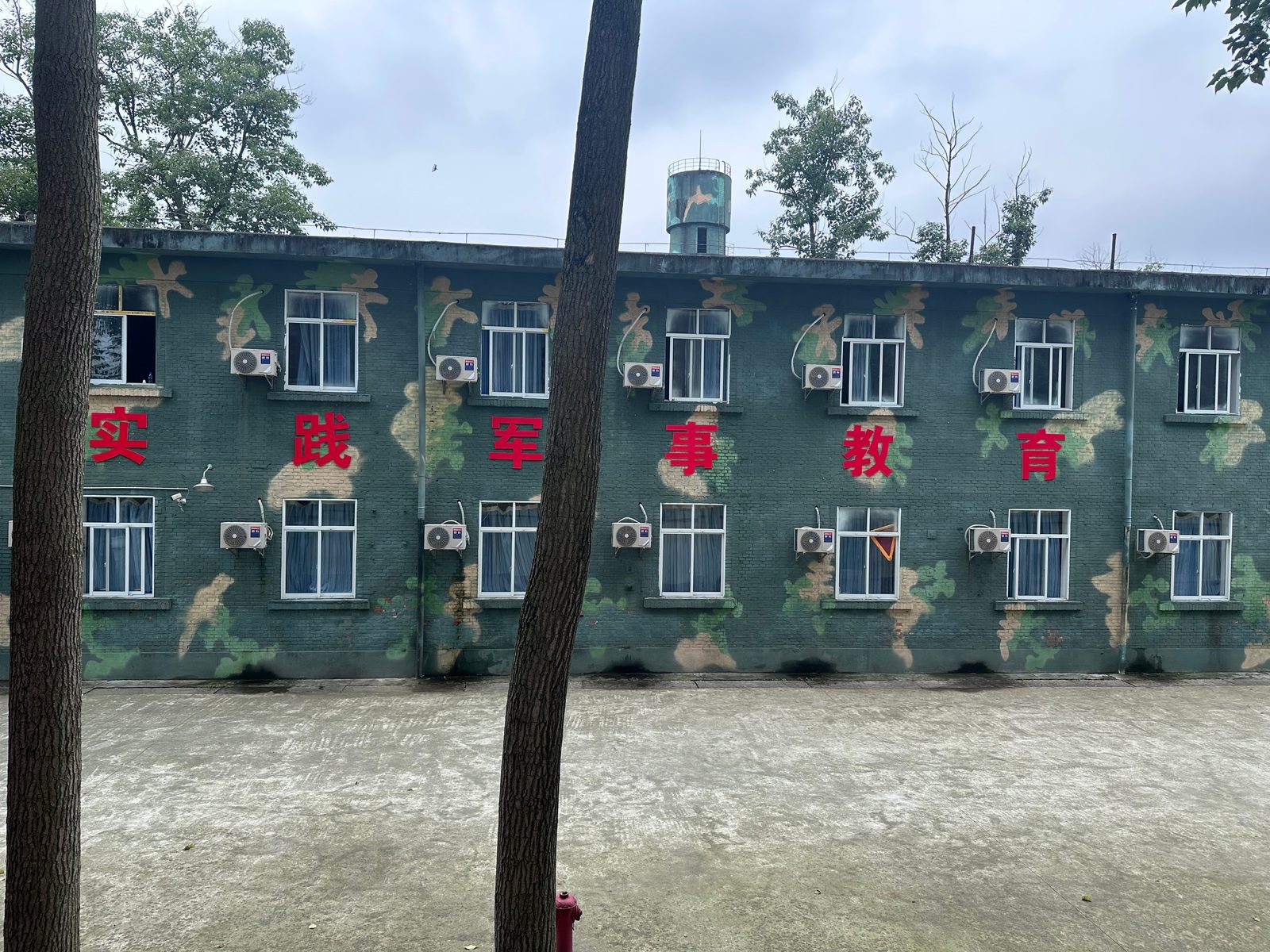
A building at Huaxiu Vocational School.
Before she could reply to the teacher's message, her parents' car had already driven into Huaxiu Vocational School. Once inside, a man received her parents while two female students received her, separating her from them. The two girls chatted with her, saying this really was a cosmetology school—they did not take away phones, classes did not start until after 9 a.m., and finished by around 5 p.m. She believed them.