business
NEV Startup Sales Gap Widens in H1 2026: Leapmotor Tops 350,000 Units, NIO/XPeng/Li Auto Below 200,000
The stratification among new energy vehicle (NEV) startups is widening.
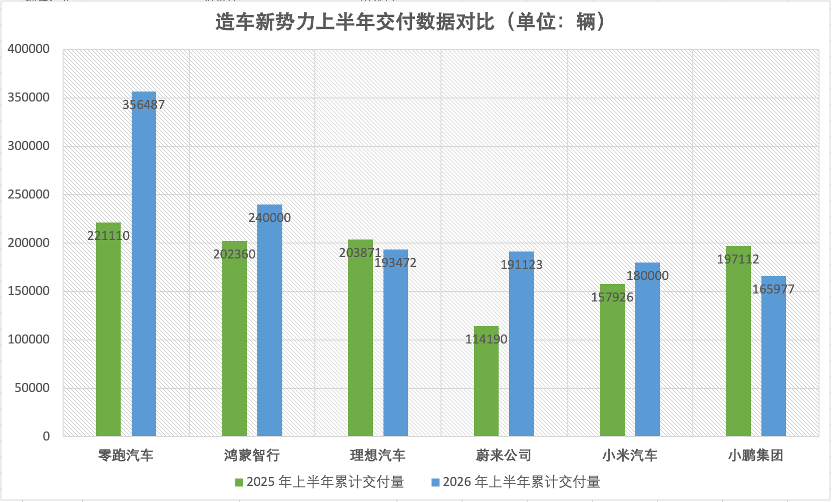
On July 1, the June sales rankings for NEV startups were released. Leapmotor claimed the top spot with over 90,000 units delivered, while NIO, XPeng, and other brands posted impressive figures exceeding 40,000 units. In the first-half cumulative sales ranking, Leapmotor unsurprisingly held the top position. Apart from Leapmotor and Harmony Intelligent Mobility (HIMA), no other brand exceeded 200,000 units in H1 sales.
Specifically, Leapmotor delivered 93,400 vehicles globally in June, up 95% year-on-year, setting another record high.
In the first half of the year, Leapmotor's cumulative deliveries reached 356,500 units, a 61.2% increase YoY. This sales level has created a significant gap between Leapmotor and other NEV startups. However, it is worth noting that Leapmotor is known for its cost-effectiveness, with an average per-vehicle price far below that of HIMA, NIO, and other brands.
In terms of sales target completion, Leapmotor's full-year target is 1 million vehicles, with a H1 completion rate of 35.65%.
HIMA delivered 50,600 units in June, down 4.02% YoY. Among these, the Shangjie Z7 series, co-developed by SAIC Motor and Huawei, surpassed 10,000 monthly deliveries in June.
In H1 2026, HIMA cumulatively delivered 240,000 new vehicles, up 18.6% YoY.
NIO also achieved record-high H1 deliveries and recorded the largest growth rate.
In June, NIO delivered 40,600 new vehicles, hitting a new high for the year, up 62.9% YoY. Of these, the NIO brand delivered 21,900 units (+50.1% YoY), the Onvo brand delivered 11,700 units (+83.5% YoY), and the Firefly brand delivered 6,946 units (+76.7% YoY).
In H1 2026, NIO delivered a total of 191,100 new vehicles, setting a record, up 67.4% YoY. All three brands achieved record-high H1 deliveries. Specifically, the NIO brand delivered 119,500 units (+60.5% YoY), Onvo delivered 42,500 units (+33.3% YoY), and Firefly delivered 29,200 units (+271.9% YoY).
NIO previously disclosed its expectation of 40%-50% full-year growth, which translates to a completion rate of approximately 39.1%-41.9%.
XPeng's sales also crossed the 40,000-unit monthly threshold in June.
XPeng announced June deliveries of 40,100 new vehicles, up 15.9% YoY, with Q2 cumulative deliveries reaching 103,300 units. Of these, 6,739 units were the XPeng GX, and on July 1, the model celebrated its 10,000th vehicle rolling off the production line. XPeng stated that with increased core component production lines, GX capacity will continue to rise and delivery pace will accelerate. Customers with delivery cycles exceeding 35 weeks can expect a reduction of 1-3 weeks in wait time.
In H1, XPeng cumulatively delivered 166,000 units, down 15.8% YoY.
Li Auto has yet to break through its sales bottleneck, remaining at around 30,000 units per month: it delivered 30,900 new vehicles in June, down 14.8% YoY.
In H1 this year, Li Auto cumulatively delivered 193,500 new vehicles, down 5.1% YoY. As of June 30, 2026, Li Auto's cumulative historical deliveries reached 1.7337 million units.
Like Li Auto, Xiaomi EV's monthly deliveries also stood at the 30,000-unit tier.
Xiaomi EV stated that it delivered over 30,000 new vehicles in June, compared to over 25,000 in the same period last year. In H1 2026, Xiaomi EV cumulatively delivered approximately 180,000 units, compared to 157,900 units in H1 last year (according to CPCA data).
Xiaomi EV previously disclosed its full-year sales target of 550,000 units, with a H1 completion rate of approximately 31%.
NEV startups incubated by traditional automakers also achieved notable growth, but the gap with other tiers is widening: SAIC's IM Motors delivered 40,100 units in H1, up 58% YoY; Voyah cumulatively delivered 76,300 units in H1, up 36% YoY.