business
Houthi Forces Announce Blockade on Saudi Arabia, Global Supply Chains Face Middle East “Double Lock” Dilemma
The ongoing fighting between the U.S. and Iran is toppling yet another domino threatening stability across the Middle East.
According to Xinhua, on July 20 local time, Yahya Saree, spokesman for Yemen's Houthi armed forces, announced in a statement broadcast on the group's Al-Masirah TV that it would immediately impose a maritime embargo on Saudi Arabia, a decision made on the principle of "blockade for blockade."
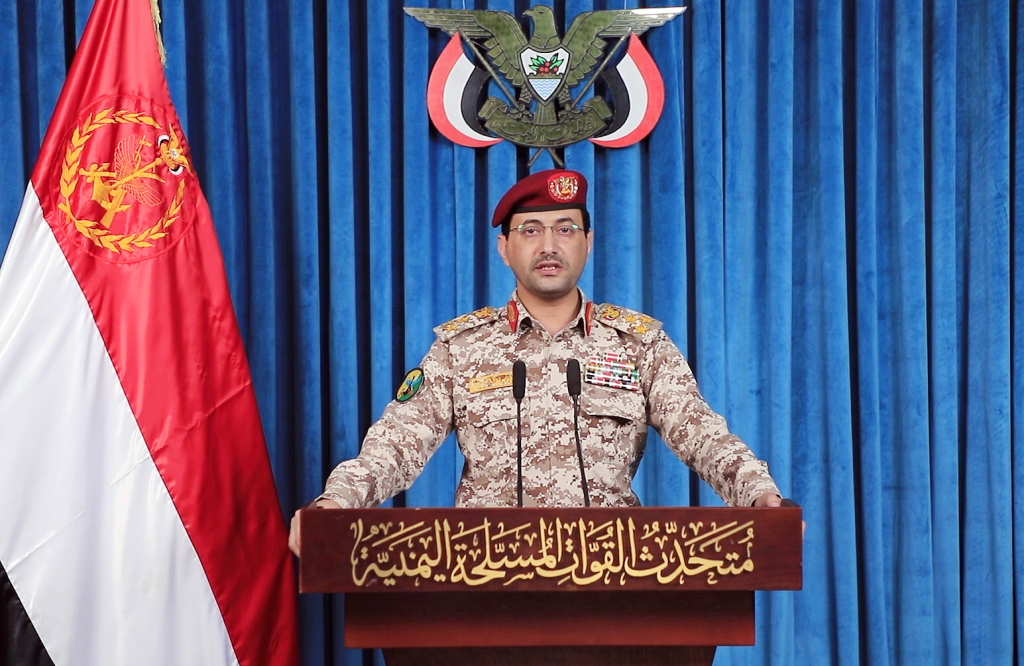
Yemen's Houthi forces spokesman Yahya Saree. (Visual China Group / file photo)
The statement said the move is a response to Saudi Arabia's nearly 12-year land, sea and air blockade of Yemen. Recent airstrikes on Sana'a International Airport were also cited as one of the reasons for the measure. The statement did not specify how the maritime embargo would be enforced or which vessels would be restricted.
Saudi Arabia's Foreign Ministry issued a statement on the 20th condemning the Houthi allegations that Saudi Arabia is besieging Yemen and imposing a maritime blockade, emphasizing that Saudi Arabia "will take all actions" to ensure the passage of its vessels in the region.
Also according to Xinhua, Turki al-Maliki, spokesman for the Saudi-led multinational coalition, said in a statement on the 20th that the coalition command has begun taking measures to protect the safe passage of member states' vessels through the Bab el-Mandeb Strait, and that the coalition will respond "swiftly and decisively" to any threat posed by the Yemeni Houthi forces.
Sun Degang, director of the Center for Middle Eastern Studies at Fudan University, told The Paper (www.thepaper.cn) that the escalation between the Houthis and Saudi Arabia means the conflict in the Middle East has spread from the Gulf region to the Red Sea, and that the Strait of Hormuz issue is now converging with the Bab el-Mandeb issue. "At the micro level, this is the Houthis countering Saudi threats to their security; at the macro level, it is also coordinating with Iran's strikes against the United States, blocking global supply chains in the Middle East," he said.
Tian Wenlin, director of the Middle East Research Institute at the Academy of Regional and Country Studies of Renmin University of China, told The Paper that the Houthis' actions will not only hit Saudi oil and gas exports and economy but also deal a considerable blow to global energy supply and production supply chains. At the same time, Iran's blockade of the Strait of Hormuz and the Houthis' threat to blockade the Bab el-Mandeb have made the international community realize that "weaponizing straits" is a highly effective geopolitical weapon, and that "the possibility cannot be ruled out that other places and other forces may try to use control of other straits as a geopolitical weapon in the future."
U.S.–Iran Conflict Spills Over into the Red Sea Region
The Houthis announced this decision after clashing with Saudi Arabia last week. Amir, deputy director of the Houthi media office, wrote on social media that the Houthis are "closing the Bab el-Mandeb Strait and will not allow Saudi enemy vessels to pass."
A source close to the Houthis told The Times of Israel that the group has completed preparations for attacks on shipping, deploying missiles and drones near the Bab el-Mandeb — the gateway to the Red Sea — and in the Yemeni highlands overlooking Hodeidah and the Gulf of Aden, ready to act as soon as orders are given.
The Houthis also said they are "fully prepared to respond to all options" and warned that any "foolish" move by Saudi Arabia would be met with a "comprehensive and decisive" response.
Saudi Arabia reacted strongly. The Saudi-led coalition said in a statement on the 20th that the Houthi "threats blatantly violate international law and are outright acts of piracy."
Since last week, the relatively calm situation in Yemen has suddenly intensified. According to Reuters, Yemen's Defense Ministry said that on July 13, Yemeni armed forces attacked the international airport in the capital, Sana'a, to prevent an Iranian plane carrying Houthi personnel from landing at the airport.
The Houthis then launched an attack on July 13 against the international airport in the southern Saudi city of Abha, in retaliation for the Yemeni government army's attack on Sana'a airport. On July 16, Houthi leader Abdul Malik al-Houthi warned that if Saudi Arabia participates in larger-scale military operations against Yemen, Saudi oil facilities and other strategic infrastructure could become targets.
For more than a decade, aircraft entering Yemeni airspace have had to obtain prior permission from the Saudi-led coalition, which supports the Yemeni government and claims the restriction was imposed at the government's request. The Associated Press reported that the Houthis allowed an international direct flight to land without the Saudi-led coalition's approval, trying to establish a new reality that would let them independently decide on Yemeni airspace.
Sun Degang argued that the Yemeni government forces' attack on Sana'a airport, against the backdrop of the renewed U.S.–Iran conflict, is an act by the U.S., Saudi Arabia and the Yemeni government to suppress members of the Iran-backed "Axis of Resistance." He said that recently, in addition to pressuring Saudi Arabia, the U.S. has also pressured the governments of Iraq, Lebanon and other countries, forming a "comprehensive suppression of the Iran-backed 'Axis of Resistance.'" Faced with such a situation, the threat to blockade the Bab el-Mandeb becomes the Houthis' "trump card," but if the Saudi-led coalition can take decisive action, "the pressure on the Houthis would still be great."
Tian Wenlin, however, believes that Saudi support for the Yemeni government's initiative to escalate the situation is indeed closely related to the restart of U.S.–Iran fighting, but this move "is very puzzling." He analyzed that since intervening in the Yemeni situation in 2015, Saudi Arabia has not actually gained any advantage, and against the backdrop of the U.S.–Iran conflict, Saudi Arabia and other Gulf countries are in a "caught-in-the-middle" state — daring neither to engage in direct military confrontation with Iran nor to completely offend the United States. "Saudi Arabia may feel that striking the Houthis can show off its military strength," he said, "but the problem is that its approach directly stimulates the Houthis to threaten to blockade the Bab el-Mandeb. If the Red Sea region is really blocked, Saudi Arabia's own position will be very bad."
According to the U.S. news site Axios, Saudi Crown Prince Mohammed bin Salman spoke by phone with U.S. President Trump before the attacks on the Houthis, seeking and obtaining his support. The report pointed out that if Saudi Arabia and the Houthis reignite fighting, it would exacerbate regional tensions and further spill over the impact of the U.S.–Iran war.
Why Enter the Fray Now? The Houthis' Strategic Calculus
This is not the first time the Houthis have issued a blockade threat against a specific country in this region.
The Bab el-Mandeb Strait is a 32-kilometer-wide waterway located between southwestern Yemen and the Horn of Africa, connecting the Red Sea and the Gulf of Aden, and serving as a key channel for Europe, North Africa and the Atlantic region to reach Asia via the Mediterranean Sea and the Suez Canal