top-news
Europe Faces Most Severe Heatwave in History; Scientists Say Impossible Without Climate Crisis
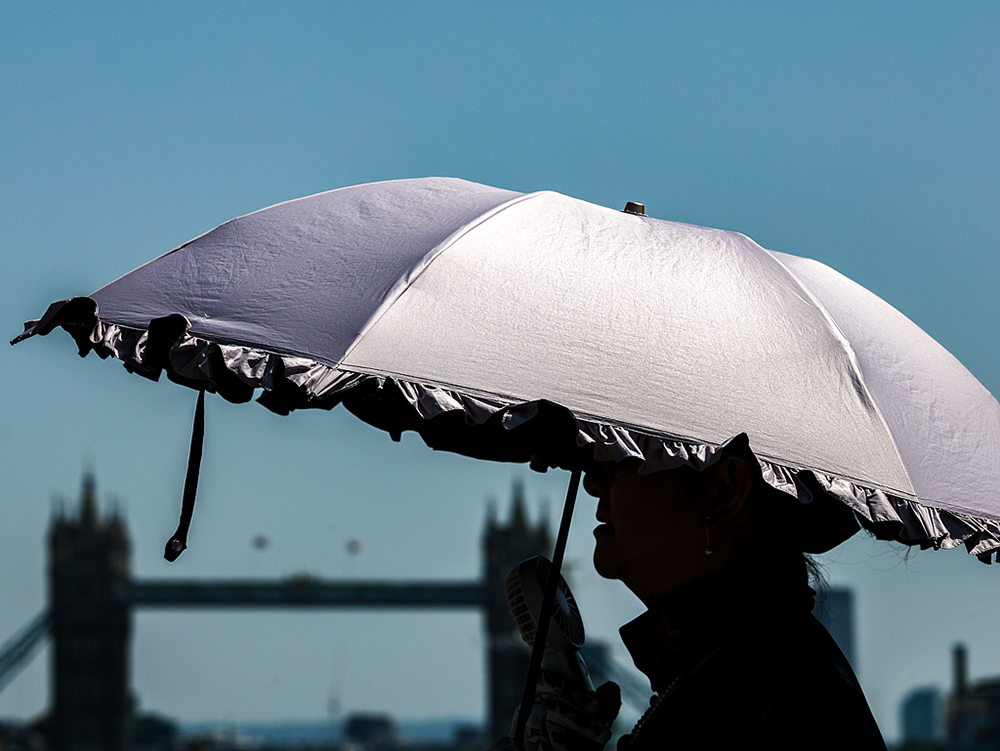
Photo: A woman walks with an umbrella on London Bridge on June 25, 2026. Visual China
Scientists issued a stark warning on Thursday, stating that the extreme heatwave currently sweeping across Western Europe is not only the most severe and widespread ever recorded in the region, but that such extreme weather would be completely impossible without the climate crisis caused by humanity's burning of fossil fuels.
New research also shows that the high humidity accompanying the heat is subjecting residents of hundreds of European cities to the worst 'heat stress' on record. The muggy, sweltering weather is disabling the body's sweat-based cooling mechanism, making an already fierce heatwave even more deadly.
In France, deaths and accidents directly or indirectly caused by the heat have surged. According to The Guardian, a hospital in Marseille confirmed on Friday that an 18-month-old toddler died after being accidentally left in a scorching hot car by his father. This is already the fifth child to tragically die in France during this heatwave.
Beyond tragedies involving vehicles, water-related accidents are also rising sharply. French Sports Minister Marina Ferrari said on Thursday that the number of drowning deaths related to heat relief activities has soared to 55 nationwide, with the government deeply concerned that the situation could worsen further.
Extreme heat has also paralyzed public services and transportation. Schools across continental Europe have been forced to close, hospitals are overwhelmed, and rail and air services have been widely canceled. In the UK, Somerset recorded a record-breaking 36.7°C on Thursday — the hottest June temperature ever recorded. London's ambulance service responded to 641 life-threatening emergencies in a single day on Wednesday, a historic high.
Without Climate Change, This Would Be Impossible in June
On Thursday, scientists from the World Weather Attribution (WWA) group used peer-reviewed scientific methods to conduct a rapid attribution analysis of the three hottest consecutive days under the 'heat dome' over Western Europe. The results were unequivocal: global warming is the driving force behind this extreme heatwave.
Dr. Theodore Keeping, an extreme weather researcher at Imperial College London and a member of the WWA team, said this is the most severe and widespread heatwave ever to affect such a large area of Europe. Over the past fifty years, the Earth has warmed by 1.1°C, and the probability of a heatwave of this magnitude has changed dramatically. Without climate change, this would simply be impossible in June.
The analysis shows that as carbon pollution continues to accumulate in the atmosphere, the intensification of extreme heat is accelerating at an alarming rate. In 2003, a heatwave of this intensity would have been 2°C cooler; in the famous heatwave year of 1976, it would have been 3.5°C cooler. Today, the probability of oppressive nighttime heat that severely disrupts sleep is about 100 times higher than in 2003.
Scientists warn that if urgent climate action is not taken, future heatwaves will become even more extreme. Looking back, this brutal summer may even come to be seen as 'relatively cool.'
Humidity Off the Charts — Nearly Half of All Cities Under Health Alert
The most dangerous characteristic of this heatwave is the double blow of high humidity combined with high temperature. To assess the additional danger posed by humidity, scientists used the 'Wet Bulb Globe Temperature' (WBGT) to measure the body's ability to cool itself down.
Dr. Keeping noted that among 850 large European cities with populations over 50,000, 45% — nearly half — are experiencing the worst humid-heat conditions ever recorded. Because the human body cannot effectively cool itself through sweating, the health impact of this heatwave is expected to be extremely devastating, with the speed of temperature change being particularly alarming.
On Thursday, over 100 million people across Europe faced temperatures above 35°C. Many capital cities not only broke their historical three-day average temperature records for June, but also set all-time three-day average high-temperature records for any season.
Existing Infrastructure Was Built for a Climate That No Longer Exists
Carolina Pereira Marghidan of the Red Cross Red Crescent Climate Centre noted that since the catastrophic 2003 heatwave, many European countries have invested in early warning systems and action plans, which have indeed saved many lives. But this is far from enough. She called for massive investment in heat-proof housing, cities, and infrastructure to ensure people's safety.
The UK government's official advisory body, the Climate Change Committee, has previously pointed out sharply that Britain's existing infrastructure was built for a climate that no longer exists and urgently needs upgrading.
UN Climate Change head Simon Stiell commented that the world's dependence on burning coal, oil, and gas is fueling climate chaos. But the solution is equally clear: a faster transition to clean energy, which is now far cheaper than fossil fuels, along with full-scale forest protection and comprehensive climate resilience building.
Professor Friederike Otto, co-founder of WWA, expressed frustration that scientists like her now sound like a broken record, year after year reacting to ever-rising extreme temperatures. 'Yes, this is climate change; yes, we are the ones responsible; yes, we hold the solutions in our hands — but we are not implementing them fast enough. The fundamental question now is: what kind of future do we want for ourselves, and are we willing to make the necessary effort to achieve it?' she said.