business
China's Summer Grain Harvest Hits Record as Output Surpasses 300 Billion Jin for the First Time
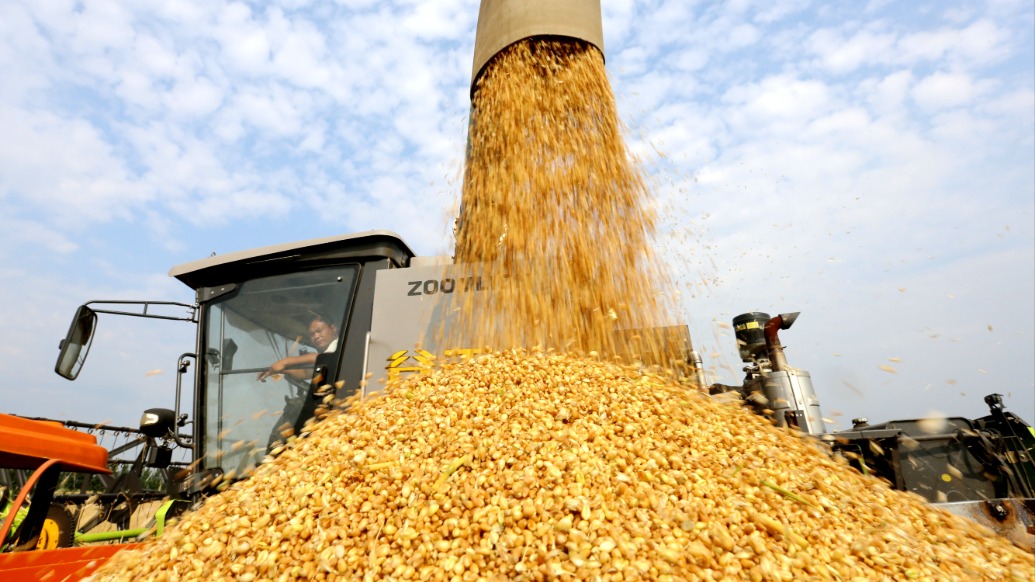
Since the beginning of this year, under the strong leadership of the Party Central Committee with Comrade Xi Jinping at its core, all regions and departments have rigorously implemented the Party and government joint-responsibility system for food security, further consolidated and shouldered the responsibility for grain production, and overcome adverse factors such as the widespread late sowing of winter wheat in the Huang-Huai-Hai region and heavy rainfall in some areas, achieving a bumper summer grain harvest nationwide. In 2026, the national summer grain sown area remained basically stable, per-unit yield rose steadily, and summer grain output reached 301.49 billion jin, surpassing 300 billion jin for the first time—an increase of 2.00 billion jin, or 0.7%, over the previous year.
I. Sown Area of Summer Grain Remained Basically Stable
In 2026, the national summer grain sown area was 398 million mu, a decrease of 690,000 mu (0.2%) from the previous year, remaining basically stable. By crop type, the wheat sown area was 345 million mu, down 998,000 mu (0.3%). Of this, the winter wheat sown area was 338 million mu, down 325,000 mu (0.1%). By region, among the 25 provincial-level regions (provinces, autonomous regions, and municipalities) producing summer grain, 19 saw increases in sown area, with Anhui, Sichuan, and Hebei increasing by 211,000 mu, 137,000 mu, and 113,000 mu respectively. Some western regions continued to adjust the planting structure of summer and autumn crops, leading to a reduction in summer grain sown area, with Xinjiang, Gansu, and Yunnan decreasing by 1.176 million mu, 326,000 mu, and 144,000 mu respectively.
The main reasons the summer grain sown area remained basically stable are as follows: First, production responsibilities were consolidated and tightened. All regions rigorously implemented the Party and government joint-responsibility system for food security, strengthened the protection and quality improvement of cultivated land, advanced the construction of high-standard farmland with high quality, and continuously carried out the rectification of "non-grain" use of cultivated land and the re-cultivation of abandoned land. By stepping up the development and utilization of winter fallow fields and optimizing the planting structure, they stabilized the summer grain sown area. Second, policy support was active and favorable. The state strengthened coordination and policy support in terms of prices, subsidies, and insurance, stabilized the minimum wheat purchase price and the cultivated land fertility protection subsidy policy, reinforced insurance guarantees, and implemented the inter-provincial horizontal benefit-compensation policy between major grain-producing and major grain-consuming regions, thereby fully mobilizing the enthusiasm of farmers to grow grain and of local governments to promote grain production. Third, every effort was made to ensure winter wheat was sown wherever conditions allowed. Winter wheat is the main component of summer grain. Facing the adverse situation last autumn in which continuous rain in the Huang-Huai-Hai region delayed winter wheat sowing over a large area, the central government promptly allocated special funds to support rush harvesting and sowing. All regions actively drained excess field water and advanced rush harvesting and sowing in parallel, implementing moisture-resistant sowing and adaptive techniques for late sowing, so that winter wheat was basically sown wherever conditions allowed, laying a solid foundation for summer grain production.
II. Per-Unit Yield of Summer Grain Rose Steadily
In 2026, the national summer grain per-unit yield was 378.8 kg per mu, an increase of 3.2 kg (0.8%) over the previous year. By crop type, wheat per-unit yield was 402.6 kg per mu, up 3.4 kg (0.9%). Of this, winter wheat per-unit yield was 403.5 kg per mu, up 3.6 kg (0.9%). By region, Shaanxi, Jiangsu, and Henan, whose yields were affected by drought last year, saw restorative increases this year, with per-mu yields rising by 14.2 kg, 5.8 kg, and 3.0 kg respectively; Shanxi, Hebei, Sichuan, Shandong, and Anhui saw per-mu yield increases of 5.3 kg, 2.4 kg, 2.2 kg, 1.7 kg, and 1.5 kg respectively; Hubei saw a per-mu yield reduction of 2.2 kg due to heavy rainfall.
The main reasons the summer grain per-unit yield rose steadily are as follows: First, overall favorable meteorological conditions. Although last year's continuous rain in the Huang-Huai-Hai region and other areas caused widespread late sowing of winter wheat, after entering the overwintering period, meteorological conditions in the main wheat-producing regions were generally favorable—higher temperatures, sufficient precipitation, and no large-scale spring drought, "late spring cold," or "hot dry wind" disasters. Plant disease and pest control measures were implemented effectively, and outbreaks were relatively mild, which benefited wheat growth and yield formation. Second, efforts to turn weak seedlings into strong ones were vigorous and effective. To cope with the large-scale late sowing of winter wheat, all regions generally increased the seeding rate and improved sowing quality to ensure sufficient basic seedlings. The central government advanced the allocation of funds for "one spray, three protections" (against pests, diseases, and disasters) and pest and disease control, and coordinated the allocation of subsidies for turning weak seedlings into strong ones, supporting all regions in implementing key technical measures such as shifting fertilizer and water application earlier and compaction and hoeing, so that wheat seedling conditions continued to improve. Third, the impact of rainfall was generally controllable. From mid-to-late May to early June, widespread rainfall occurred in many parts of both north and south, with heavy rain in some areas such as Hubei and localized wheat lodging in some fields. All regions actively adopted remedial rush-harvesting measures to minimize the impact of disasters. Southern regions basically completed rush harvesting before the rain, securing the summer grain harvest, while northern wheat regions were in the grain-filling stage, where timely rainfall effectively replenished soil moisture and helped raise per-unit yields—especially for dryland wheat, which saw notable increases.
III. Summer Grain Output Surpasses 300 Billion Jin
In 2026, national summer grain output reached 301.49 billion jin, an increase of 2.00 billion jin (0.7%) over the previous year. By crop type, wheat output was 277.90 billion jin, up 1.57 billion jin (0.6%). Of this, winter wheat output was 273.07 billion jin, up 2.17 billion jin (0.8%). By region, among the 25 summer grain-producing regions, 22 achieved increases. Among them, Henan, Jiangsu, and Shaanxi saw restorative increases of 530 million jin, 490 million jin, and 400 million jin respectively; Anhui, Shandong, Hebei, and Sichuan increased by 300 million jin, 280 million jin, 260 million jin, and 150 million jin respectively. Hubei saw a reduction of 40 million jin due to heavy rainfall, and Xinjiang a reduction of 840 million jin due to planting structure adjustments.

The bumper summer grain harvest in 2026 has laid a solid foundation for stabilizing annual grain production, and provided strong support for coping with the complex and severe international situation, promoting steady and sound economic development, and achieving a good start to the 15th Five-Year Plan period.