business
PC, Memory and Hard Drive Prices Remain High: Hard Drive Prices Change Three Times a Day, Dealers Say 'Don't Buy Unless Necessary'
The digital terminal market is experiencing a structural shock with no end in sight.
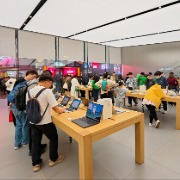
On July 3, a reporter from The Paper visited several digital malls in Shanghai, where multiple PC dealers stated that component and system prices are already at extreme highs, and will continue to rise, with no end to the price hikes expected for at least another year.
This round of sustained price increases has been going on for quite some time, with the latest trigger being Apple's high-profile official price hike announcement.
On June 25, due to the surging costs of memory and storage chips, Apple officially announced price increases for its iPad and Mac product lines. Rough estimates show an average starting price increase of about 20% across both categories. Apple stated in its announcement: "The consumer electronics industry is facing unprecedented challenges. The rapid expansion of AI data centers has led to a surge in storage demand, and we have never seen component prices rise at such magnitude and speed."
Another PC manufacturer, Lenovo Group, also issued a warning at ISC 2026 (International Supercomputing Conference), stating that DRAM and NAND flash prices have entered a structural upward cycle. Even with major manufacturers continuing to expand production, prices are extremely unlikely to fall back to early 2025 levels, and price increases will ultimately become the "new normal" for 2030 and beyond.
Behind the successive warnings from supply chain giants lies the persistently tight supply-demand relationship for upstream core hardware. The massive AI server infrastructure construction has severely squeezed wafer production capacity, causing storage-class basic hardware represented by memory modules and SSDs to enter a surge cycle, driving up consumer electronics prices across the board.
A PC dealer told the reporter that memory and hard drive prices are skyrocketing, and system prices will hardly come down within three years: "The starting increase is 800 to 1,000 yuan. Last year the market only saw modest increases, but this year it's a full-blown surge. Take gaming laptops for example — overall prices have been pushed up by 5,000 yuan. Previously, mainstream gaming laptops like the Legion series were priced at around 10,000 yuan, but now they've jumped directly to 15,000 to 16,000 yuan."
The same dealer admitted that faced with high-end PCs that now cost 17,000, 18,000, or even 20,000 yuan, there are certainly fewer buyers, with customers shifting toward more affordable price points. However, he emphasized that the price hike trend will eventually affect every product: using a computer currently priced at 7,999 yuan as an example, its official price will soon rise to 8,999 yuan.
Another PC dealer was even more candid, advising the reporter "don't buy unless you really need it," even though he didn't know when prices would eventually drop: "System prices will rise further this month, especially gaming laptops — they're rising the most. I think prices won't come down for at least a year; they'll keep rising until this time next year. If you're not in a hurry, don't buy. Don't buy unless it's a necessity."
Under this seemingly endless bullish market, not only are branded system prices staying high, but the DIY assembly market and component prices are also experiencing剧烈 fluctuations every day.
A custom PC builder lamented to the reporter: "Computers have gotten expensive. I also advise customers — if it still works, just use it; if it's really broken, bring it in for repairs... I want to replace my own laptop too, but prices are just too high now. Take a high-end Lenovo laptop — I sold it for 19,200 yuan a few days ago, and today it's already 20,800 yuan. That's just one week."
According to this builder, he assembled a computer for a client five days ago, and the price for the same configuration would cost 300 yuan more just five days later. It's not just computers — hard drives are seeing "one price in the morning, another in the afternoon and evening." A SanDisk 1TB SSD might be priced at 820 yuan in the morning and jump to 860 yuan by evening.
The builder stated bluntly: "Unless the AI bubble bursts, prices can't come down. We're just following the market — this is how it is lately." He also revealed that one of his corporate clients had purchased a certain laptop model at 4,600 yuan last year, but last month the procurement quote for the same configuration had skyrocketed to 6,400 yuan, forcing them to suspend their purchase plan.
Notably, the price surge ignited by primary manufacturers has also rapidly spread to the second-hand digital market.
A reporter from The Paper learned that with Apple's official price increase, the used Mac market has seen across-the-board price hikes, and the cost for second-hand dealers to acquire inventory has also been rising. Currently, used Macs with M1 chips sell for around 5,000 yuan, while those with M4 chips cost over 8,000 yuan.
Whether it's individual consumers forced to "make do and mend" or enterprise clients facing budget overruns, "don't buy unless necessary" is becoming the truest portrayal of the consumer electronics industry. Behind it all is the still-expanding supply-demand gap in the upstream supply chain.
Goldman Sachs, in its storage industry report released earlier this year, pointed out that the current global storage market supply-demand imbalance has reached its highest level in nearly 15 years, projecting a global DRAM supply deficit of 4.9% and an NAND deficit of 4.2% in 2026, presenting a typical supply-shortage scenario.
According to TrendForce's latest memory price survey released in July this year, the overall DRAM landscape in Q3 2026 remains extremely tight, but due to downward revisions in consumer-grade application demand and the high base effect, contract price increases have moderated, with an expected quarterly increase of 13% to 18%.
Meanwhile, NAND Flash demand continues to be primarily supported by AI inference and large-scale data center construction. However, with contract prices already at historical highs and consumer-side demand slowing, customers' price tolerance has reached its limit. The overall NAND Flash contract price is expected to increase by 10% to 15% quarter-over-quarter, a significant narrowing compared to previous quarters.
TrendForce noted that in the Q3 PC DRAM market, PC OEM inventory replenishment demand will support purchasing momentum, but as laptop system inventories further roll over to high-cost materials, channel prices for complete systems will rise across the board, affecting full-year shipment volumes.