world
"Golden Generation" Falls in Group Stage! The "Absurdity" Behind South Korean Football's "Secret Administration" and Chaebol Control
South Korea's national football team was eliminated in the group stage of the USA-Canada-Mexico World Cup, finishing in 34th place. This marks the second consecutive World Cup group-stage exit since the 2018 Russia World Cup. Given the context of this World Cup's "expansion," the result ignited disappointment and anger within South Korea. From President Lee Jae-myung denouncing it as "absurd" to businesses posting signs saying "Hong Myung-bo (team coach) not allowed inside," the backlash was widespread.
On the eve of the World Cup, expectations were high. Multiple Korean media outlets described the squad as the "Golden Generation," with several overseas-based stars including Son Heung-min (LAFC), Kim Min-jae (Bayern Munich), Lee Kang-in (Paris Saint-Germain), and Hwang In-beom (Feyenoord). The team's total value stood at €139 million.
Yet what followed was a bitter outcome. Criticized for having elite players but no capable coach, Hong Myung-bo became the target of public fury. His resignation announcement after the tournament failed to quell public outrage, with some Korean netizens even issuing death threats against him.
On the 28th, Lee Jae-myung blasted the Korea Football Association's (KFA) coach selection mechanism on social media, saying "incompetent people are pushed into leadership positions," comparing the outcome to a predictable fire. Han Byung-do, the acting representative of South Korea's ruling party, pointed out at a Supreme Council meeting on the 29th that "the KFA is filled with secretive administration marked by the coach's tactical inadequacy and arbitrary decision-making. Moreover, the 'cronyism'-ridden football interest groups are at the core of the problem."
Minister of Culture, Sports and Tourism Choi Hwi-young announced the formation of a special committee to investigate the causes of the team's World Cup group-stage elimination and conduct a thorough review of the entire process. "We will pursue a radical and comprehensive reform of the entire football administration with the determination to 'scrape the poison off the bone,'" he stated.
Korean media analysis widely suggests that this World Cup collapse is not merely the coach's personal failure, but the inevitable consequence of "KFA administrative corruption and selection scandals." The power games within South Korean football involve chaebol conglomerates, courts, police, and government, with the current turmoil evolving into a social and political storm.
Coach Becomes the "Target" of Public Anger
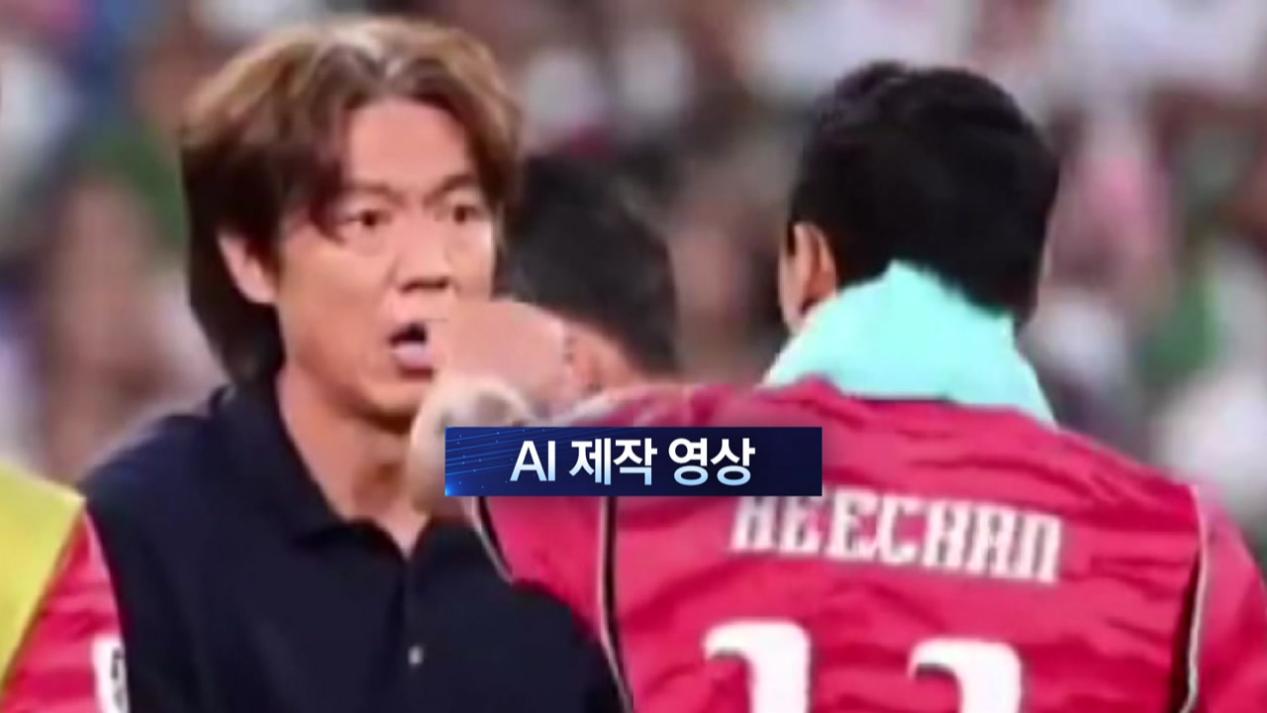
In one video, Hong Myung-bo is seen yelling at a player, who then throws a punch at him. This video is actually an AI-generated creation uploaded to social media under the title "The Number One Video Koreans Most Want to Reenact," and it has been widely shared.
Fueled by long-standing resentment over the KFA's "selection scandals," South Koreans directed overwhelming condemnation toward Hong Myung-bo.
This was Hong's seventh World Cup in his personal career. Having participated in four World Cups as a player, he captained South Korea to the semi-finals in the 2002 Korea-Japan World Cup, securing an important place in Korean football history.
Twelve years ago, at the Brazil World Cup, South Korea was also eliminated in the group stage with Hong Myung-bo as head coach. That failure raised questions about the former legend's coaching ability. In this World Cup, he set a tactical foundation of "pragmatic football," prioritizing solid defense before aiming for narrow 1-2 goal victories. However, in the third group match against South Africa, this conservative strategy reached an extreme. After conceding the first goal, the team should have switched to attack, but the exhausted players appeared sluggish and ultimately lost 0-1.
Yonhap News reported that the "Hong Myung-bo" Taeguk Warriors showed signs of declining performance in every match, even facing the stinging criticism of playing "tactics-free football." Korean football commentator Kim Dae-gil remarked, "The team exhausted too much energy in the first and second group matches." How to make players run more efficiently and create more threats is precisely the head coach's responsibility.
At the post-match press conference following the loss to South Africa, a Korean journalist confronted Hong directly, asking, "Today's match is practically synonymous with terrible performance." Noticing the players looked in poor condition, the journalist asked, "Did the whole team get food poisoning?" Hong admitted outright, "The result is entirely the coach's responsibility."
Hong Myung-bo was appointed as South Korea's national team head coach in 2024, with a contract originally set to run until the 2027 Asian Cup. After confirming the team's group-stage exit, he immediately announced his resignation. In reality, this appointment two years ago was fraught with controversy and is widely considered a "forced insider selection."
Seoul police announced on June 29 that they are currently investigating eight complaints related to Hong Myung-bo's appointment. As early as July 2024, police had taken over the case involving KFA President Chung Mong-gyu's alleged obstruction of official duties and breach of trust in appointing Hong, yet no decision has been made to date.
The Ministry of Culture, Sports and Tourism, during its 2024 audit of the KFA, pointed out "problems in the selection process of head coach Hong Myung-bo" and demanded "heavy disciplinary action" against Chung Mong-gyu. The KFA contested the decision, filing a lawsuit with the Seoul Administrative Court to have the punishment withdrawn. In April of this year, the court ruled against the KFA and made the relevant facts public.
The court's ruling stated that during the 2024 selection process for Hong Myung-bo, the procedure by which the KFA's Technical Strengthening Committee listed him as the top candidate was illegal. The former committee chairman, Jung Hae-sung, abruptly resigned during communication with the president. Subsequently, KFA leadership transferred the authority to recommend the head coach to former Technical Director Lee Lim-saeng, who did not actually possess this authority. Furthermore, when the KFA board heard the committee's report and ultimately approved the coach's appointment, there was insufficient discussion, making it a unilateral decision.
"For a football coach, leading a team to a single World Cup is already a dream opportunity. Coach Hong Myung-bo was given this opportunity twice — a privilege-like treatment. Yet he still failed to deliver satisfactory results," said Korean football commentator Park Moon-sung on YTN television.
Hyundai Family Flexes Financial Muscle to "Hard Control" the KFA
Under the "Chung Mong-gyu regime," Hong Myung-bo held key positions including national team head coach and KFA executive, receiving significant trust. Just two weeks before the World Cup, Chung Mong-gyu publicly announced on May 29 that he would step down as KFA president after the tournament. The team headed to the competition amid external turmoil, with Hong admitting the news left him unsettled.
Since being elected KFA president in January 2013, Chung Mong-gyu has been re-elected four times, serving 13 years and becoming the longest-serving president in KFA history. The achievements and failures of Korean football administration under the "Chung Mong-gyu era" have received extremely polarized evaluations.
During his tenure, the national team achieved 11 consecutive World Cup qualifications and reached the Round of 16 in the 2022 Qatar World Cup. However, the selection processes for national team coaches including Jurgen Klinsmann and Hong Myung-bo repeatedly raised procedural legitimacy concerns. Combined with the KFA's attempt to grant a "lightning amnesty" to football figures involved in match-fixing and corruption scandals, Chung faced fierce criticism. Voices demanding his resignation grew increasingly loud within football circles.
Behind Chung Mong-gyu stands the Hyundai Group chaebol. He is the younger brother of the group's founder Chung Ju-yung and the son of former Hyundai Motor chairman Chung Se-yung. He is also a cousin of former KFA president Chung Mong-joon. At the KFA's 55th presidential election held in February last year, Chung Mong-gyu won 156 out of 182 valid votes, securing victory in the first round. This starkly illustrates the enormous gap between public perception and internal football circles.
As the "control tower" of Korean football, since Chung Mong-joon first took office as KFA president in 1993, the presidency has been held exclusively by members of the Hyundai Group家族 — except for a brief four-year period (2009-2013) under Chung's confidant and former footballer Cho Joong-yeon — for over 30 consecutive years.