
world
France's Heatwave Survival Story: Fleeing to Hotels for 'Refuge,' Struggling to Get Fans for Kindergartens Amid 'Procedural Compliance' Scrutiny
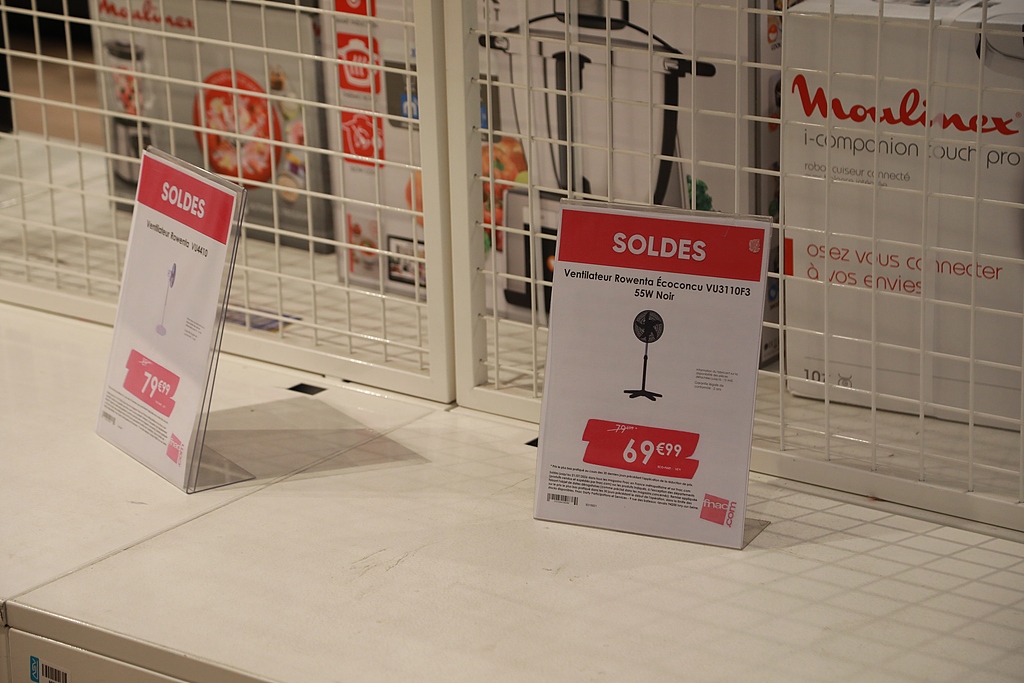
On June 26, 2026, local time in Paris, France, due to the heatwave, demand for cooling appliances surged at local electronics stores, with some air conditioner and fan models sold out. Visual China Image
At little past two in the morning, Zhang Wei still couldn't fall asleep. Her two-and-a-half-year-old child tossed and turned in bed, face flushed bright red, repeatedly crying out, "It's too hot, I can't sleep."
For Zhang Wei's family, June 24 was the most unbearable night of this extreme heatwave in France. The previous days, she thought they could tough it out — at least at night, her child could still sleep. But that night, the fan could no longer blow any coolness; the heat seemed to have solidified in the room, impossible to disperse. The child started fussing around 1 a.m. and didn't finally fall asleep until past 2 a.m.
Zhang Wei, however, dared not relax at all. She kept reaching out to touch her child's body, worried she might have a fever or heatstroke. She knew that fear contained a mother's instinctive irrationality, but at that moment, her fear was real. Once the child finally fell asleep, she picked up her phone and began searching for nearby hotels with air conditioning.
She initially thought perhaps she should go farther away, to the countryside to find a cooler place for a few days. But her husband still had to work, and taking the child far away wasn't practical. In the end, she found an aparthotel a 20-minute walk from home and booked three nights. Before placing the order, she noticed the hotel's fine print: no noise between 10 p.m. and 8 a.m. She stared at that line and hesitated — the night before, her child had been too hot to sleep all night, and she couldn't guarantee there wouldn't be noise. But at that point, she couldn't afford to care anymore.
When she actually checked in, she realized she wasn't alone. The hotel was almost entirely filled with families escaping the heat with their children. Several guests waiting at the front desk said they lived nearby — their homes were simply too hot to stay in. Adults couldn't bear it, let alone children. At that moment, Zhang Wei suddenly realized she had become a kind of "climate refugee."
She had only ever seen that term in the news before, usually associated with islands swallowed by the sea or farmers driven away by drought. But in Nancy, eastern France, amid this heatwave with no visible gunfire, no floods, and no ruins, she truly understood for the first time: when a person is forced out of their own home by extreme heat and must temporarily find a room with air conditioning to shelter, that too is a climate-driven displacement.
During her three days at the hotel, she felt as if she were in isolation. The windows couldn't be opened; ventilation relied entirely on the hotel's internal air conditioning circulation system. She could barely hear any outside sounds and didn't even know how unbearable it was out there. The radiation outside remained terrifyingly strong; she kept the curtains tightly drawn, only opening them briefly in the morning before direct sunlight hit. When her child occasionally went outside for a few steps, she would immediately say she didn't want to walk anymore and wanted to go home.
Zhang Wei realized that this heatwave had fundamentally changed people's most basic way of life: many had stopped cooking, because using the stove at home had become a very "expensive" thing — not in terms of money, but in heating cost. Her husband's colleague once said that just frying a zucchini in his apartment raised the indoor temperature by one degree. So during that period, almost everyone ate cold food, salads, or pre-made sandwiches from the supermarket. She saw at the nearby Carrefour that the air-conditioned supermarket was packed with people, water bottles were frequently sold out, salads and ready-to-eat foods were flying off the shelves, and the racks for electric fans and air conditioners had been empty for a long time.
Outsiders often cannot understand French society's rejection of air conditioning. But Zhang Wei says that at this point, the debate over air conditioning has lost its meaning. She understands that air conditioning is not a long-term solution, and she understands the concerns of ecologists and environmentalists about AC. Her husband is himself an ecologist, a typical leftist who instinctively opposes using air conditioning. But she also says frankly that when a family's "survival" becomes the issue, air conditioning is no longer a matter of ideology but a practical necessity. She knows a couple who normally live an extremely eco-friendly lifestyle — riding bicycles, eating organic food — yet after enduring the first week of this heatwave, they went straight out and bought an air conditioner. "Because at the end of the day, this has become a survival issue," she said.
The City-Wide Search for Cool Air: Cafés, Libraries, and Hotels Become Temporary Sanctuaries
In this extreme heatwave that has lasted over two weeks in France, Zhang Wei's experience is far from unique. More and more French people are discovering that when their homes are no longer a refuge from the scorching heat, simply surviving becomes a very real problem.
In Paris, writer Sarah Willison documented this survival experience in full on her blog. The apartment she lives in was originally the servant's quarters on the top floor of a Haussmannian building, now converted into a tiny 15-square-meter studio, pressed tightly against the dark gray zinc roof. At the peak of the heatwave, the indoor temperature reached 43°C, remaining at 38°C even at night.
She spent several nights sleeping in a tent in the suburban forest, then tried returning to her apartment for three agonizing nights. Every evening, she would wander the city with her laptop: from co-working spaces to hotel lobbies, taking cold showers at the gym, then soaking her feet in park fountains, not daring to go home until 1 a.m. Once home, she opened all the windows, draped wet towels over the fan, wrapped herself in wet sheets, wore frozen socks, and clutched ice packs. But within two hours, all these makeshift cooling tools had become dry and hot again. By the seventh day, she finally sent a distress message in a WhatsApp group, asking for a truly air-conditioned space where she could sleep.
She wrote, "People's lives and daily routines are falling apart — cooking, cleaning, washing all come to a halt. Many are forced into expensive hotels, spending all day coping with the heat and searching for solutions. You are completely trapped."
Not everyone can afford to stay in hotels long-term, especially when only 25% of Paris hotels have air conditioning. Willison's daytime "shelter" is one of the few air-conditioned cafés in Paris. She spends entire days there, with the place packed. Children play chess (schools have been closed), elderly people read quietly, someone is on a low-volume Zoom meeting, and a woman wearing headphones conducts with a baton while rehearsing from sheet music on her tablet. Everyone is trying to maintain their daily dignity as best they can, but the real reason they're all gathered here is simple: they are all "AC refugees."
On social media, a furious exchange of information about "where to find cool air" is underway. People constantly update which hotel lobbies welcome visitors, which cafés have air conditioning, which malls are coolest, and which libraries are still open. The heatwave has redefined the city's commercial, cultural, and office spaces into survival infrastructure.
On a larger scale, heat-escape spaces are being pushed to their limits. Le Monde reported that some people hide in air-conditioned courtrooms for entire trials, while others spend their days in air-conditioned bereavement rooms at funeral homes designated for families. In urban areas, libraries, cinemas, and museums have become popular destinations. Meanwhile, rural residents flock to forests, riversides, or mountain campsites for relief, but this has also led to record drowning incidents.
Many people choose to extend their work hours in air-conditioned offices, or head to churches, municipal swimming pools, and large shopping malls to escape the heat. Christophe Péroucha, a 53-year-old business owner, even humorously described visiting a frozen food store six times in a single day. He repeatedly studied product labels, and the checkout lines, though long, had no one complaining.
One unexpected subplot with "Chinese connections" emerged: Chinese companies' no-drill portable split air conditioners were hailed by European consumers as "summer saviors," with sales surging and multiple regions selling out. An Austrian consumer showcased on social media how he spent two days searching across all of Austria to find the last portable AC unit, buying it just before the heatwave arrived.
Under the scorching heat, this European country once famous for its outdoor cafés, romantic streetscapes, and slow-paced lifestyle has transformed into one massive heat-escape scene. People no longer enter a space for coffee, exhibitions, shopping, or work — they go to find a place where they can briefly catch their breath.
When Systems Begin to Fail: How Daycares, Transport, Hospitals, and Public Institutions Are Overwhelmed by Heat
What truly shocked Zhang Wei was not just her own family's struggle in the heat, but her discovery that the entire society's functioning was beginning to warp and fail under the heatwave.
Before deciding to flee to a hotel that night, she had noticed many anomalies during the week-long heatwave. She works at a university, and during the worst days of the heat, the school would frequently announce early afternoon closures. The buildings were simply too hot inside, with neither air conditioning nor effective sun-shading. Many of the university's buildings date from the 1960s and 70s modernist era — large glass curtain walls without sunshades, essentially functioning like greenhouses in extreme heat.
She recalled while writing at the university café, she saw a middle-aged Muslim couple, clearly not students, sitting there seeking relief. The place had no air conditioning, it was just slightly cooler due to better ventilation. They sat in silence, not speaking. She understood immediately — their home was probably too hot, with nowhere else to go. And the woman had to be covered from head to toe. Later, even this café closed at 2:30 p.m. Zhang Wei wondered where they could possibly go next.
Similar situations were widespread in Paris. Multiple libraries were forced to close or reduce hours due to AC failures, and the Louvre also temporarily adjusted its opening arrangements. The heat not only deprived these public cultural spaces of their service capacity but also severely undermined their intended function as "public cooling centers."
The heatwave's impact on infrastructure went far beyond this. Larger system failures were spreading. When a Paris metro train broke down underground, passengers were trapped in near-50°C heat for an entire hour. Nationwide, railway lines including the Eurostar were suspended due to rails buckling under heat, and even highways began to melt. Several of France's nuclear reactors were forced to shut down or operate at reduced capacity because the cooling water discharged into rivers was too hot.
Public transport, energy systems, cultural facilities, educational institutions — these seemingly stable pillars of modern cities simultaneously revealed their fragility in the face of extreme heat.
Hospitals bore the most direct consequences. Although Paris authorities had already banned alcohol consumption in public spaces (alcohol accelerates dehydration and numbs awareness of heatstroke, easily triggering fatal heat-related illnesses, cardiovascular emergencies, and high-risk accidents like drowning), it seemed to little avail — large numbers of dehydration, heatstroke, and cardiac arrest patients, along with emergency calls, flooded the emergency system daily.
The worst outcomes were inevitable. France's national public health agency reported that during the worst days of the heatwave, the country recorded approximately 1,000 more deaths than usual, with 85% of victims aged 65 and above. However, death rates increased across all age groups, especially in the Paris region, where mortality growth was particularly pronounced in hospitals, nursing homes, and private homes.
Zhang Wei's concerns about her child's daycare were even more acute. During the heat, she discovered that the daycare did not have a single electric fan, and not even a thermometer. This meant staff couldn't even accurately determine which room was hotter and which was relatively cooler, let alone adjust children's activity and napping spaces in a timely manner. She simply couldn't understand: in a country where extreme heat is becoming increasingly frequent, why would a childcare facility still lack the most basic heat protection equipment?
She tried to push for changes through the parent committee — adding sun-shading, buying fans, discussing longer-term cooling solutions. But she quickly realized the system's response was far slower than the heat. Some felt "things are being handled well enough" because children could be temporarily moved to a cooler space at a nearby nursing home for naps; others' first thought was that any renovation had to meet layers of regulations and standards. To Zhang Wei, this "prove the procedure is fine first" approach created a stark contrast with the direct impact of the heatwave on real life.
"French society lives in a kind of ostrich-like 'denial' to some extent," she said. "People don't not know there's a problem; they just prefer to maintain the status quo and avoid real change."
Later, at the hotel, she met another French father. He also had young children and similarly felt that daycares and early childhood institutions were far from adequate in heat response. He told Zhang Wei that in France, many things required layers of approval; everyone discussed things, yet no one was truly responsible, and the end result was often that nothing ever got done.
Zhang Wei deeply agreed. She said this was one of her strongest criticisms of French society: the bureaucratic system was bloated and redundant, extremely inefficient, and within such a system, the response to increasingly frequent extreme heat was always delayed.
She doesn't deny that France and Europe have made some climate adaptation efforts in recent years. She noted that after the 2003 heatwave that killed many elderly people, French nursing homes were generally required to install air conditioning and shelter measures, and hospitals had similar requirements. The government also offers subsidies for thermal renovation of old houses, and housing has an A-to-G energy efficiency rating, with poorly rated homes even facing mandatory renovation. She admits Europe hasn't "done nothing." But the problem is that these efforts are clearly far from enough — society as a whole was never truly prepared for today's heat.
In her view, the inequality in the heat is especially stark. She said this experience made her truly understand what "climate refugee" means. In the past, she only saw on the news Pacific islands being swallowed by seawater and residents being forced to relocate, thinking that was what a "climate refugee" was. But this time, she herself briefly became a climate refugee in France — unable to live in her own home, forced to flee elsewhere. And she was among the lucky ones, barely able to afford three nights at a hotel. But how many French people don't have that money? How many live in top-floor apartments or worse housing, with no choice but to endure? If they have more children, moving to a hotel becomes even more impossible. Those who suffer most are always the poor.
She recalled that at the worst of the heatwave, she was forced to acknowledge: "This is a disaster. It's just that this disaster doesn't have the obvious destruction of an earthquake or flood — no buildings collapsing, no floodwaters rushing in. On the surface, everything seems to be functioning normally, but in reality, it has already robbed many people of their ability to live normally."
Why Is the 'Climate Pioneer' Unprepared: When Emissions Narrative Collides with Survival Reality
This heatwave has also led many living in France to re-examine a question: why does Europe, long considered a "pioneer" in global climate governance, appear so unprepared in the face of increasingly frequent extreme heat?
He Xin, who moved from Guangdong to Paris, experienced this "survival experiment" as a pregnant woman. She recalls that this round of heat began in mid-to-late June, arriving earlier than the Paris summers she remembered. What she found most unforgettable was the Summer Solstice Music Festival night, when she took the RER A and B lines into the city center, heavily pregnant. The air conditioning on the train was virtually non-existent. On the return trip, the B line had no AC at all. She felt dizzy from the heat in the carriage, barely able to stand. Although someone offered her a seat, she preferred to stand by the door, where at least there was a little airflow.
For her, the nights were even harder to endure. Her past impression of Paris was "hot during the day, but it always cools down at night" — but this time was different. Days were hot, and nights remained hot, producing what she had only heard described in her experience of southern Chinese cities: "day-night compound heat." Because they had a cat at home, the couple even discussed whether to leave the door open at night. Eventually, they could only freeze ice to cool the living room. Pregnant women are sensitive to heat at night — "as soon as I fall asleep, I'm drenched in sweat" — and she could only power through with lots of water and mung bean soup.
He Xin's confusion came not just from physical discomfort but from a systemic contrast. When she lived in Guangzhou, she certainly knew that southern summers were hotter and understood the health risks of high temperatures, but shopping malls, hospitals, transport systems, and public spaces were almost all equipped with air conditioning. The entire city had a relatively mature set of experience in dealing with heat. By contrast, Paris seemed to be improvising.
In her view, Europe has long invested most of its energy into "mitigating" climate change: carbon emissions, green buildings, energy ratings, carbon trading — these institutional designs are all relatively mature. But on the "adaptation" front — building design, air conditioning deployment, public cooling facilities, and protection of vulnerable groups — there is clear lag. Many buildings were designed for cold climates, emphasizing insulation, making them more prone to heat retention in summer. Historic building preservation, restrictions on zinc roof modifications, limits on AC installation, costs, and lifestyle habits have all prevented cooling infrastructure from becoming standard.
Paris's iconic gray zinc roofs are the most typical symbol of this contradiction. Seen from above, they are romantic, uniform, and rich in historical character — a crucial part of the city's landscape. But for those living in tiny top-floor apartments, these roofs become enormous heat-collecting plates during a heatwave. Research has found that Paris's heat-related mortality risk is among the highest of any European capital.
Experts point out that Europe's adaptation lag has clear historical and institutional inertia. Dominik Sprenger, Chief Representative of the Zhejiang Office of the Hanns Seidel Foundation Germany, told The Paper that until recently, European summers were relatively mild, and buildings, regulations, and public expectations were all built on that assumption. Now, the frequency and intensity of heatwaves are rapidly increasing, but many public institutions still operate under "climate conditions that no longer exist." The limited air conditioning in schools, hospitals, and nursing homes is not just a technical or cost issue — it reflects institutional adjustment lagging behind climate change itself.
Dimitri de Boer, Chief Representative of ClientEarth's Beijing office, also noted that Europe has fallen behind many other countries and regions in climate adaptation. As the fastest-warming continent on Earth, climate change is increasingly affecting daily life. He emphasized that adaptation measures should first protect vulnerable groups — the elderly, women, children, and low-income people — because they bear the heaviest impact. Beyond engineering solutions like air conditioning, natural ecosystems such as trees, vegetation, and water bodies can effectively provide shade and local cooling. But ultimately, the continued burning of fossil fuels remains the root cause of extreme heat.
France last year released a 388-page national adaptation plan containing 52 measures; London has also recently launched an urban heat prevention plan calling for large-scale residential renovation and public building upgrades. But all these plans face the same challenge: setting goals is relatively easy, but raising long-term funding and actually implementing renovations is much harder. A recent report by the European Environment Agency noted that all EU countries have developed adaptation plans, but "long-term funding shortages" are a common obstacle.
A survey covering 27 European countries and more than 27,000 respondents showed that four-fifths of respondents had experienced at least one climate-related disaster in the past five years, but only one-quarter had appropriate tools to cope with climate change; one-fifth had taken no household-level response measures, and more than 38% said they could not afford the cost of keeping their homes cool in summer.
This is Europe's current paradox: it has long played the role of pioneer in global climate governance, possessing mature emissions-reduction language and institutional tools, yet when the heatwave truly enters the details of daily life, its basic adaptation capacity is exposed as inadequate. In the past, when people talked about climate change, they often focused on grand goals like "1.5°C," "carbon neutrality," and "net-zero emissions." But now, the more urgent question has become: how will a pregnant woman, a child, or someone living in an old top-floor apartment get through week after week of heatwaves? While emissions-reduction narratives remain in policy documents and grand goals, ordinary people are already bearing the survival-level impact in their bedrooms, daycares, subways, and hospitals.
The reality is that World Weather Attribution's rapid attribution analysis of the three hottest consecutive days of this Western European "heat dome" clearly pointed out that global warming is the "absolute driver" behind this extreme heatwave. In other words, today's France and Europe are not experiencing an accidental "abnormal summer" — they are entering a new climate normal.
After the heat had temporarily passed, Zhang Wei returned to her home. She found the room felt as if it had been baked, the heat stubbornly clinging to the floors and walls, refusing to dissipate. She said this heatwave felt like suddenly waking up from a nightmare.
What she fears most is not this particular heatwave itself, but not knowing when the next one will come. If more and more summers become like this, how many times can she stay in a hotel? How will her child endure? And what will the city use to protect those who have no choice?
Zhang Wei says her deepest feeling now is that many people don't completely fail to understand climate change — they just haven't truly recognized it as a problem requiring immediate and serious response. Some are indifferent, some habitually deny it, and some are satisfied with "good enough." Once the weather cools, many quickly forget everything, as if the disaster never happened. But in reality, the problem hasn't gone away — it's just waiting for the next wave to return.
"This is just a respite," she said. "After all, the real summer hasn't arrived yet."
(At the request of the interviewee, Zhang Wei is a pseudonym)