top-news
Observation: Japan-Philippines "EEZ Delimitation Talks" Invalid, China's Rights Safeguarding is Legal and Reasonable
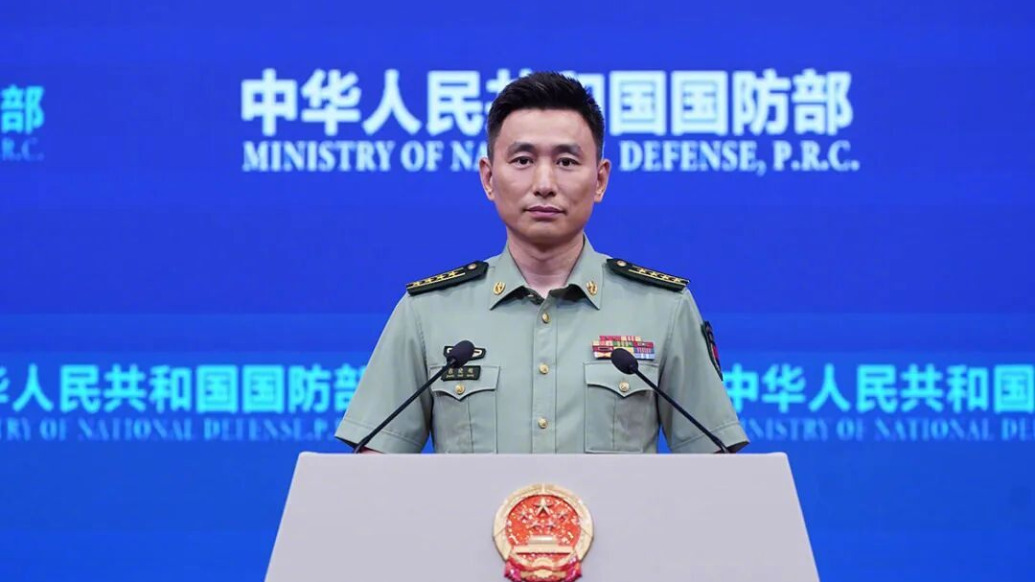
On the afternoon of June 25, the Ministry of National Defense held a regular press conference where Senior Colonel Zhang Xiaogang, spokesperson for the Ministry of National Defense, answered reporters' questions. A reporter asked about Japan and the Philippines launching exclusive economic zone (EEZ) negotiations, while China conducted law enforcement operations in waters east of Taiwan Island. Institutions from the United States, the United Kingdom, France, and Germany stationed in Taiwan expressed views that China's actions threatened regional stability, freedom of navigation, and international shipping safety, escalating tensions.
In response, Zhang Xiaogang stated that the maritime area Japan and the Philippines proposed for delimitation is located east of China's Taiwan Island, and China possesses an exclusive economic zone and continental shelf in these waters. Japan and the Philippines bypassed China and unilaterally launched so-called maritime delimitation negotiations, which seriously violate international law, including the United Nations Convention on the Law of the Sea (UNCLOS), as well as basic norms of international relations, and severely infringe upon China's maritime rights and interests. China's law enforcement patrols in the relevant waters are legitimate and necessary — a just act to safeguard national territorial sovereignty and maritime rights and interests.
At the end of May, Philippine President Ferdinand Marcos Jr. visited Japan, and the two heads of state issued a joint statement announcing the "launch of negotiations on the delimitation of the exclusive economic zone and continental shelf between the two countries." Maritime delimitation negotiations are a common practice when disputes exist between states over EEZ and continental shelf claims. However, regarding the specific claims of Japan and the Philippines this time, the waters east of China's Taiwan Island are first and foremost an area where China's maritime rights and interests overlap with those claimed by the Philippines and Japan. By launching so-called "delimitation negotiations" that ignore facts and escalate contradictions, Japan and the Philippines have violated the principle of good faith under international law.
The so-called "delimitation" by Japan and the Philippines involves at least three considerations
First, Japan and the Philippines hope to confuse international opinion and fabricate the illusion that they are "maritime neighbors." Neither Japan nor the Philippines has disclosed their specific claims or clearly defined their baseline points for delimitation. In fact, under post-war arrangements, several "territories" claimed by the two countries remain subject to legal disputes, and their claimed baseline points are untenable. Moreover, a glance at the map shows that Japan and the Philippines are far apart, with China's treasured island of Taiwan lying between them — there are simply no geographical conditions to initiate bilateral delimitation negotiations.
Japan and the Philippines claim they will negotiate in accordance with the relevant provisions of UNCLOS, demonstrating their "respect for the spirit of international law." However, UNCLOS explicitly stipulates the "equitable principle" for EEZ delimitation between states. The EEZ and continental shelf claims of Japan and the Philippines largely lie in waters east of China's Taiwan Island — waters where China asserts maritime rights and interests under international law, including UNCLOS. It is evident that delimitation negotiations in waters east of Taiwan Island without China's participation constitute a serious infringement on China's maritime claims. Japan and the Philippines' act of bypassing China to make private arrangements clearly deviates from the spirit of UNCLOS and violates the "equitable principle."
Japan and the Philippines' desire to launch bilateral delimitation negotiations reflects either a lack of geographic and legal knowledge or a deliberate pretense of ignorance. Japanese Chief Cabinet Secretary Yoshimasa Hayashi publicly acknowledged that the Japan-Philippines delimitation has no legal effect on third parties. Unlike previous hype surrounding maritime issues, officials from the countries involved and international law experts have been notably silent about these so-called "delimitation negotiations." It seems the parties themselves are well aware that launching these delimitation negotiations is neither reasonable, justified, nor legally binding.
So why do Japan and the Philippines insist on provoking China by announcing these negotiations? Their second objective is to strengthen their presence in the waters east of Taiwan Island and opportunistically seize maritime economic benefits. UNCLOS stipulates that coastal states enjoy sovereign rights over natural resources and related economic activities within their exclusive economic zones. If other countries wish to conduct marine scientific research or other activities, they require the coastal state's consent. Coastal states also have enforcement rights — including boarding, inspection, arrest, and judicial proceedings — when exercising their sovereign rights over living resources. With respect to the continental shelf, UNCLOS also explicitly grants coastal states sovereign rights to explore and exploit its natural resources.
EEZ and continental shelf delimitation negotiations between states are no trivial matter; they must be based on solid survey data and claims founded on one's own evidence. Japan and the Philippines may be using the announcement of delimitation negotiations as a probe — if international opposition is muted, they may expand marine surveys in waters east of Taiwan Island, plunder fishery and other marine resources, conduct continental shelf exploration, and even intensify maritime law enforcement based on their unilateral EEZ and continental shelf claims. It is clear that launching these negotiations without China and any subsequent actions they may take seriously infringe upon China's maritime rights and interests.
Furthermore, the timing of this announcement conceals a third calculation — "holding onto the US and destabilizing the Western Pacific." In May 2026, the heads of state of China and the United States agreed to establish a "constructive strategic stability relationship" as the new orientation for bilateral ties. Most countries globally and regionally hope for stable US-China relations that will bring more peace, prosperity, and progress. However, for Japan and the Philippines, who have been consistently stirring up trouble in East Asian waters, they fear that a US-China détente would reduce US involvement in regional affairs, leaving them unable to "bully others by flaunting powerful connections."
Both parties intend to use the delimitation negotiations to artificially create friction with China, interfere with US decision-making, pressure Washington to take a stance, and prompt the United States to maintain or even strengthen its involvement in the Western Pacific. On June 8, the US, Japan, and the Philippines held a maritime affairs dialogue in Manila. Before the dialogue, the US had not taken an official position on the Japan-Philippines delimitation negotiations, but recently, the US and a few European countries have issued statements expressing "concerns about China" that favor Japan and the Philippines. Did Japan and the Philippines lobby Washington? It is worth pondering.
Japan and the Philippines are further strengthening military cooperation
Japan and the Philippines are moving increasingly closer, seemingly intent on demonstrating to the outside world — especially to the US — that their cooperation is seamless and that they have both the capability and the will to work together with the US to contain the first island chain. In mid-June, Japan's House of Councillors approved the Japan-Philippines Reciprocal Provision of Supplies and Services Agreement (RAA). With the agreement entering into force, Japan and the Philippines will be able to directly share fuel, ammunition, food, weapons, and other critical supplies when responding to military conflicts. The signing of this agreement marks the further institutionalization of military cooperation between the two countries.